Update 22:45 EST: Officials in Italy have confirmed that the parbuckling of the Costa Concordia has been completed after a 19 hour operation and the ship is now sitting in its final upright position on underwater platforms. Additional coverage of successful parbuckling HERE.
The capsized cruise liner Costa Concordia lies on its side next to Giglio Island September 16, 2013. REUTERS/Tony Gentile
Previous: By James Mackenzie
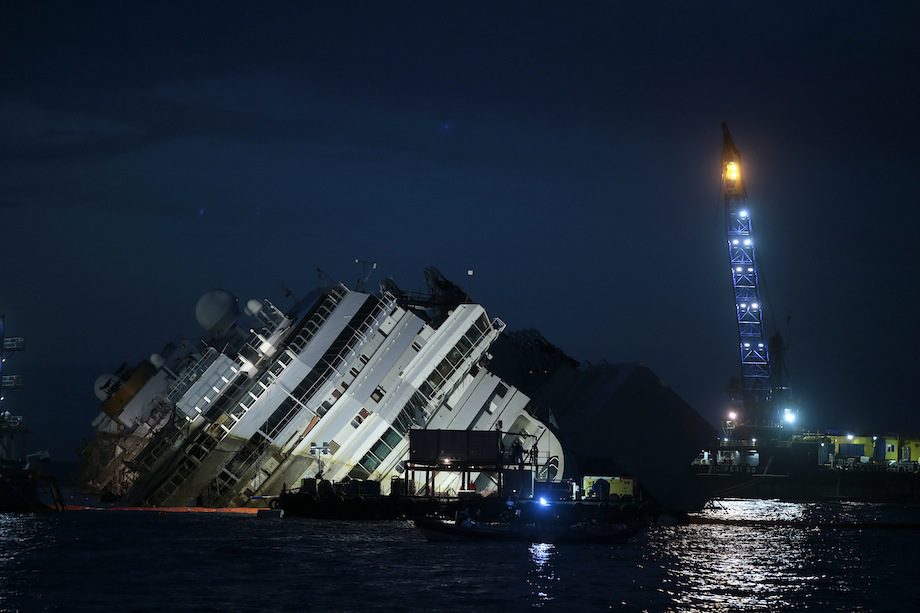
GIGLIO, Italy, Sept 16 (Reuters) – Salvage crews shifted the wrecked Costa Concordia cruise ship slowly off a rock shelf on Monday in a painstaking process that looked set to continue into the early hours of the morning.
The most complex and costly salvage operation of its kind ever attempted began at 9 a.m. (0700 GMT) on the Italian island of Giglio after a three-hour delay due to an overnight storm, and progress was slower than originally estimated.
Still on its side, the flank of the ship was entirely off the rock shelf and raised far enough out of the sea to reveal a dirty brown water mark staining the white hull.
“The ship is reacting very well because it’s rotating in a uniform fashion, which is what we expected but it’s a pleasure to see it confirmed,” said Franco Porcellacchia, leader of Costa Cruise’s technical team.
The Concordia was carrying more than 4,000 people went it hit rocks off Giglio on Jan. 13, 2012 and capsized with the loss of 32 lives. Two bodies have yet to be recovered and underwater cameras failed to find any sign of them as darkness fell and searchlights lit up the port.
“They must still be under the keel of the Concordia and I hope after this finally they will have a grave (their families)can cry over,” said Luciano Castro, a 49-year-old journalist who was on the ship when it sank.
In contrast to the accident, a catalogue of mishap and misjudgement over which the Concordia’s captain Francesco Schettino faces multiple charges, the salvage operation has so far been a tightly coordinated engineering feat.
At a cost estimated at more than 600 million euros ($795 million), it is expected to be the most expensive maritime wreck recovery, accounting for more than half of an overall insurance loss of more than $1.1 billion.
The so-called “parbuckling” operation will see the 114,500-ton vessel slowly rotated upright using a series of huge jacks and cables prior to be towed away and broken up for scrap, probably next spring.
Italy’s Civil Protection Authority said work would probably continue until dawn. Engineers said they were satisfied with progress and not concerned about the time.
MOUNTAIN ON THE SEABED
A multinational team of 500 salvage engineers has been on Giglio for most of the past year, stabilising the wreck and preparing for the lifting operation, which has never been attempted on such a large vessel in such conditions.
“We have done parbuckling before but never on a location like this,” Nick Sloane, the South African engineer coordinating the recovery for contractor Titan Salvage, told Reuters.
“She is on the side of a mountain on the seabed, balanced on two reefs and she is a really large ship – she’s three football fields long, a hundred thousand tonnes plus … So it’s never been done on this scale,” he said.
A series of 11 towers with hydraulic mechanisms controlling 205-kg (450 lb) cables under the ship and attached to its side slowly rotated the vessel, aiming to place it on six specially built platforms drilled into the granite rock bed.
As the sunken side of the vessel inched out of the water, engineers eased the pressure from the cables, preparing for a second phase, when huge tanks fixed to the ship’s exposed side begin filling with water, using the effect of gravity to pull the ship vertical.
Oil booms surround the vessel to intercept waste water and oil trapped in the ship, but no significant environmental damage was observed in the first hours of the operation.
Once the Concordia is upright, salvage teams will spend a months stabilising it and preparing for it to be re-floated with the aid of additional giant buoyancy tanks before it is towed away for scrap.
Marine insurers who have to calculate the cost of covering a new breed of large cargo and cruise vessels have been watching progress closely, as any problems could have a significant impact on future insurance contracts.
On Giglio, locals were hoping the ship which has given their Tuscan holiday island global fame would soon be gone.
Giancarlo Farni, who said he was one of the first rescuers on the scene, said: “I saw it sink and now I want to see it brought upright and taken away.”
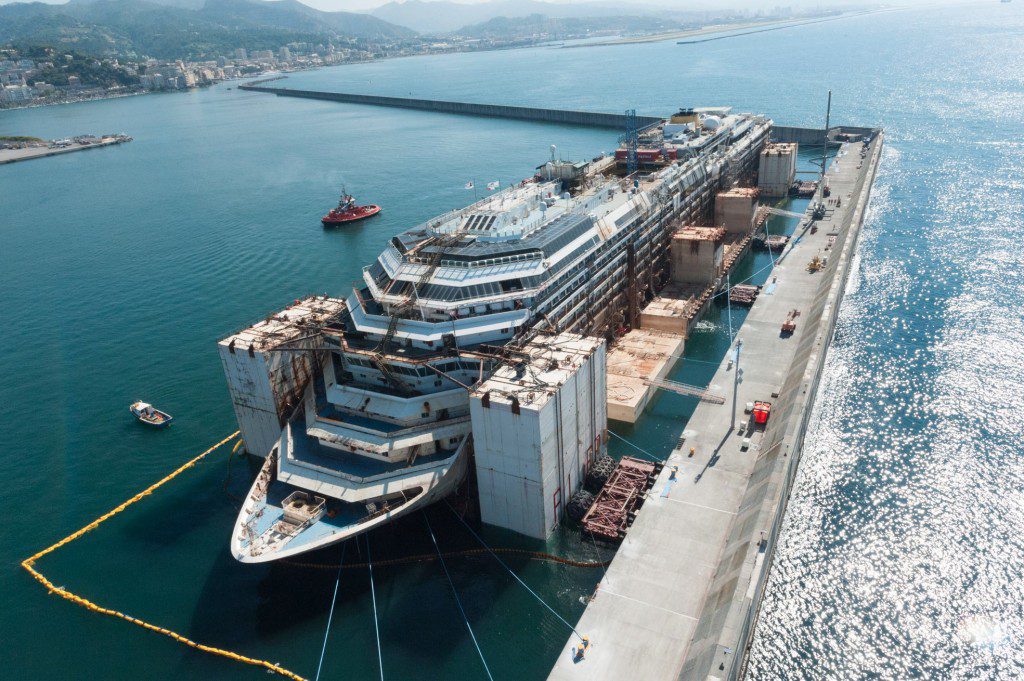
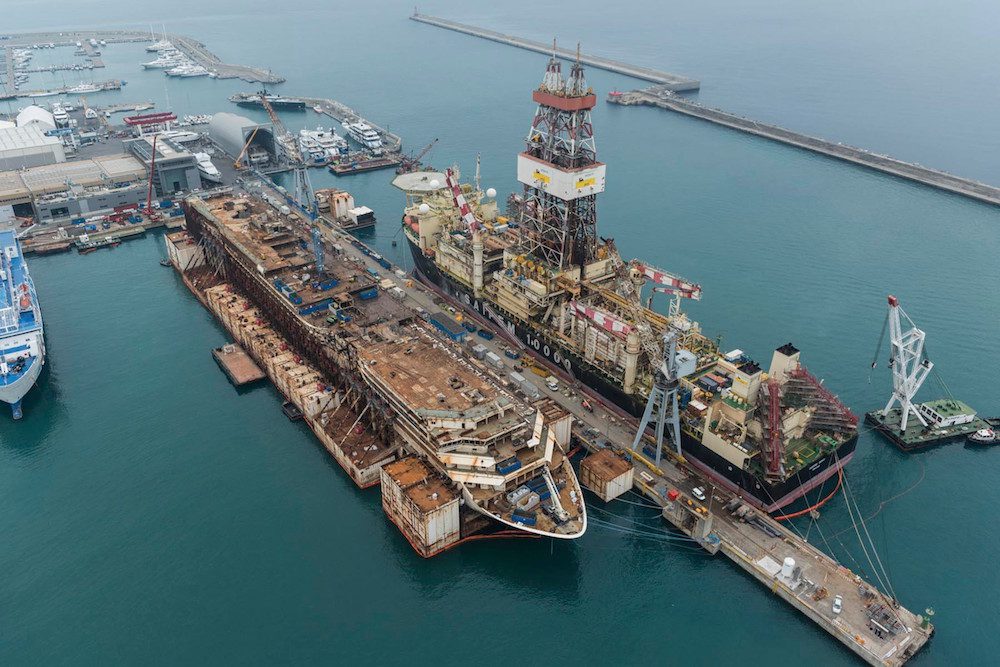
The dismantling and recycling of the infamous Costa Concordia cruise liner has been completed in Italy, marking the official end to final phase of what is considered the largest maritime salvage...
The wreck of the Costa Concordia – or least what’s left of it – continues to be broken up in Genoa, Italy in preparation for final demolition sometime later this...
February 19, 2016
Total Views: 774
Get The Industry’s Go-To News
Subscribe to gCaptain Daily and stay informed with the latest global maritime and offshore news
— just like 106,969 professionals
Secure Your Spot
on the gCaptain Crew
Stay informed with the latest maritime and offshore news, delivered daily straight to your inbox
— trusted by our 106,969 members
Your Gateway to the Maritime World!
Essential news coupled with the finest maritime content sourced from across the globe.

 Join The Club