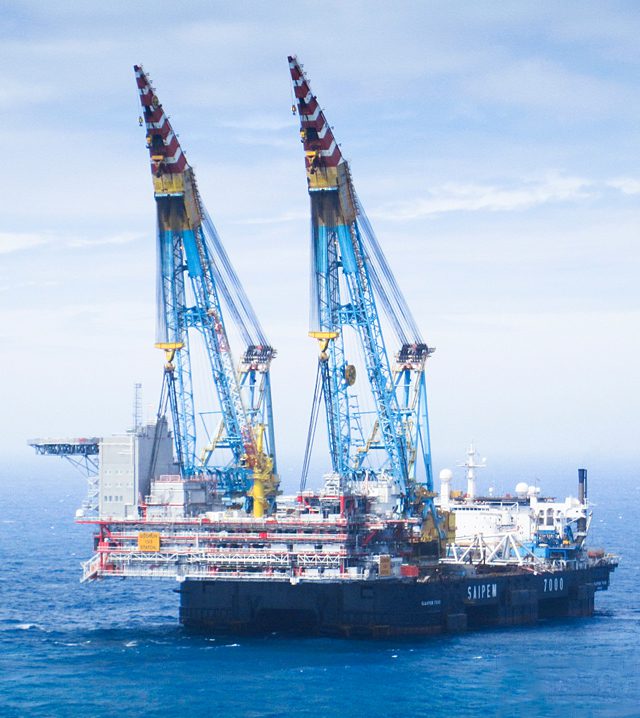
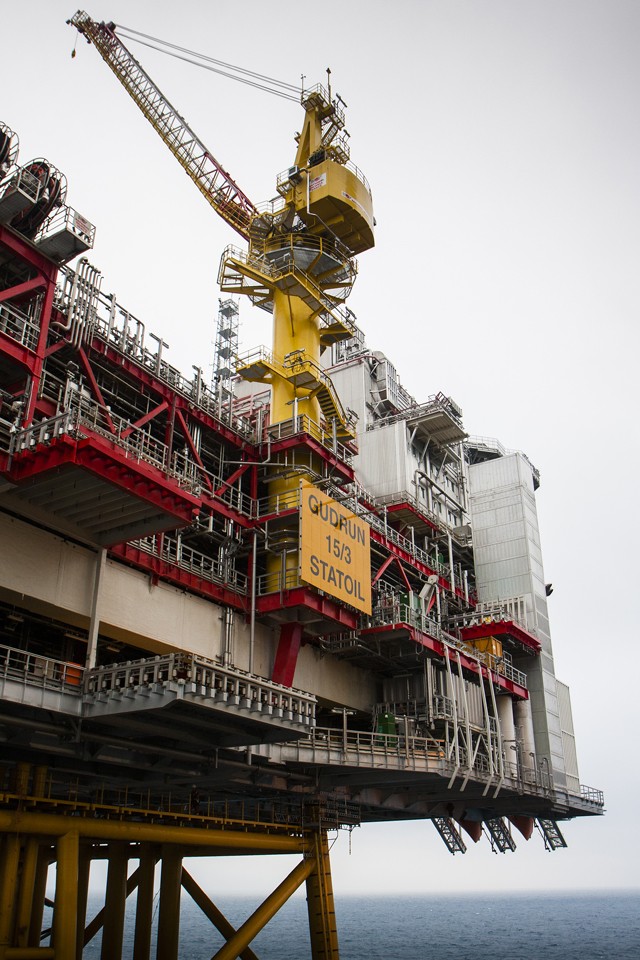
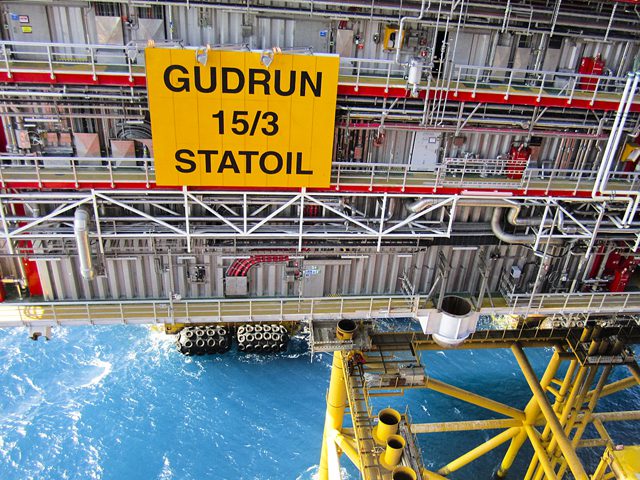
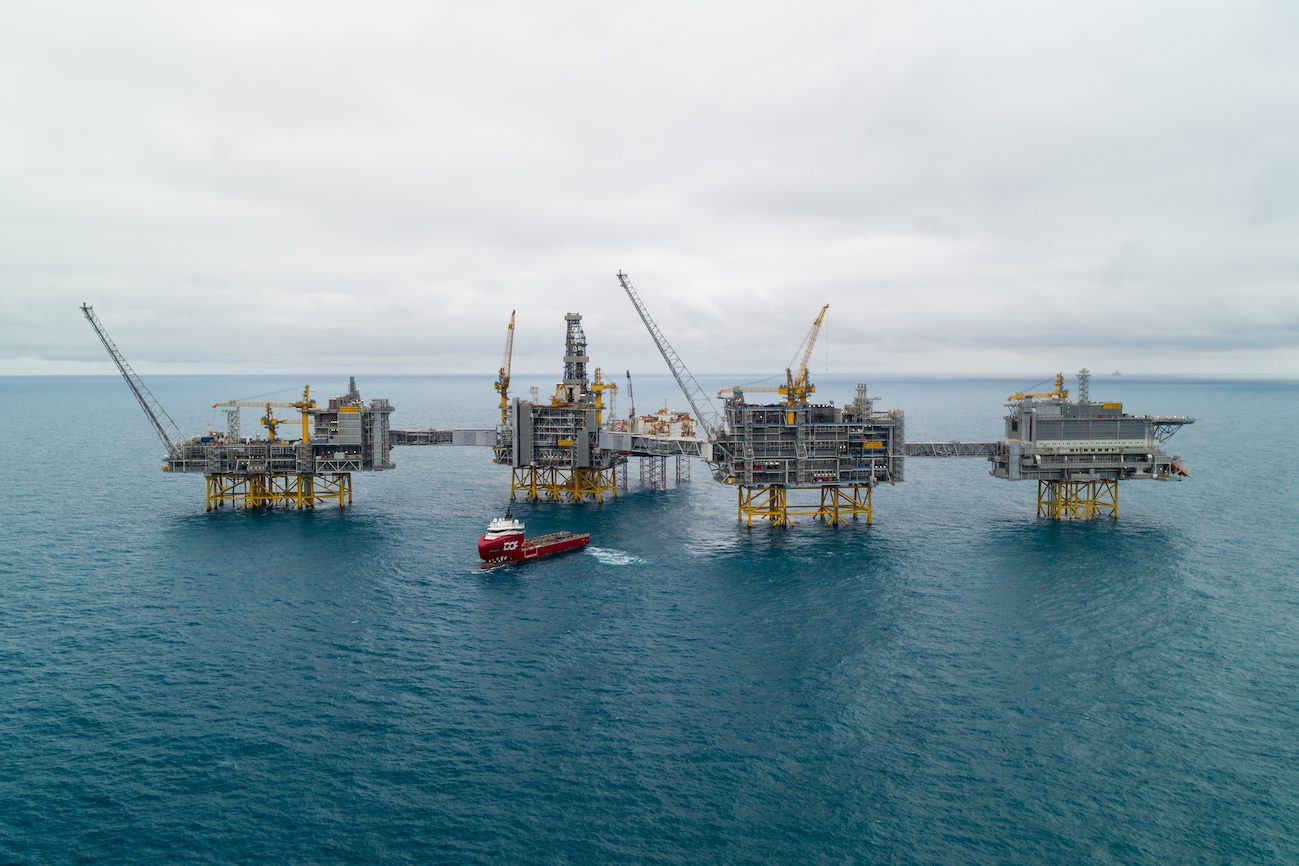
The world’s second largest crane vessel was contracted this week by Statoil to lift and transport the 10,600 ton topsides module into position atop the Gudrun jacket in the Norwegian North Sea. The vessel departed Aibel’s shipyard in Haugesund and arrived on station 25 hours later.
“The operation has been safe and efficient with favourable sea conditions,” commented Øyvind Haugsdal, transport and installation manager for the Gudrun project. “It was an incredible feeling to watch it all go as planned.”
The topsides were positioned on top of the jacket at 1743 local time on Thursday 18 July 2013. Photo: Kjell-Arve Tysnes – Statoil
Haugsdal has been planning this lifting operation for the last three and a half years.
After the topsides were positioned in place, the platform’s distinctive flare tower was installed which reached into the sky 232.5 meters above the sea.
Statoil plans to start up production at this facility in the first quarter of 2014, at which point they will start paying off the NOK 19 billion investment they will have made into the development of the field. They note that this price is NOK 2 billion less than planned however.
“We were given good prices when we awarded the contracts in 2010, in a market characterised by the financial crisis,” says Margaret Øvrum, executive vice president for Technology, Projects and Drilling in Statoil.
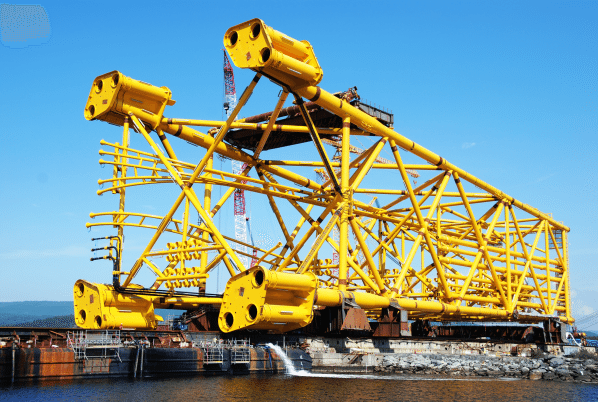
Gudrun’s 7400 ton jacket destined is prepared for installation, image courtesy Kvaerner
About Gudrun
Discovered in 1975, Gudrun is an oil and gas field situated in the middle of the Norwegian part of the North Sea (license area PL025). The field is situated approximately 55 kilometers north of the Sleipner installations.
The extractable reserve is 126.5 million barrels of oil equivalent (around 2/3 oil, 1/3 gas and NGL)
Gudrun has a process facility for partial stabilisation of oil and gas. Transport of oil and gas to the Sleipner A platform Oil is transported to Kårstø while the gas is transported to the European markets via gas pipes connected to Sleipner.
The reservoir is situated at a depth of 4,200-4,700 metres and dates back to the Jurassic period. The pressure in the reservoir reaches as much as 860 bar, with a temperature of up to 150 degrees Celsius.
The platform is equipped with 16 well slots and a total of 7 production wells will be drilled. Available slots may be used for further wells to further increase production from Gudrun or wells from other fields.
110 kilometres of pipelines (two pipelines of 55 kilometres each) have been laid in the sea bed between Gudrun and Sleipner, as well as 55 kilometres of power cable.
Equinor expects 10-20% production decline at Johan Sverdrup, Europe's largest oil field growth source. The decline signals broader challenges for global oil supply amid aging fields.
By Mark Chediak Jan 18, 2026 (Bloomberg) –President Donald Trump’s campaign against offshore wind power in the US sustained major setbacks last week when three different judges blocked enforcement of a government ban...
The U.S. District Court for the District of Columbia has granted Empire Offshore Wind LLC a preliminary injunction allowing construction to resume on the Empire Wind offshore wind project, ending...
January 15, 2026
Total Views: 2165
Get The Industry’s Go-To News
Subscribe to gCaptain Daily and stay informed with the latest global maritime and offshore news
— just like 107,452 professionals
Secure Your Spot
on the gCaptain Crew
Stay informed with the latest maritime and offshore news, delivered daily straight to your inbox
— trusted by our 107,452 members
Your Gateway to the Maritime World!
Essential news coupled with the finest maritime content sourced from across the globe.

 Join The Club