The Georgia Ports Authority Board approved more than $34 million to help expedite an additional 1.6 million twenty-foot equivalent container units in capacity to the Port of Savannah that will begin coming online in December.
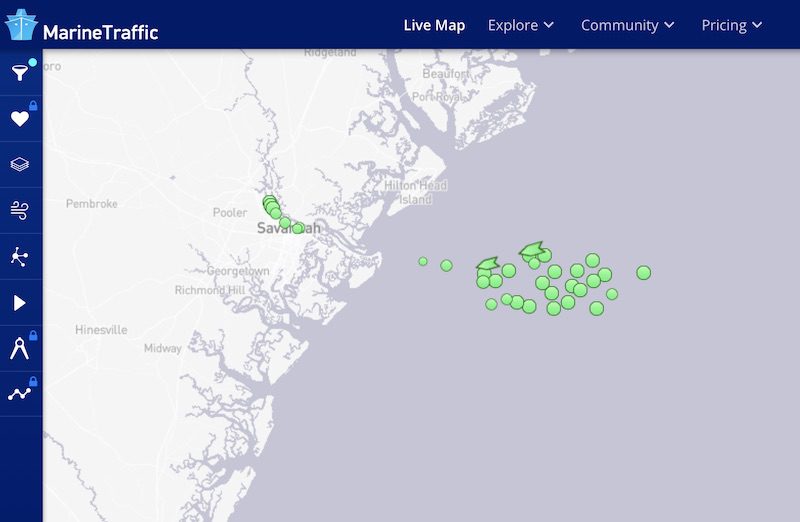
The news comes on the heels of reporting the second busiest month in the port’s history in August thanks to the pandemic-fueled imports boom. The high volumes has created a containership traffic jam off port, the worst on the U.S. East Coast. Maersk on Monday called the situation in Savannah “increasingly challenging” as congestion picks up, with more than 30 ships at anchorage and wait times upwards of 7 days as of mid-September.
“In three months, this investment will begin to deliver the additional capacity we need to better accommodate increased volumes and demand for our services,” said Griff Lynch, executive director for the GPA.
A screengrab of AIS data from MarineTraffic.com shows the traffic jam of containerships at anchorage off the Port of Savannah. Taken September 28, 2021. Courtesy MarineTraffic.com
Part of the approved expenditures included the purchase of 22.2 acres adjacent to GPA’s 145-acre West Expansion property. The board also provided funds to begin developing another 18 acres of land adjacent to GPA’s 60-acre Peak Capacity project, currently under construction. In total, the developments will add 230 acres of container handling space, coming online in phases with full completion in 2023.
“The GPA’s expansion strategy will not only maintain Savannah’s position as the hub port of the U.S. Southeast, but strengthen its ability to drive economic growth and private investment for communities across Georgia,” said Joel Wooten, GPA’s chairman of the board. “In light of unprecedented demand, it is incumbent on the Board to maintain our ports to promote job growth for the state.”
The Port of Savannah handled 485,595 TEUs in August, an increase of 10 percent, or 44,000 TEUs over the same month last year, which was the previous high for August. It was the second busiest month in GPA history, after only March 2021, when Garden City Terminal handled 498,000 TEUs.
Annually, the Port of Savannah handled about 5.3 million TEU in its FY2021, which ran June to July, another new record and up 20 percent or nearly 900,000 TEUs compared 2020. This puts it second behind the Ports of New York & New Jersey on the U.S. East Coast in terms of annual TEU throughput.
“I would like to thank our Board of Directors for their confidence in our ability to grow our existing terminals; our customers for sticking with us and, in many cases, increasing their commitment to Georgia’s ports; and to the men and women working throughout the supply chain, and especially GPA’s employees, I want to thank you for your hard work and dedication during unprecedented times in our industry,” said Lynch.
The Port of Los Angeles handled a record 1,042,652 twenty-foot equivalent units (TEUs) in September, marking the busiest month in its 118-year history as strong consumer demand and shifting global...
The Port of Los Angeles reported its best single month in its history. In a media briefing, port executive director Gene Seroka announced the port processed 1,042,652 TEUs, 23k TEUs more than the July 2025 record.
U.S. container imports are finally beginning to slow after an unusually long peak shipping season that stretched through the summer and into early fall, according to the latest Global Port Tracker report from the National Retail Federation (NRF) and Hackett Associates. The slowdown comes after months of stronger-than-expected cargo volumes at major U.S. ports, as retailers continued bringing in merchandise despite tariffs, inflation and higher transportation costs. Ports covered by Global Port Tracker handled 2.3 million twenty-foot equivalent units (TEUs) in August, up 0.4% from July but down 0.7% from a year earlier. August now appears to have been the busiest month of 2026, marking a shift from last month’s forecast that September would take the top spot. “Even with any fluctuations in final data, we’re likely past the busiest part of the year,” said Jonathan Gold, NRF vice president for supply chain and customs policy. “The truth is that the peak season started early and was stretched out through the summer and early fall, with the difference from month to month often amounting to little more than a rounding error,” Gold said. The latest forecast puts September imports at 2.28 million TEUs, down from the 2.31 million TEUs projected a month ago. October is expected to ease further to 2.25 million TEUs before volumes fall to 2 million TEUs in November. Despite the expected slowdown, imports are still running well ahead of last year in some months. September volumes are forecast to rise 8.2% year over year, followed by an 8.5% increase in October. The revised outlook follows a peak season that has repeatedly defied expectations. Retailers moved merchandise into the country earlier this year to get ahead of tariff changes and supply chain uncertainty, initially raising expectations that imports would peak early and decline through the summer. Instead, volumes remained elevated, with shipping delays and resilient consumer demand helping extend the traditional peak season. The strength has been evident at individual ports. The Port of Los Angeles recorded its busiest three-month stretch on record during June, July and August, while the Port of Savannah reported a record September earlier this week, handling 504,015 TEUs, up 3.7% from a year earlier. Hackett Associates founder Ben Hackett said the economic outlook remains mixed, with consumers continuing to spend despite signs of weakening confidence. “Despite this, consumers appear to remain confident and cautious at the same time, with consumer confidence indexes sliding to multi-year lows while consumer spending continues to be robust in the face of increasing inflation,” Hackett said. For the full year, Global Port Tracker now expects imports at major U.S. container ports to reach 25.8 million TEUs, up 1.4% from 25.4 million TEUs in 2025. That is slightly above last month’s forecast of 25.7 million TEUs. Looking ahead, January 2027 imports are forecast at 2.07 million TEUs, down 1.9% year over year, followed by 1.92 million TEUs in February, up 1%. For retailers, the extended shipping season means much of the merchandise needed for the holidays is already in the country, reducing the need for another major import surge before year-end. “Most holiday merchandise has arrived, and the remainder of the year is just a matter of last-minute replenishment and preparation for early 2027,” Gold said.
October 8, 2026
Total Views: 867
Get The Industry’s Go-To News
Subscribe to gCaptain Daily and stay informed with the latest global maritime and offshore news
— just like 106,597 professionals
Secure Your Spot
on the gCaptain Crew
Stay informed with the latest maritime and offshore news, delivered daily straight to your inbox
— trusted by our 106,597 members
Your Gateway to the Maritime World!
Essential news coupled with the finest maritime content sourced from across the globe.

 Join The Club