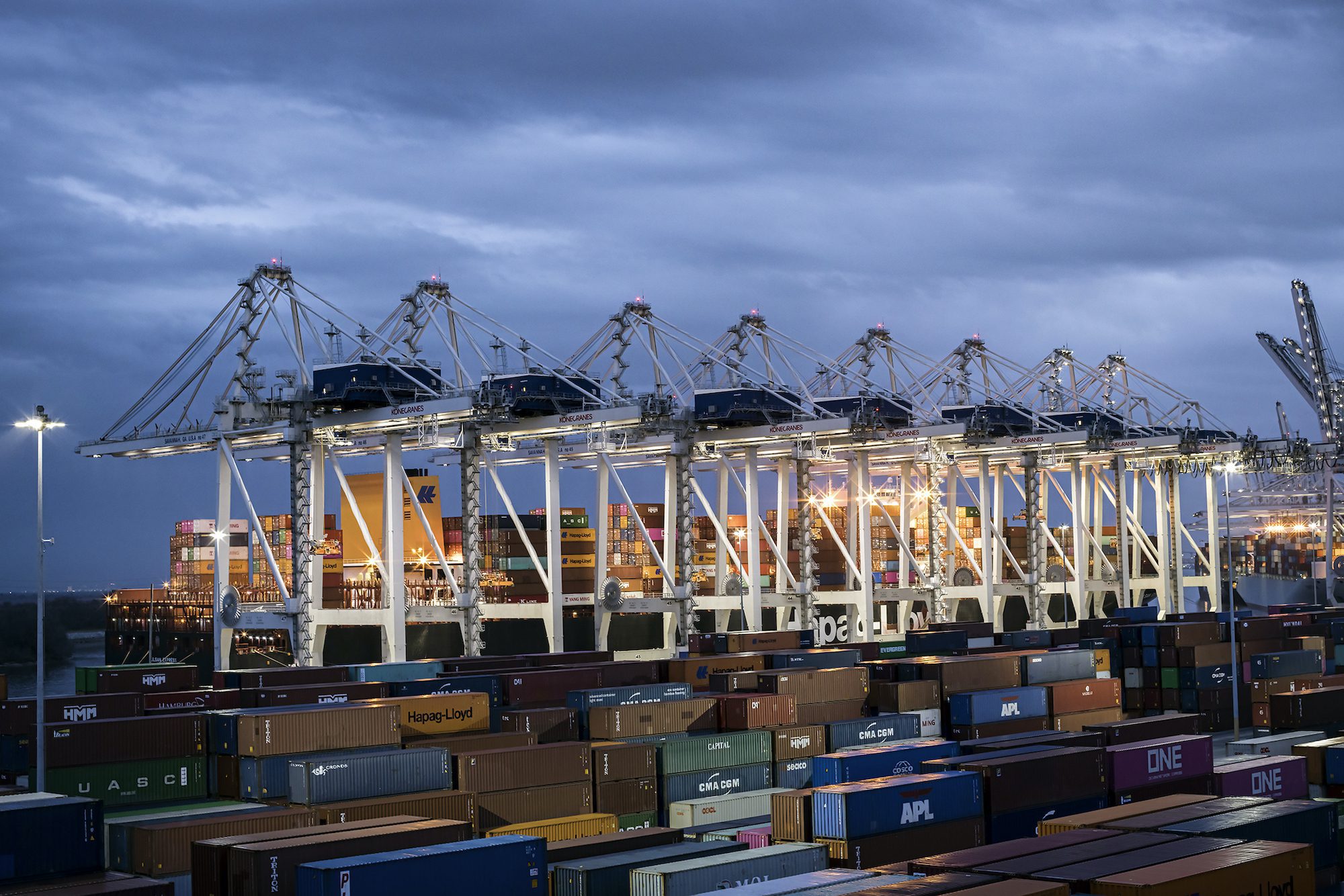
January’s cargo volumes represent an increase of 4 percent over the same month a year ago, when cargo volumes expanded by 22 percent from before the pandemic-driven import surge. The Port of Savannah has now set monthly records for the past 18 months.
“The steps we have taken to add capacity have broken the logjam in global logistics for our customers and created jobs throughout the supply chain” said Georgia Ports Authority (GPA) Executive Director Griff Lynch. “The dedication and hard work of our GPA employees, the International Longshoremen’s Association (ILA), and our other partners throughout the logistics community have also played a key role to keep cargo flowing.”
Over the last 18 months, the Port of Savannah has grown its container volumes by 1.2 million TEUs, including more than 930,000 TEUs in 2021 alone.
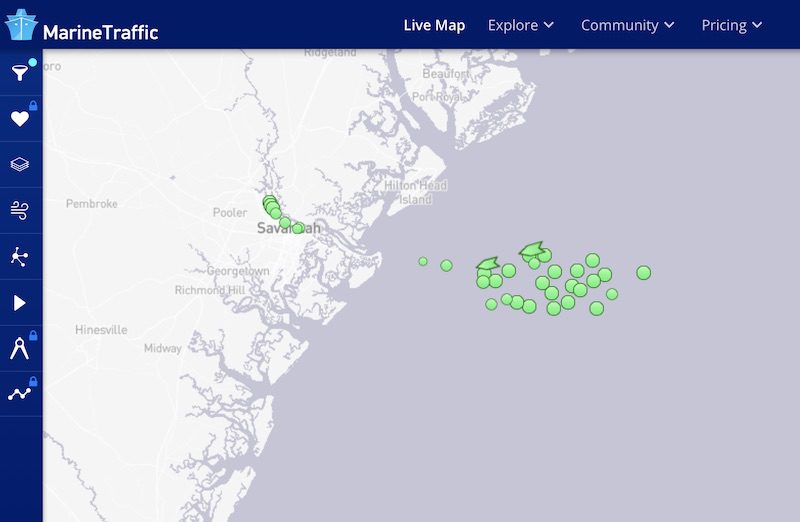
It’s been quite a turnaround for Savannah since peak congestion experienced there last fall. Figures released by the Georgia Ports Authority on Wednesday showed just three ships at anchor outside the Port of Savannah, down from a peak of around 30 in mid-September.
A screengrab of AIS data from MarineTraffic.com shows the traffic jam of containerships at anchorage off the Port of Savannah. Taken September 28, 2021. Courtesy MarineTraffic.com
To help relieve congestion, GPA has activated five off-terminal “pop-up” container yards near manufacturing and distribution centers, the most recent being the 330-acre CCX Yard in Rocky Mount, N.C., which is owned and operated by CSX. Four other pop-up facilities are located near manufacturing and distribution centers in Savannah, Atlanta, Statesboro and the Appalachian Regional Port.
Combined, the yards add 410,000 TEUs of additional container space, bringing cargo closer to customers and reducing the amount of storage time at Savannah’s Garden City Terminal.
“The success of our inland pop-up yards has provided an excellent pressure relief valve and reduced the number of containers at the Port of Savannah,” said GPA Board Chairman Joel Wooten. “In combination with the on-terminal storage capacity that we continue to expand, our customers can be assured of the fast, reliable, world-class service they have come to expect from Georgia Ports.”
According to a recent economic impact study by the University of Georgia’s Terry College of Business, port activity supports one job for every 10 TEUs moved each year, or an additional 93,000 full- and part-time jobs throughout Georgia in 2021. GPA alone grew by 145 employees last year. “It has been an inspiration to see how our team, the ILA and so many others in the supply chain have been ramping up the workforce with highly skilled and dedicated team members,” Lynch said.
In 2021, the Port of Savannah moved a record 5.6 million TEU, for an increase of about 20% compared to 2020.
The Port of Los Angeles handled a record 1,042,652 twenty-foot equivalent units (TEUs) in September, marking the busiest month in its 118-year history as strong consumer demand and shifting global...
The Port of Los Angeles reported its best single month in its history. In a media briefing, port executive director Gene Seroka announced the port processed 1,042,652 TEUs, 23k TEUs more than the July 2025 record.
U.S. container imports are finally beginning to slow after an unusually long peak shipping season that stretched through the summer and into early fall, according to the latest Global Port Tracker report from the National Retail Federation (NRF) and Hackett Associates. The slowdown comes after months of stronger-than-expected cargo volumes at major U.S. ports, as retailers continued bringing in merchandise despite tariffs, inflation and higher transportation costs. Ports covered by Global Port Tracker handled 2.3 million twenty-foot equivalent units (TEUs) in August, up 0.4% from July but down 0.7% from a year earlier. August now appears to have been the busiest month of 2026, marking a shift from last month’s forecast that September would take the top spot. “Even with any fluctuations in final data, we’re likely past the busiest part of the year,” said Jonathan Gold, NRF vice president for supply chain and customs policy. “The truth is that the peak season started early and was stretched out through the summer and early fall, with the difference from month to month often amounting to little more than a rounding error,” Gold said. The latest forecast puts September imports at 2.28 million TEUs, down from the 2.31 million TEUs projected a month ago. October is expected to ease further to 2.25 million TEUs before volumes fall to 2 million TEUs in November. Despite the expected slowdown, imports are still running well ahead of last year in some months. September volumes are forecast to rise 8.2% year over year, followed by an 8.5% increase in October. The revised outlook follows a peak season that has repeatedly defied expectations. Retailers moved merchandise into the country earlier this year to get ahead of tariff changes and supply chain uncertainty, initially raising expectations that imports would peak early and decline through the summer. Instead, volumes remained elevated, with shipping delays and resilient consumer demand helping extend the traditional peak season. The strength has been evident at individual ports. The Port of Los Angeles recorded its busiest three-month stretch on record during June, July and August, while the Port of Savannah reported a record September earlier this week, handling 504,015 TEUs, up 3.7% from a year earlier. Hackett Associates founder Ben Hackett said the economic outlook remains mixed, with consumers continuing to spend despite signs of weakening confidence. “Despite this, consumers appear to remain confident and cautious at the same time, with consumer confidence indexes sliding to multi-year lows while consumer spending continues to be robust in the face of increasing inflation,” Hackett said. For the full year, Global Port Tracker now expects imports at major U.S. container ports to reach 25.8 million TEUs, up 1.4% from 25.4 million TEUs in 2025. That is slightly above last month’s forecast of 25.7 million TEUs. Looking ahead, January 2027 imports are forecast at 2.07 million TEUs, down 1.9% year over year, followed by 1.92 million TEUs in February, up 1%. For retailers, the extended shipping season means much of the merchandise needed for the holidays is already in the country, reducing the need for another major import surge before year-end. “Most holiday merchandise has arrived, and the remainder of the year is just a matter of last-minute replenishment and preparation for early 2027,” Gold said.
October 8, 2026
Total Views: 730
Get The Industry’s Go-To News
Subscribe to gCaptain Daily and stay informed with the latest global maritime and offshore news
— just like 106,723 professionals
Secure Your Spot
on the gCaptain Crew
Stay informed with the latest maritime and offshore news, delivered daily straight to your inbox
— trusted by our 106,723 members
Your Gateway to the Maritime World!
Essential news coupled with the finest maritime content sourced from across the globe.

 Join The Club