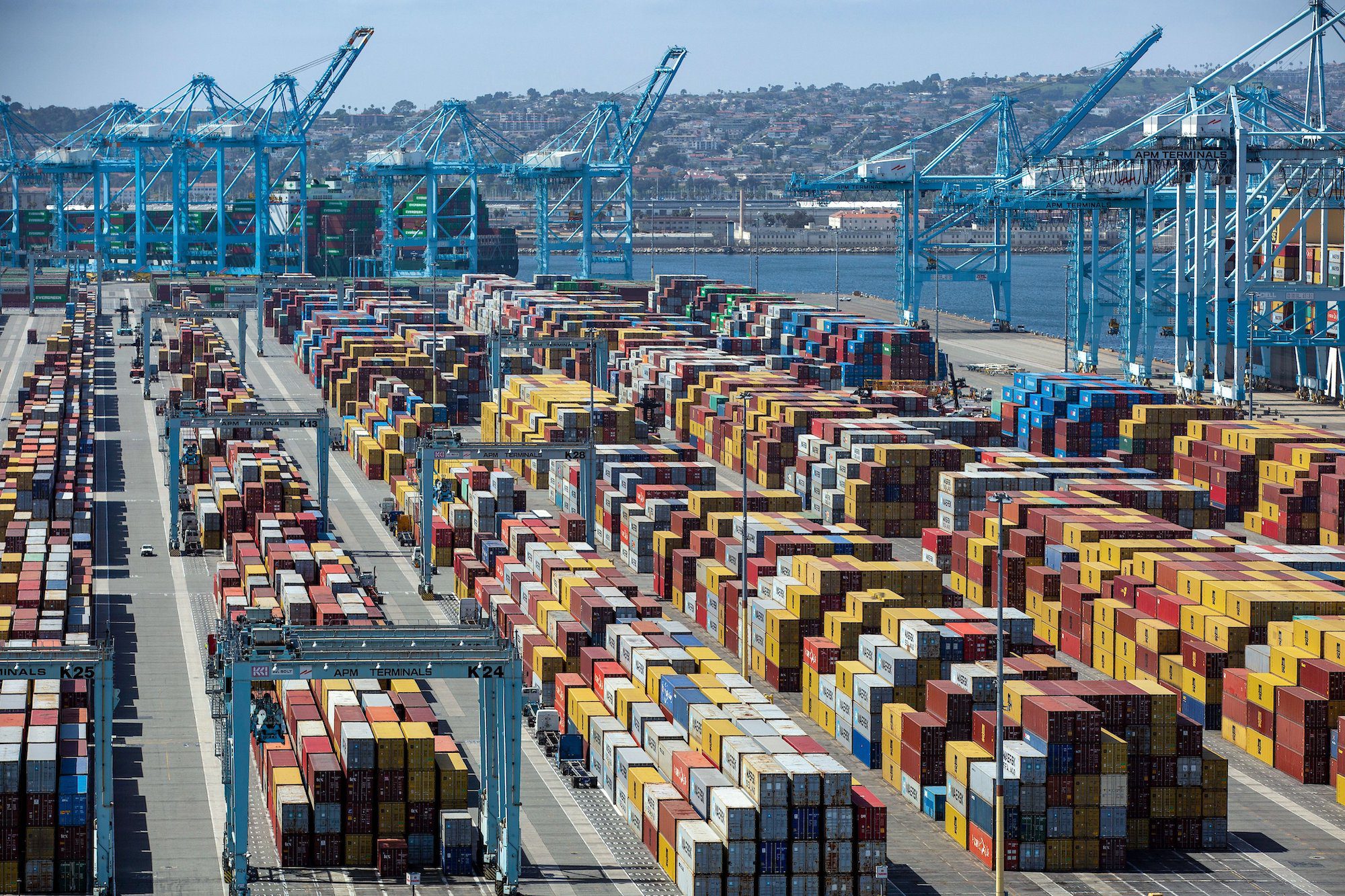
The Port of Los Angeles recorded its third-busiest month ever last month as work continues to clear marine terminals of cargo and reduce the number of ships waiting at sea.
The Port of Los Angeles on Tuesday reported processing 958,674 Twenty-Foot Equivalent Units (TEUs) in March, marking a third consecutive monthly cargo record for the nation’s top container port.
The final numbers mean March 2022 is now the third-best month ever for L.A., just behind the record 1,012,048 TEUs handled in May 2021 and 980,729 TEUs in October 2020.
With last month’s numbers, the Port of Los Angeles has now marked its best first quarter ever this year, tracking 3.5% ahead of the previous record set last year in 2021.
Announcing the monthly data, Port of Los Angeles Executive Director Gene Serok said March 2022 loaded imports reached 495,196 TEUs, an increase of 1% compared to same month in 2021. Loaded exports came in at 11,781 TEUs, a 9% decrease compared to the same period last year. xports have now declined 37 of the last 41 months in Los Angeles.
Meanwhile, empty containers shipped overseas climbed to 351,697 TEUs, a jump of 2% compared to last year.
Three months into 2022, overall cargo volume has now reached 2,682,034 TEUs, making for a 3.5% increase compared to 2021.
“With improved fluidity on our docks and fewer vessels waiting to enter the port, our terminals are processing cargo at record levels,” said Seroka. “Yet we’re not taking anything for granted. We’re using our Port Optimizer data to find developing issues and adjust to market demands. We will keep working at this every day.”
Meanwhile, the latest dwell time report from the Port of Los Angeles showed 65,185 imported containers in marine terminals, a decrease of 31% compared to October 24, 2021 when it announced penalties for aging import containers. Of the 65,000, a little over 20,000 have dwelled for 9+ days, representing a decrease of 46% over the same period.
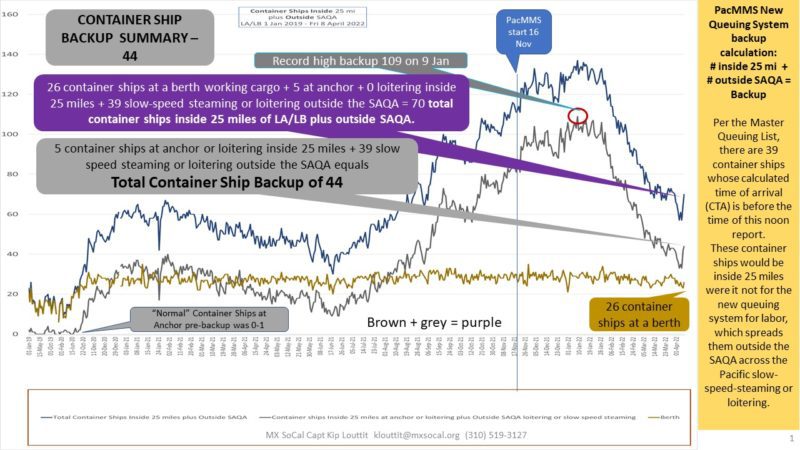
Looking at the backup of ships the San Pedro Bay Port Complex, which includes the ports of Los Angeles and Long Beach, the Marine Exchange of Southern California reported this week there are 44 containerships in the arrival queue, down from a record of 109 in early January. The 44 includes 39 waiting or “slow steaming” or loitering in the Pacific outside the Safety and Air Quality Area (SAQA), plus five at the port’s anchorages.
The chart below from the Marine Exchange shows the backup, in grey, peaking January 9th and ticking up with the most recent reporting. You can see the backup grew steadily from June 2021, the month following last May’s all-time record, through the end of the year.
Credit: Marine Exchange of Southern California
Seroka announced the latest cargo data during a media briefing which included his interview with International Longshore and Warehouse Union (ILWU) President Willie Adams and ILWU Coast Committeeman Frank Ponce De Leon, during which they discussed a range of topics including upcoming contract negotiations which have major implications for the nation’s supply chains in the coming the months.
The Port of Los Angeles reported its best single month in its history. In a media briefing, port executive director Gene Seroka announced the port processed 1,042,652 TEUs, 23k TEUs more than the July 2025 record.
U.S. container imports are finally beginning to slow after an unusually long peak shipping season that stretched through the summer and into early fall, according to the latest Global Port Tracker report from the National Retail Federation (NRF) and Hackett Associates. The slowdown comes after months of stronger-than-expected cargo volumes at major U.S. ports, as retailers continued bringing in merchandise despite tariffs, inflation and higher transportation costs. Ports covered by Global Port Tracker handled 2.3 million twenty-foot equivalent units (TEUs) in August, up 0.4% from July but down 0.7% from a year earlier. August now appears to have been the busiest month of 2026, marking a shift from last month’s forecast that September would take the top spot. “Even with any fluctuations in final data, we’re likely past the busiest part of the year,” said Jonathan Gold, NRF vice president for supply chain and customs policy. “The truth is that the peak season started early and was stretched out through the summer and early fall, with the difference from month to month often amounting to little more than a rounding error,” Gold said. The latest forecast puts September imports at 2.28 million TEUs, down from the 2.31 million TEUs projected a month ago. October is expected to ease further to 2.25 million TEUs before volumes fall to 2 million TEUs in November. Despite the expected slowdown, imports are still running well ahead of last year in some months. September volumes are forecast to rise 8.2% year over year, followed by an 8.5% increase in October. The revised outlook follows a peak season that has repeatedly defied expectations. Retailers moved merchandise into the country earlier this year to get ahead of tariff changes and supply chain uncertainty, initially raising expectations that imports would peak early and decline through the summer. Instead, volumes remained elevated, with shipping delays and resilient consumer demand helping extend the traditional peak season. The strength has been evident at individual ports. The Port of Los Angeles recorded its busiest three-month stretch on record during June, July and August, while the Port of Savannah reported a record September earlier this week, handling 504,015 TEUs, up 3.7% from a year earlier. Hackett Associates founder Ben Hackett said the economic outlook remains mixed, with consumers continuing to spend despite signs of weakening confidence. “Despite this, consumers appear to remain confident and cautious at the same time, with consumer confidence indexes sliding to multi-year lows while consumer spending continues to be robust in the face of increasing inflation,” Hackett said. For the full year, Global Port Tracker now expects imports at major U.S. container ports to reach 25.8 million TEUs, up 1.4% from 25.4 million TEUs in 2025. That is slightly above last month’s forecast of 25.7 million TEUs. Looking ahead, January 2027 imports are forecast at 2.07 million TEUs, down 1.9% year over year, followed by 1.92 million TEUs in February, up 1%. For retailers, the extended shipping season means much of the merchandise needed for the holidays is already in the country, reducing the need for another major import surge before year-end. “Most holiday merchandise has arrived, and the remainder of the year is just a matter of last-minute replenishment and preparation for early 2027,” Gold said.
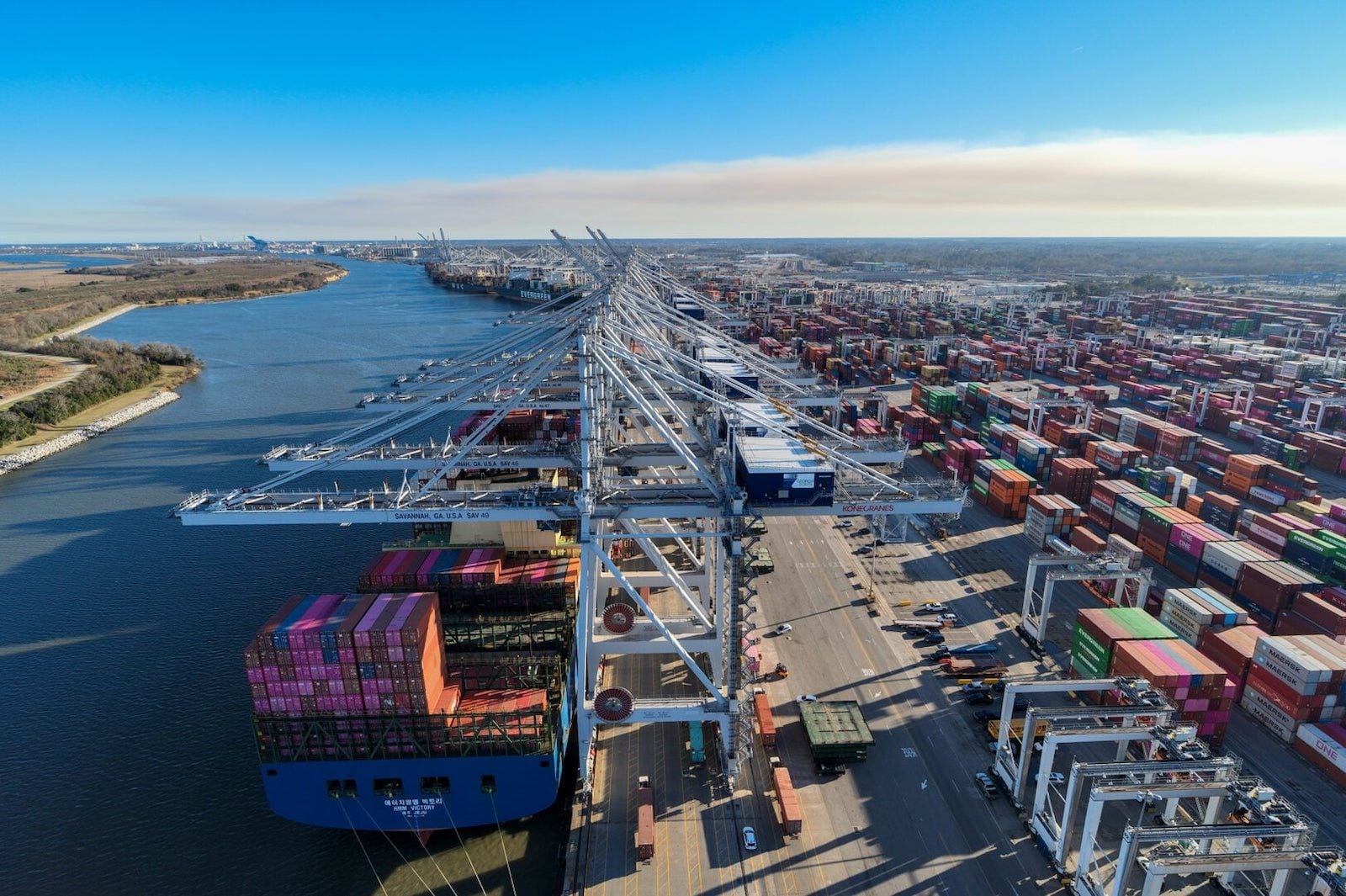
The Port of Savannah handled a record 504,015 twenty-foot equivalent units in September, up 3.7% from a year earlier as strong imports and a later-than-usual peak season boosted volumes.
October 7, 2026
Total Views: 683
Get The Industry’s Go-To News
Subscribe to gCaptain Daily and stay informed with the latest global maritime and offshore news
— just like 106,875 professionals
Secure Your Spot
on the gCaptain Crew
Stay informed with the latest maritime and offshore news, delivered daily straight to your inbox
— trusted by our 106,875 members
Your Gateway to the Maritime World!
Essential news coupled with the finest maritime content sourced from across the globe.

 Join The Club