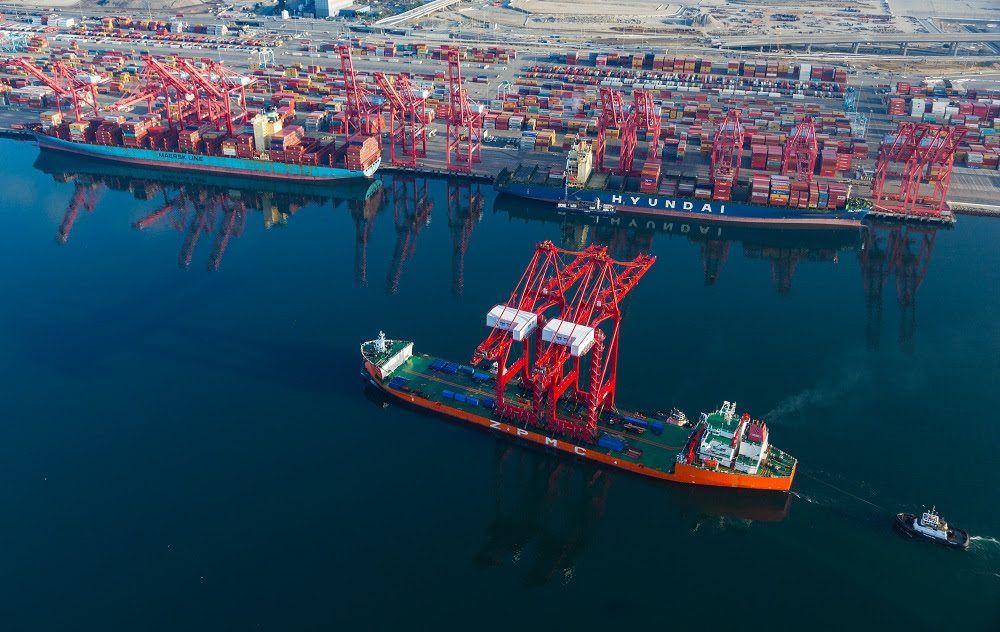
New ship-to-shore cranes, capable of handling 22,000 TEU vessels, arrived at Total Terminals International Pier T in August. Photo courtesy Port of Long Beach
The Port of Long Beach said cargo volumes in August slid more than two percent compared to a year ago amid the on-going U.S.-China trade war.
The Port of Long Beach on Thursday reported that it handled a total 663,992 twenty-foot equivalent units (TEUs) in August, down 2.3% compared to August 2018 and marking the fifth-busiest August in the port’s 108-year history.
Imports slid 5.9 percent to 322,780 TEUs, exports rose 4.5 percent to 124,975 TEUs and empty containers sent overseas for use in the global supply chain decreased 0.3 percent to 216,238 TEUs, according to the port.
Long Beach volumes after the first eight months of 2019 are 4,971,407 TEUs, down 6.6 percent from last year’s record pace.
“These results are strong for any North American seaport, but lag behind our record high numbers last year, when retailers shipped goods to beat expected tariffs,” said Port of Long Beach Executive Director Mario Cordero. “We are still on track for one of our busiest years ever and our focus remains on delivering efficiency and reliability as we await the swift resolution of the U.S.-China trade dispute.”
“International trade has continued and will continue to evolve,” said Long Beach Harbor Commission President Bonnie Lowenthal. “Our focus as policy makers for the Port must be long-term, and our future as the primary gateway for trans-Pacific commerce remains very positive. We are investing billions in efficient and sustainable cargo movement to serve the needs of the supply chain today and decades from now.”
Earlier this week, the neighboring Port of Los Angeles reported a 4.2 percent increase in the amount of cargo it handled August. Despite the increase, however, Port of Los Angeles Executive Director Gene Seroka, called for an to the trade war as importers race to beat tariffs on Chinese goods.
“The final months of 2018 ended with an extraordinary influx of imports to beat expected tariffs on China-origin goods,” Seroka said. “We don’t expect to see those kind of volumes in the months ahead. We need a negotiated settlement of the U.S.-China trade war to restore global trade stability.”
Updated: November 18, 2020 (Originally published September 12, 2019)
Editorial Standards · Corrections · About gCaptain

 Join The Club