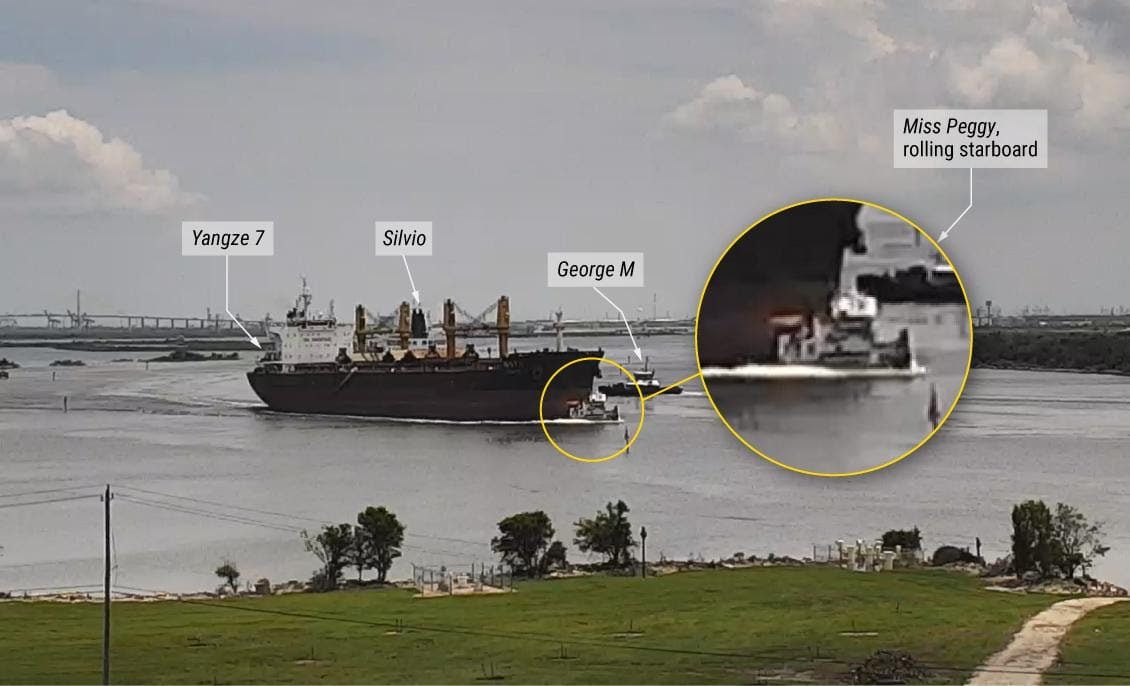
A Houston ship pilot’s extended personal cell phone conversation and multiple failures to maintain a proper lookout led to the fatal 2024 collision between the bulk carrier Yangze 7 and the towing vessel Miss Peggy in the Houston Ship Channel, according to a newly released National Transportation Safety Board investigation.
The July 19, 2024, collision near Lynchburg, Texas, caused the Miss Peggy to capsize and sink with five crewmembers aboard. Four mariners were rescued by a nearby vessel, while a fifth was later found dead inside the wreck. One crewmember suffered serious injuries, another sustained minor injuries, and an undetermined amount of oil was released into the waterway. Damage and cleanup costs totaled an estimated $3.7 million, while the Yangze 7 escaped without damage.
The NTSB found that the Houston pilot directing the 656-foot bulk carrier had been engaged in a non-operational phone call with another pilot for 39 minutes leading up to the accident. Although the call ended just over two minutes before impact, investigators concluded it distracted the pilot long enough for him to lose awareness of the towing vessel ahead.
The investigation also found that the Yangze 7‘s bridge team failed to intervene despite recognizing the pilot was engaged in personal conversations, reflecting ineffective bridge resource management. At least one officer told investigators he was “very afraid” because the pilot was chatting through a Bluetooth earpiece while issuing helm orders and that the conversation had nothing to do with navigation or vessel operations.
The Miss Peggy‘s captain likewise failed to maintain a proper lookout and did not detect the bulk carrier approaching from astern. Meanwhile, the Yangze 7 bridge team did not spot the towboat until it was less than a ship’s length ahead. The NTSB concluded that all three parties—the pilot, the ship’s bridge team, and the towing vessel’s captain—lost situational awareness because they failed to keep a proper lookout.
According to the investigation, the Houston Pilots had no policy at the time prohibiting pilots from using personal electronic devices for non-operational purposes while directing vessels. Investigators said that absence of a policy likely normalized the practice, increasing safety risks for vessels and crews.
The NTSB has recommended that the U.S. Coast Guard prohibit the non-operational use of personal electronic devices by anyone directing vessel movements in U.S. waterways. It also called on the American Pilots’ Association to develop guidance banning such use by pilots actively navigating vessels and encourage member associations to adopt similar rules.
The report highlights a broader pattern of distraction-related marine casualties. According to the NTSB, personal electronic device distraction was identified as either a contributing factor or the probable cause in at least 10 marine accidents between 2009 and 2024, resulting in three deaths and 45 injuries.
The full 92-page Marine Investigation Report identifies the probable cause as the loss of situational awareness by the Houston pilot, the Yangze 7 bridge team, and the Miss Peggy‘s captain due to failures to maintain proper lookouts. It concludes that the pilot’s prolonged personal cell phone use—and the lack of any policy prohibiting it—directly contributed to the fatal casualty.

 Join The Club