By Daniel Katzive (gCaptain) – Unapproved use of a propane torch on deck triggered the explosion aboard a New York City municipal sludge tanker Hunts Point last May, according to a report issued by the National Transportation Safety Board last month. The blast killed the vessel’s chief engineer and injured two other crew members while causing significant damage to the vessel.
Chief Engineer Raymond Feige died in the blast on May 26, 2025. Feige was 59 years old and a 34-year veteran employee of the city’s Department of Environmental Protection, New York’s water and sewer agency. Feige had served aboard the Hunts Point since the vessel was launched in 2014, The explosion occurred while the tanker was docked at the North River Wastewater Treatment Plant, located in Manhattan at around West 138th Street on the Hudson River shoreline.
Feige was seen using a torch in an attempt to remove broken bolts from a hatch cover shortly before the blast which blew him off the tanker. He was found between the concrete dock and a wooden fender alongside the vessel and declared dead at the scene by fire department paramedics. An assistant engineer was found on deck, injured and covered in sludge, but conscious. The NTSB concluded that the torch had likely ignited flammable methane gas in the hold, triggering the explosion.
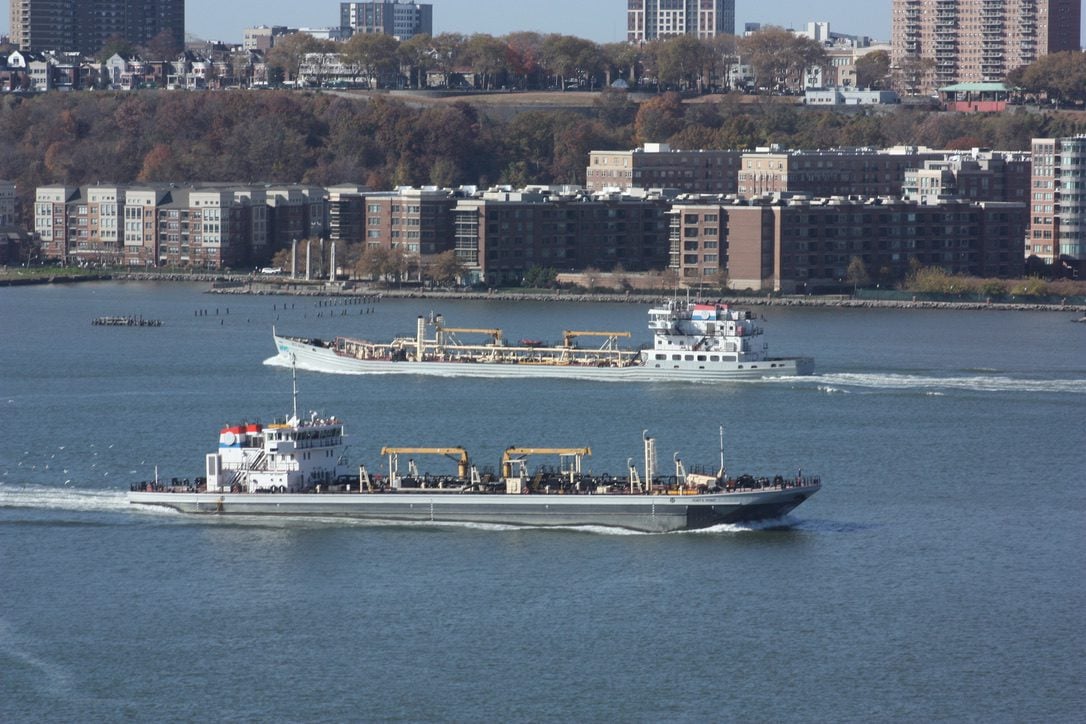
New York City maintains a small fleet of tankers to ferry sludge between water treatment plants. Sludge is a by-product of the sewage treatment process, essentially residual solids that can be converted to a fertilizer product. The use of tankers by the city goes back to the days when sludge was dumped offshore, but the Hunts Point is one of three 289-foot tankers acquired by the city in 2014, long after offshore dumping ended. In the modern era, these tankers are used to move the material from treatment plants around the five boroughs that lack centrifuge mechanisms to dewater the sludge, like the North River plant, to those that do. On the day of the accident, the Hunts Point was loading sludge to be brought for dewatering back at the larger Wards Island sewage plant on the East River.
The tanker’s hatches were being opened that day so that water from a dockside hydrant could be added to the tanks in order to loosen sludge that had become too viscous to pump out after sitting overnight. This procedure, known as “innage reduction” was not done often and the report indicates it was last performed on the Hunts Point five years earlier. In the interim, removable plugs in the hatch covers had rusted shut, necessitating the removal of flanges from the hatch cover securing the plugs. During this process, a number of rusted bolts sheared off. The chief engineer and an assistant engineer were attempting to remove these broken bolts when the blast occurred.
NYC DEP procedures documented by the NTSB prohibited sources of flame on the decks of the tankers and called for a permit to be completed prior to beginning any hot work on a DEP vessel, and none was completed in this case. Moreover, the report indicated the vessel’s master told investigators he had specifically instructed the chief engineer not to use a torch near the tanks and had also warned the assistant engineer to remind the chief.
The NTSB concluded its report noting “Despite these warnings, the chief engineer used a torch to heat a broken bolt by an unprotected opening to a tank containing flammable gas. The chief engineer had other tools available that could have removed the broken bolts without the risk of igniting the flammable gas. Had he used any of these tools, the casualty could have been prevented.”
In the aftermath of the accident, the DEP issued two memos directing personnel to review procedures for hot work and hazards associated with sludge. A spokesperson for the DEP told gCaptain by email “The safety of our employees remains our top priority….Information from the NTSB report, along with an independent investigation DEP commissioned right after the accident, is being used to enhance safety procedures, training and communication, as well as reinforce accountability throughout DEP’s operations.”
Damage to the Hunts Point tanker is estimated at $10 million according to the NTSB report. The vessel has not returned to service since the accident and last pinged AIS from the Caddell shipyard on Staten Island.The city’s oldest tanker, the North River which was launched in the 1970s during the era of offshore dumping, is also out of service and undergoing repairs. The DEP told gCaptain that the Hunts Point is expected to be in action again in September 2026, but that no decision has been made yet about possible retirement of the North River. This leaves the DEP with just three tankers to perform work normally covered by five for now, though privately owned sludge barges have also been seen servicing the North River plant since the accident last year.
For more details on the accident, see the full NTSB report.
This article has been updated with additional information provided by the New York City Department of Environmental Protection.

 Join The Club