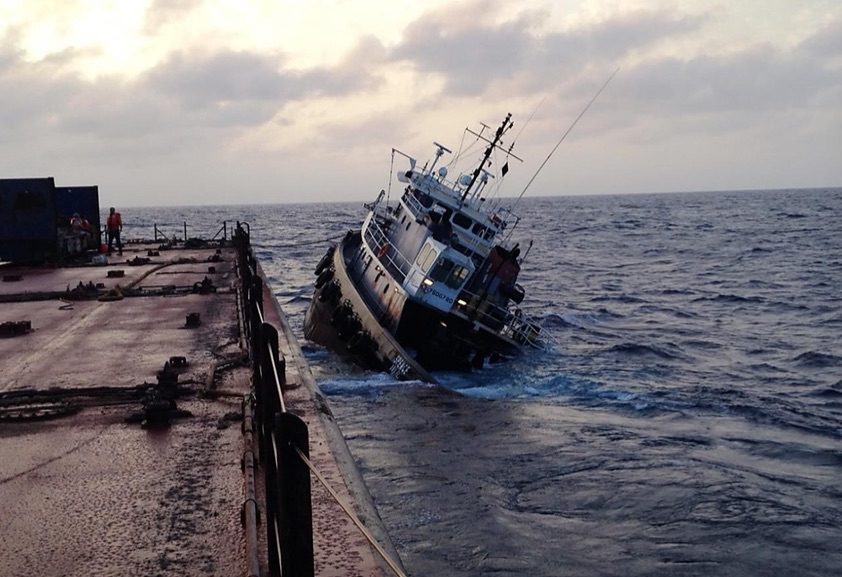
The towing vessel Spence shortly before sinking and after crewmembers had abandoned ship to the barge Guantanamo Bay Express. Photo by Spence crewmember provided by U.S. Coast Guard
The NTSB has released a Marine Accident Brief on its investigation into the December 2015 sinking of the towing vessel Spence in the Caribbean Sea.
On December 14, 2015 the U.S.-flagged towing vessel Spence listed severely after taking on water about 115 nautical miles north of Cartagena, Colombia. Despite the crew’s effort to correct it, the list continued to worsen and consequently, the captain activated the vessel’s emergency position indicating radio beacon (EPIRB) and the crew climbed onto the barge that the Spence was towing. The towing vessel sank shortly thereafter.
The four crewmembers were later rescued from the drifting barge by the Coast Guard cutter Decisive. Three of the crewmembers sustained non-life threatening injuries.
Following its investigation, the National Transportation Safety Board determined that the probable cause of the sinking of the towing vessel was gradual flooding from an unknown point of ingress into the aft void space followed by downflooding to the engine room.
In its Marine Accident Brief, the NTSB noted that the Spence and the 32-year-old barge had just completed extensive repairs and maintenance work at the COTECMAR Shipyard in Cartegena to address a number of repairs. These included 29 repairs identified during an American Bureau of Shipping survey to renew the towing vessel’s international load line certificate, which were all corrected and the vessel was issued the certificate.
In a post-sinking analysis, the Coast Guard Marine Safety Center determined that there was not enough information available to comment on the possibility of the repairs having compromised the hull of the vessel.
“The most likely sinking scenario involved gradual flooding in the aft void, which caused the aft deck to submerge and the vessel to enter a lolling condition, resulting in a sudden list to starboard,” the MSC analysis said. “In this state, water would then have likely entered other spaces through downflooding points, causing progressing flooding and sinking by the stern without capsizing.”
You can find the full NTSB report HERE.
Updated: November 17, 2020 (Originally published March 31, 2017)
Editorial Standards · Corrections · About gCaptain

 Join The Club