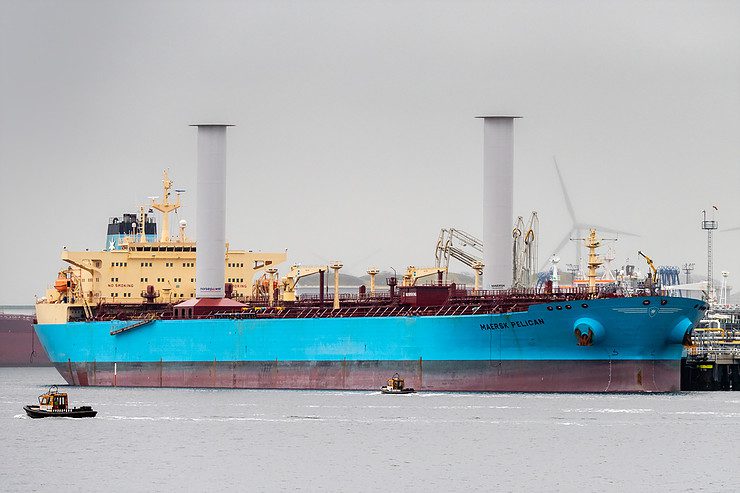
Maersk Pelican with two 30-meter Norsepower Rotor Sails installed. Photo courtesy Norsepower
Finnish technology company Norsepower has confirmed fuel savings of more than 8 percent from a trial of its Rotor Sails onboard the Maersk Tankers product tanker, Maersk Pelican.
The company’s Rotor Sails are a modern version of a Flettner Rotor, a type of spinning cylinder that uses the Magnus effect to harness wind power to help propel a ship and enhance fuel savings.
In August 2018, two 30-meter tall Rotor Sails were installed onboard Maersk Pelican, which trades in a wide range of conditions in Europe, Middle East, Asia and Australia.
According to Norsepower, during a year-long trial from September 2018 to September 2019, the aggregated total fuel saved was 8.2 percent, equivalent to approximately 1,400 tonnes of CO2.
Performance data from the trial was analyzed and validated by Lloyd’s Register’s (LR’s) Ship Performance Group.
Because of the success of the trial, Maersk says it has opted to keep the Rotor Sails installed on the Pelican.
“During the one-year trial period on Maersk Pelican, crew and operators have reported positively on the usability, safety and performance of the Rotor Sails in all conditions,” says Tommy Thomassen, Chief Technical Officer at Maersk Tankers.
“We see wind technology as one of the technologies that can give us a real breakthrough in reducing CO2 and help us achieve our emission-reduction target of 30% by 2021,” Thomassen said.
Norsepower’s Rotor Sails are currently installed on three vessels, including the M/V Estraden, a Bore vessel offering a Ro-Ro and General Cargo service between the UK and the Belgium; the Viking Grace, a LNG-powered Viking Line cruise ferry operating between Finland and Sweden; as well as the Maersk Pelican, a 109,647 DWT Long Range 2 (LR2) product tanker.
Norsepower simulation models show that in optimal conditions, its Rotor Sails have the ability to save around 12 percent on fuel and emissions.
“With the Maersk Pelican, there are three vessels in daily commercial operation using Norsepower’s Rotor Sails,” said Tuomas Riski, CEO at Norsepower. “Each of these cases represents a very different vessel type and operational profile, demonstrating the widespread opportunity to harness the wind through Rotors Sails across the maritime industry.”
Earlier this year, Rotor Sails were issued the first-ever type approval design certificate granted to an auxiliary wind propulsion system onboard a commercial ship from DNV GL. The certification confirms that vessels using the technology are technically capable of safely navigating “all operational and environmental situations.”
Earlier this week, Norsepower and the Finnish group Wärtsilä announced a service cooperation agreement to pursue Rotor Sail projects in the commercial maritime industry.
Updated: October 28, 2019 (Originally published October 24, 2019)
Editorial Standards · Corrections · About gCaptain

 Join The Club