Secretary of the Navy John Phelan on Friday announced a major strategic shift in naval shipbuilding, revealing the selection of a design for the Medium Landing Ship program after previously terminating four vessels from the troubled Constellation-class frigate program.
“We are fundamentally reshaping how the Navy builds and fields its Fleet,” Phelan stated on social media. “Today, I’m taking the second major step in that effort: selecting the design for our Medium Landing Ship, an operationally driven, fiscally disciplined choice that puts capability in the Fleet on a responsible timeline.”
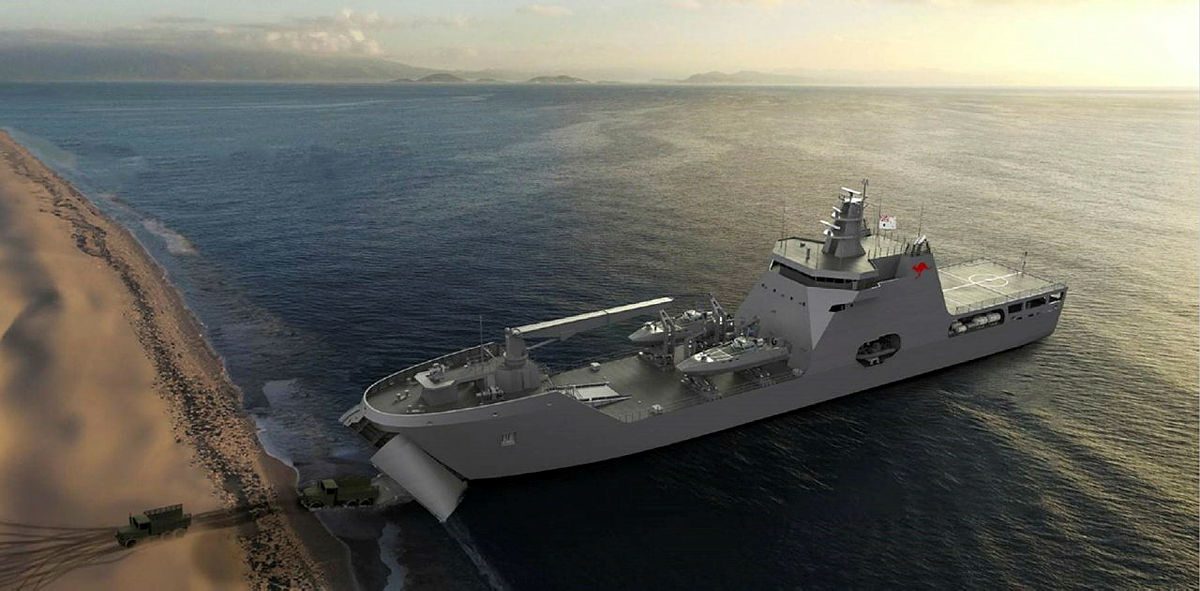
Phelan selected the LST-100 landing ship transport, designed by Dutch shipbuilder Damen, for the program. He described it as a roughly 4,000-ton ship with a range of more than 3,400 nautical miles. The same design is used by Australia’s new Heavy Landing Craft, which will be constructed by Austal in Australia.
The announcement comes as the Navy grapples with mounting delays across multiple shipbuilding programs. Last week, the service revealed it would cancel four Constellation-class frigates at Fincantieri Marinette Marine’s Wisconsin shipyard that had not yet begun construction, citing severe schedule challenges that have pushed the lead ship’s delivery from April 2026 to April 2029—a three-year delay.
The Medium Landing Ship program, previously known as the Light Amphibious Warship program, envisions procuring between 18 and 35 new amphibious vessels to support Marine Corps operations, particularly in implementing the Expeditionary Advanced Base Operations concept developed with an eye toward potential conflict scenarios with China in the Western Pacific.
Under this concept, the Marine Corps envisions reinforced-platoon-sized units maneuvering around the theater, moving from island to island to fire anti-ship cruise missiles and perform other missions alongside Navy forces. The LSMs would be instrumental to these operations, embarking, transporting, landing, and subsequently reembarking these small Marine Corps units.
Phelan said added that the Navy will competitively award a Vessel Construction Manager to oversee the LSM program.
The LSM program could be built by any of several U.S. shipyards, with the Navy’s baseline preference being a single shipyard to build all vessels, though multiple yards could be used to implement the program more quickly or cost-effectively.
The termination of the four Constellation-class frigates marks the latest in a series of federal shipbuilding program cancellations or significant alterations under the current administration. Earlier decisions include scrapping the U.S. Coast Guard’s planned eleventh Legend-class National Security Cutter at Huntington Ingalls and the partial shutdown of the troubled Offshore Patrol Cutter program at Eastern Shipbuilding.
These decisions reveal a growing pattern of cutbacks across multiple maritime programs, even as U.S. naval and Coast Guard leaders warn that the nation’s shipyards and industrial base already lag far behind China’s.

 Join The Club