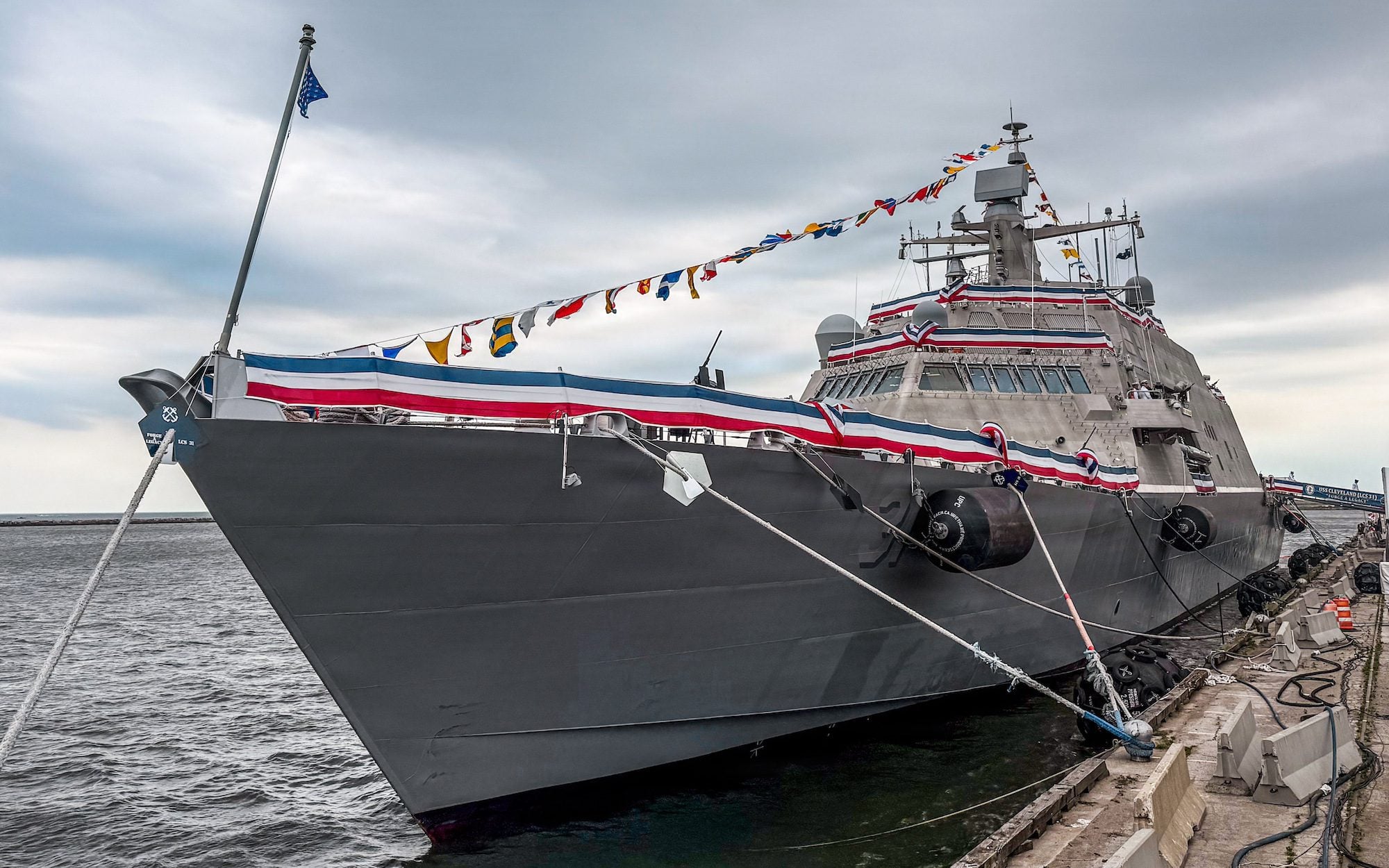
The U.S. Navy has commissioned USS Cleveland (LCS 31), officially closing out the Littoral Combat Ship program after more than two decades marked by cost overruns, mechanical failures, and shifting mission requirements.
The ceremony took place Friday in Cleveland, Ohio, with Acting Secretary of the Navy Hung Cao praising the crew as the ship entered active service.
“Today we celebrate the sailors who breathe life into this ship,” Cao said during the ceremony. “To the officers and crew of USS Cleveland, today is your day.”
Cleveland is the 16th and final Freedom-variant LCS built by Lockheed Martin and Fincantieri Marinette Marine in Marinette, Wisconsin. More significantly, it is the last Littoral Combat Ship expected to enter the fleet, bringing an end to one of the Navy’s most debated modern shipbuilding efforts.
The Navy previously commissioned USS Pierre (LCS 38), the final Independence-variant vessel, in late 2025.
The LCS class consists of two variants: the Freedom-class steel monohull built by Lockheed Martin in Marinette, Wisconsin, and the Independence-class aluminum trimaran built by Austal USA. A total of 35 LCS have been constructed.
Originally launched in the early 2000s, the LCS program aimed to deliver fast, modular warships capable of operating in contested near-shore environments. The ships were designed around interchangeable mission packages for mine countermeasures, anti-submarine warfare, and surface warfare.
Instead, the program became plagued by delays, reliability problems, and escalating criticism over survivability and combat capability, particularly as the Pentagon shifted focus toward high-end conflict scenarios in the Indo-Pacific.
Several LCS hulls have already been retired years earlier than expected, while the Navy increasingly pivots toward more heavily armed and survivable platforms such as the Constellation-class frigate.
Still, Navy officials continue to defend the ships’ role in distributed maritime operations.
“Littoral Combat Ships are fast, agile, mission-focused warships designed to operate in near-shore environments to counter 21st-century threats,” the Navy said in its commissioning announcement.
Cleveland is the fourth Navy ship to bear the city’s name. Earlier vessels served in conflicts ranging from World War I to Vietnam and Operation Desert Storm.
The ship’s commanding officer, Cmdr. Bruce Hallett, told the crew they would define the vessel’s legacy despite the broader controversy surrounding the class.
“You are not simply serving aboard this ship,” Hallett said. “You are writing the first chapter of her history.”
Following commissioning, Cleveland will transit to its homeport at Naval Station Mayport, Florida.

 Join The Club