Master Boat Builders has secured its first U.S. Navy defense shipbuilding contract as a prime shipyard, winning an agreement to build three new Landing Craft Utility vessels at its yard in Coden, Alabama.
The award includes an option for a fourth vessel, with work expected to continue through 2029. The value of the agreement was not disclosed.
For the Gulf Coast shipbuilder, the contract represents a significant step deeper into Navy construction at a time when the service is looking to tap more U.S. shipyards to expand production capacity.
“This award represents a major milestone for Master Boat and reflects the dedication of the skilled workforce that has built our reputation over the last 45 years,” said Garrett Rice, president of Master Boat Builders.
“We are honored by the Navy’s confidence in our team and proud to expand our role in supporting America’s maritime mission,” Rice added. “As we deliver these craft, we will continue investing in our people, capabilities, and Gulf Coast operations to provide the quality and performance our warfighters depend on.”
From Navy Subcontractor to Prime Shipbuilder
Master Boat is not entirely new to Navy work, but the Landing Craft Utility award marks its first defense shipbuilding contract as the prime yard.
The company has already been working with nearby Austal USA under a distributed shipbuilding arrangement supporting the Navy’s Navajo-class Towing, Salvage and Rescue Ship, or T-ATS, program.
Under that partnership, announced last year, Master Boat is fabricating two T-ATS hull modules at its Coden facility before transporting them to Austal USA’s Mobile shipyard for final erection and outfitting. Fabrication began earlier this year.
The arrangement was designed in part to demonstrate how smaller regional shipyards can absorb portions of major government programs, freeing capacity at larger yards and expanding the number of facilities capable of performing Navy-standard construction.
The new LCU award takes that concept a step further by putting Master Boat directly in charge of delivering vessels to the Navy.
Master Boat and Austal USA announced their strategic partnership in September 2025, saying at the time that distributing construction across complementary Gulf Coast facilities could help reduce bottlenecks, shorten production schedules and create additional surge capacity.
The companies also committed to workforce development as the U.S. maritime industry faces persistent shortages of skilled welders, fitters and other shipyard trades.
Replacing an Aging Landing Craft Fleet
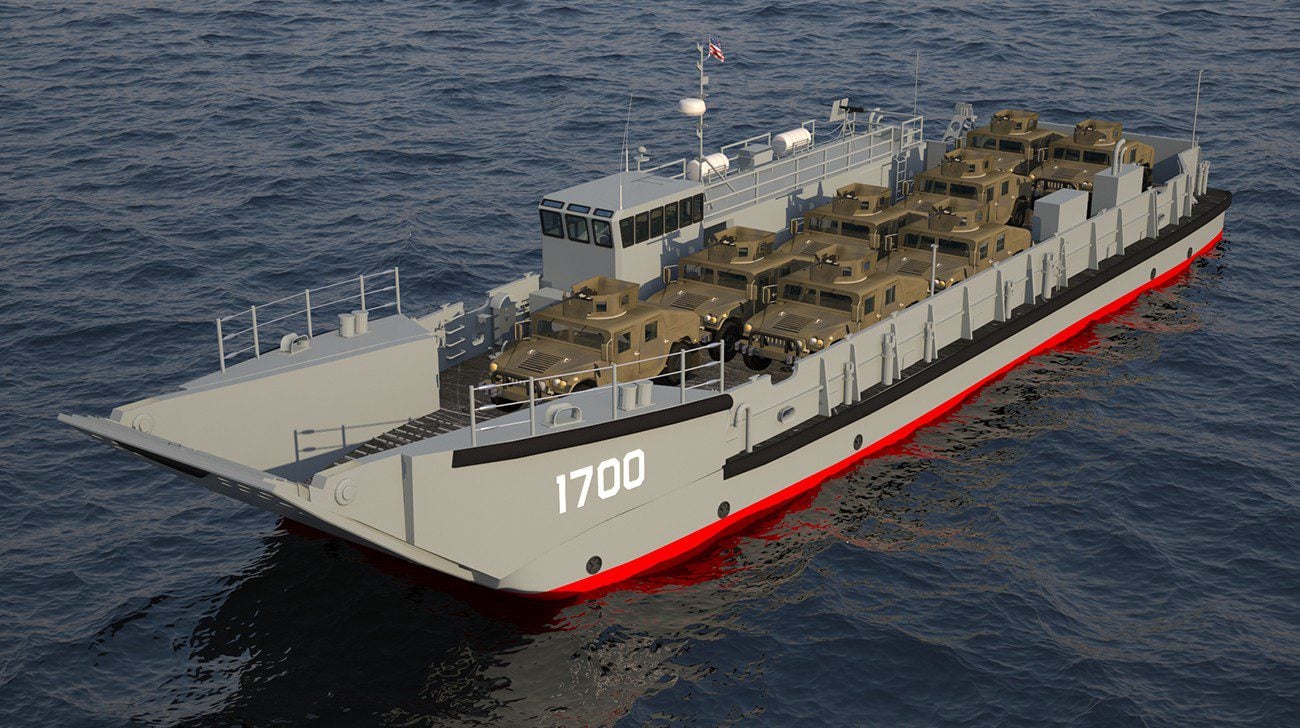
Landing Craft Utility vessels perform one of the Navy and Marine Corps’ most basic but important jobs: moving heavy equipment, vehicles, supplies and personnel between amphibious ships and shore.
Unlike higher-speed air-cushion landing craft, LCUs are conventional displacement vessels designed to carry large payloads over longer distances.
The Navy’s new LCU 1700 class is intended to replace the aging LCU 1610 fleet. The approximately 139-foot vessels are designed to carry up to 170 short tons of cargo — roughly 152 long tons — including tanks and other heavy military equipment.
The craft feature a bow ramp and stern gate that allow vehicles and cargo to move through the vessel during loading and unloading. Navy specifications call for a range of about 1,200 nautical miles at 8 knots, giving the vessels the ability to operate independently as well as from amphibious ships.
The Navy has described LCUs as heavy-lift connectors capable of supporting amphibious operations as well as humanitarian assistance, disaster response, port-clearing and other missions.
Their role is becoming increasingly important as the Navy and Marine Corps rethink how forces, fuel, weapons and equipment would be moved around dispersed operating areas in a contested maritime environment.
For Master Boat, the contract also adds another defense program to a Gulf Coast shipbuilding sector already handling a growing share of U.S. Navy and Coast Guard work.
All three vessels, and the optional fourth if exercised, will be built at Master Boat Builders’ Coden shipyard.

 Join The Club