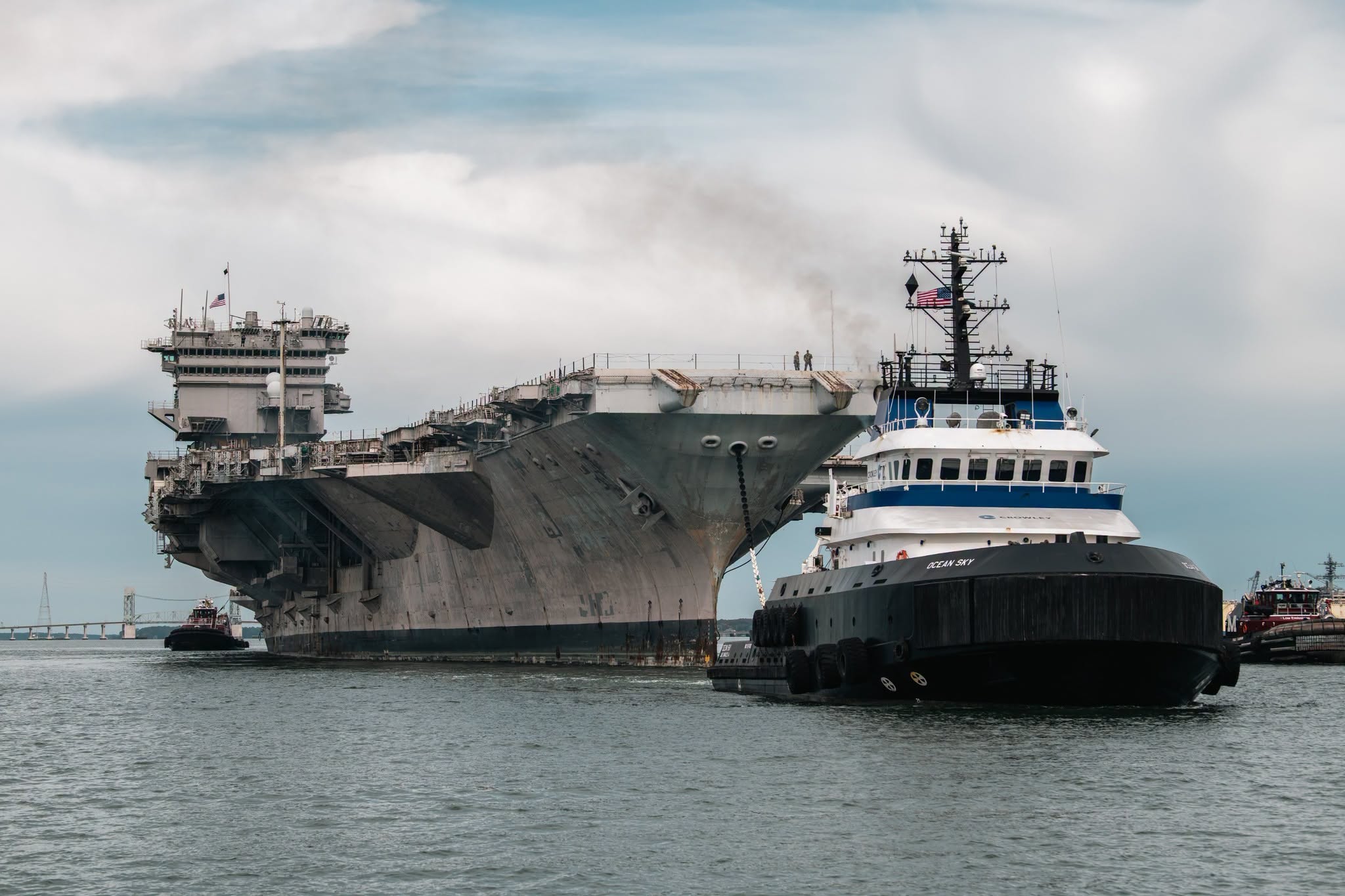
The former USS Enterprise (CVN 65), the world’s first nuclear-powered aircraft carrier, departed Newport News Shipbuilding in Virginia under tow on Monday, November 2, beginning its final journey to Mobile, Alabama, where the historic warship will be dismantled.
The departure marks another milestone in the retirement of one of the U.S. Navy’s most storied vessels, nearly 14 years after the carrier completed its final deployment and almost a decade after its formal decommissioning.
Known as the “Big E,” Enterprise spent more than five decades in service, becoming a symbol of American naval power and pioneering the use of nuclear propulsion aboard aircraft carriers.
The ship is headed to a commercial dismantling facility in Mobile, where NorthStar Maritime Dismantlement Services will carry out the work under a $418.5 million Navy contract awarded in July 2026. The project includes dismantling, recycling and disposal of the entire vessel, including its eight defueled nuclear reactor plants.
The work is expected to be completed by September 2030.
The move follows the Navy’s 2023 decision to pursue commercial dismantling rather than relying on public shipyards. The Navy determined that the commercial approach could reduce disposal costs by approximately half compared with other alternatives, shorten the dismantling timeline and free up public shipyard capacity for fleet maintenance.
The project will also serve as a test case for the eventual disposal of the Navy’s Nimitz-class nuclear-powered aircraft carriers.
NorthStar has partnered with Modern American Recycling and Radiological Services, part of Modern American Recycling Services, to perform the dismantling work in Mobile. Materials recovered from the ship will be recycled where possible, while low-level radioactive waste and other hazardous materials will be transported to authorized disposal facilities.
A Historic Carrier’s Final Chapter
Commissioned on November 25, 1961, Enterprise was the first aircraft carrier powered by nuclear reactors and the eighth U.S. Navy vessel to carry the name.
At 1,123 feet long overall, the ship was among the largest warships ever built and was powered by eight nuclear reactors driving four propeller shafts.
Throughout its career, Enterprise participated in some of the most significant U.S. military operations of the past half-century, including the Cuban Missile Crisis, the Vietnam War and combat operations in Afghanistan and Iraq.
In 1964, Enterprise participated in Operation Sea Orbit, joining the nuclear-powered cruiser USS Long Beach and destroyer leader USS Bainbridge in a historic around-the-world voyage without refueling.
By the time it completed its final deployment in 2012, Enterprise had traveled more than one million nautical miles under nuclear power.
The carrier was formally inactivated in December 2012 and decommissioned on February 3, 2017, becoming the first nuclear-powered aircraft carrier in U.S. Navy history to undergo the process.
Its nuclear fuel was removed at Newport News Shipbuilding, where the vessel remained while the Navy developed its disposal plan.
“Enterprise will always be remembered for her proud legacy of service, a legacy made possible by the Sailors and support personnel whose dedication kept her mission-ready,” said Kevin Cormier, Deputy Portfolio Acquisition Executive Maritime for Aircraft Carriers, in a statement announcing the departure.
“All who served aboard and sustained this historic ship should take pride in the vital role they played in supporting the fleet.”
While the original nuclear-powered Enterprise is headed for dismantling, its name will live on aboard the future USS Enterprise (CVN 80), a Gerald R. Ford-class aircraft carrier currently under construction at Newport News Shipbuilding.

 Join The Club