The U.S. Maritime Administration has issued a new advisory for commercial vessels transiting the Strait of Hormuz and Gulf of Oman following recent Iranian attempts to board and seize a U.S.-flagged tanker in the critical waterway.
The advisory, designated 2026-001, warns that “commercial vessels transiting the Strait of Hormuz and Gulf of Oman have long been at risk of being hailed, queried, boarded, detained, or seized by Iranian forces,” noting that Iranian forces attempted to force commercial vessels into Iranian territorial waters as recently as February 3, 2026.
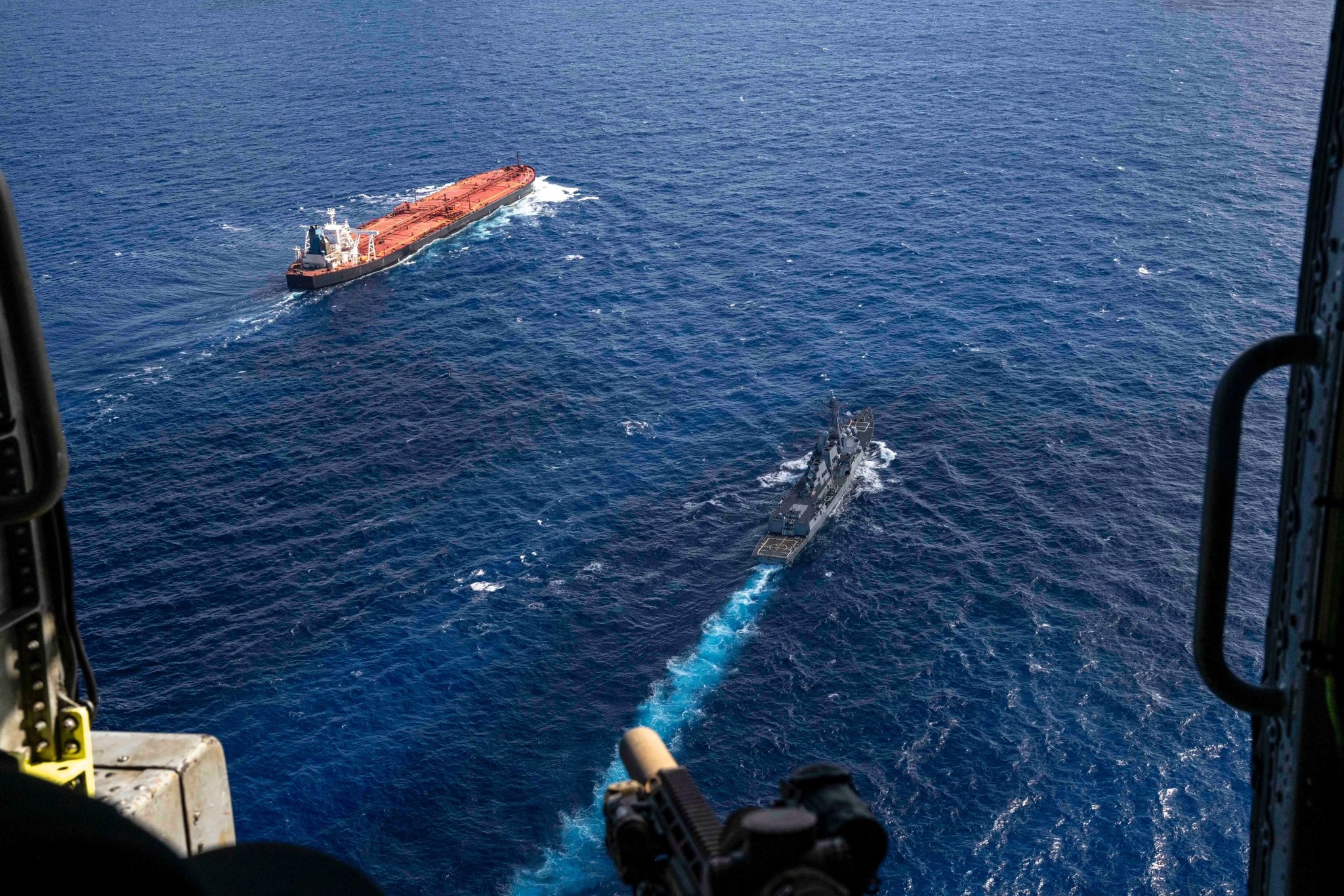
That incident involved the Stena Imperative, a U.S.-flagged product tanker enrolled in the Tanker Security Program. According to U.S. Central Command, two Islamic Revolutionary Guard Corps fast boats and an Iranian Mohajer drone approached the tanker at high speed, ordered it to stop engines, and threatened to board and seize the vessel. The tanker increased speed and continued its transit under escort from the USS McFaul, after which the situation de-escalated.
The Stena Imperative is not a routine commercial tanker. The vessel is part of a fleet of 10 U.S.-flagged product tankers designated to support Department of Defense fuel requirements during contingencies. In August 2025, the ship’s crew earned certification from Military Sealift Command enabling the tanker to conduct complex underway ship-to-ship refueling operations for U.S. naval forces.
The confrontation occurred just hours after a U.S. Navy F-35C fighter jet shot down an Iranian Shahed drone that had approached the USS Abraham Lincoln aircraft carrier group in the Arabian Sea “with unclear intent,” according to U.S. officials.
The new MARAD guidance instructs U.S.-flagged vessel masters to decline permission to board if Iranian forces make such requests, “if the safety of the ship and crew would not be compromised,” noting that vessels should affirm they are “proceeding in accordance with international law, as reflected in the Law of the Sea Convention.”However, if Iranian forces do board a vessel, crews should not forcibly resist the boarding party.
The advisory recommends that U.S.-flagged commercial vessels remain as far as possible from Iran’s territorial sea without compromising navigational safety, and when transiting eastbound in the Strait of Hormuz, vessels should transit close to Oman’s territorial sea.
Vessels are also advised to keep their Automatic Identification System transponders on unless specifically advised otherwise by U.S. Naval Forces Central Command. Some vessel seizures by Iranian forces were claimed to be a result of vessels not transmitting on AIS.
The incident comes as the United States and Iran have restarted indirect nuclear talks in Oman, even as Washington has imposed new sanctions on Iran’s shadow fleet.President Donald Trump has warned publicly that “bad things would probably happen” if talks fail, while Tehran has demanded limits on the U.S. military presence near its waters.
The Strait of Hormuz remains one of the world’s most critical maritime chokepoints, carrying roughly one-fifth of global oil supply.The new advisory will remain in effect until August 8, 2026.
U.S.-flagged vessels operating in the region are advised to coordinate voyage planning with NAVCENT Naval Cooperation and Guidance for Shipping, which maintains a 24/7 watch with current information on maritime security threats in the region.
Editorial Standards · Corrections · About gCaptain

 Join The Club