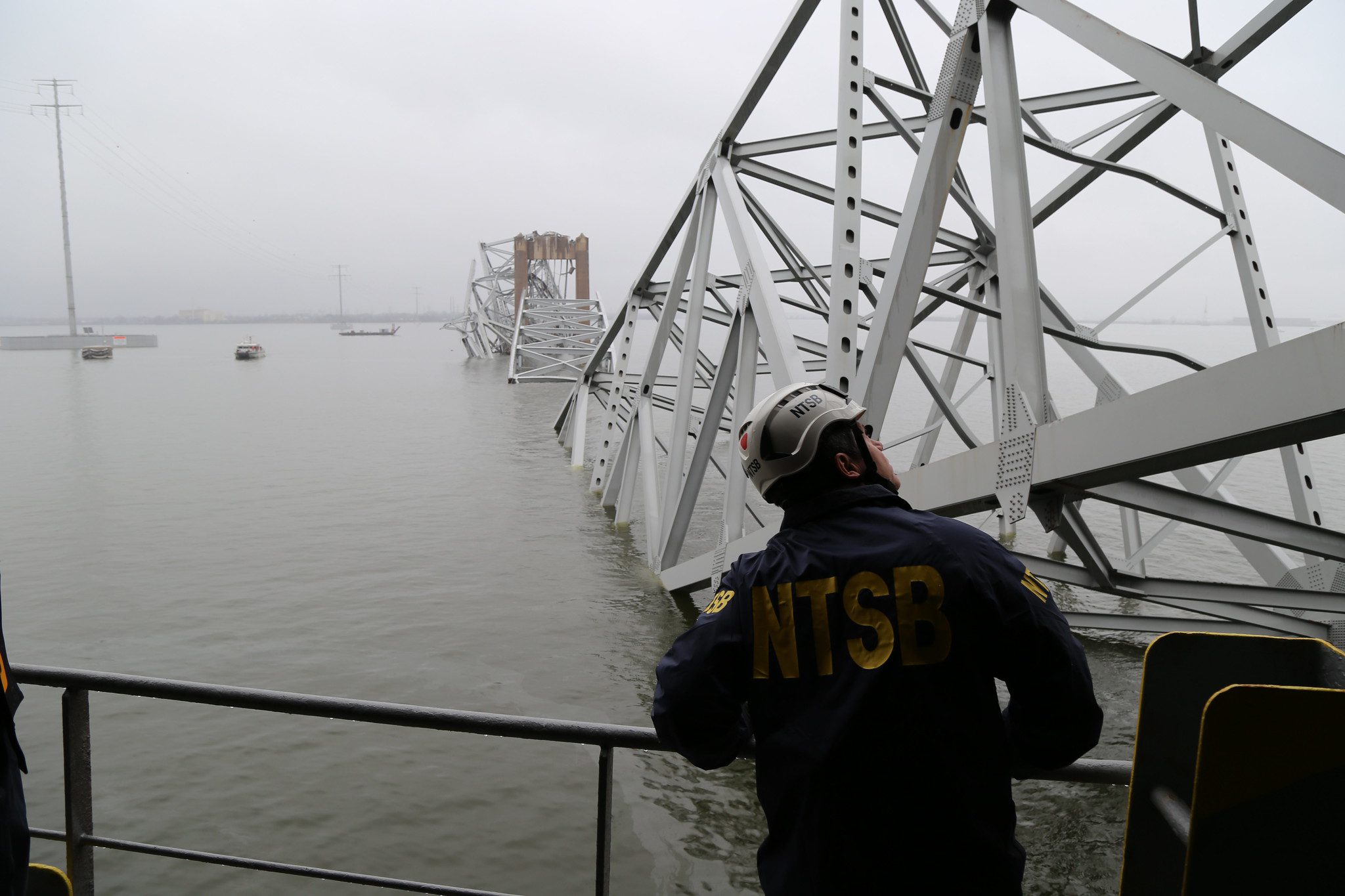
The National Transportation Safety Board has concluded that the March 2024 collapse of Baltimore’s Francis Scott Key Bridge—which killed six highway workers and severed a vital transportation artery—stemmed from an improperly installed wire label that triggered cascading electrical failures aboard the containership Dali as it approached the span.
The agency’s long-awaited final report, released this week following a November board meeting, pinpoints the accident’s root cause with precision. According to investigators, “the probable cause of the contact of the containership Dali with the Francis Scott Key Bridge was a loss of electrical power (blackout), due to a loose signal wire connection to a terminal block stemming from the improper installation of wire-label banding, resulting in the vessel’s loss of propulsion and steering close to the bridge.”
The 984-foot Singapore-flagged vessel struck Pier 17, the southern support for the bridge’s central span, at approximately 1:29 a.m. on March 26, 2024, after experiencing complete losses of electrical power, propulsion, and steering. The impact brought down a substantial portion of the structure onto the ship’s bow and forward container bays.
Damage to the Dali exceeded $18 million, while bridge replacement costs are now estimated between $4.3 billion and $5.2 billion, with the new span not expected to open until late 2030.The human toll was severe: six members of a seven-person road maintenance crew died in the collapse, while one worker survived with serious injuries and an inspector escaped unharmed.
The NTSB found that “contributing to the crew’s inability to recover propulsion from the loss of electrical power was the limited time available due to the Dali’s proximity to the bridge.” But investigators also faulted infrastructure protection gaps, noting that “contributing to the collapse of the Key Bridge and the loss of life was the lack of countermeasures to reduce the bridge’s vulnerability to collapse due to impact by ocean-going vessels, which could have been implemented if a vulnerability assessment had been conducted by the Maryland Transportation Authority.”
Communication breakdowns exacerbated the tragedy. The agency determined that “also contributing to the loss of life was the lack of effective and immediate communications to notify the highway workers to evacuate the bridge.”
In response, the NTSB issued sweeping safety recommendations, including four designated as urgent. The agency called on the Federal Highway Administration, U.S. Coast Guard, and Army Corps of Engineers to establish an interdisciplinary team to help bridge owners evaluate and reduce vessel collision risks.More than two dozen state transportation departments and bridge authorities were directed to calculate collapse probabilities for specific at-risk bridges and develop comprehensive risk reduction plans if those calculations exceed safety thresholds.
The recommendations extend beyond infrastructure. The Coast Guard was urged to study redundant propulsion systems for large single-engine cargo vessels operating in restricted waters and to propose revisions to international safety management requirements. The agency also wants improved voyage data recorder standards, including the capture of communications and data during blackout conditions.
For vessel operator Synergy Marine, the NTSB recommended implementing infrared thermal imaging to detect faulty electrical connections and ensuring proper configuration of emergency systems to prevent automatic shutdowns during critical maneuvers.
The bridge collapse has forced more than 34,000 vehicles daily—including 10 percent trucks and all hazardous materials carriers prohibited from using Baltimore’s tunnels—onto longer alternate routes, creating lasting economic disruption for the Port of Baltimore and surrounding region.
The incident serves as a stark reminder of how small mechanical failures can cascade into catastrophic consequences when critical infrastructure lacks adequate protection and emergency response protocols fall short.
The final report can be found on the NTSB website.
Editorial Standards · Corrections · About gCaptain

 Join The Club