Norwegian cruise operator Hurtigruten has announced new details on its ambitious plans for a zero-emission cruise ship intended to operate along the rugged Norwegian coast.
The groundbreaking initiative, known as “Sea Zero,” aims to develop the world’s most energy-efficient cruise ship. The project was unveiled in March 2022 and has since made significant progress, with early concept plans now revealed publicly.
The initial phase of the Sea Zero project included identifying potential technologies for zero-emission cruise operations. After a year of intensive research, Hurtigruten Norway presented its findings alongside a consortium of 12 maritime partners and the renowned research institute SINTEF.
“When we introduced the ‘Sea Zero’ project over a year ago, we faced the challenge of not knowing which technologies would be available by 2030,” said Hedda Felin, CEO of Hurtigruten Norway. “Our task was to pave the way for new innovations and enhance existing ones to align with our sustainability objectives.”
Hurtigruten Norway leveraged its expertise in operating along the Norwegian coast in the design of the purpose-built vessel.
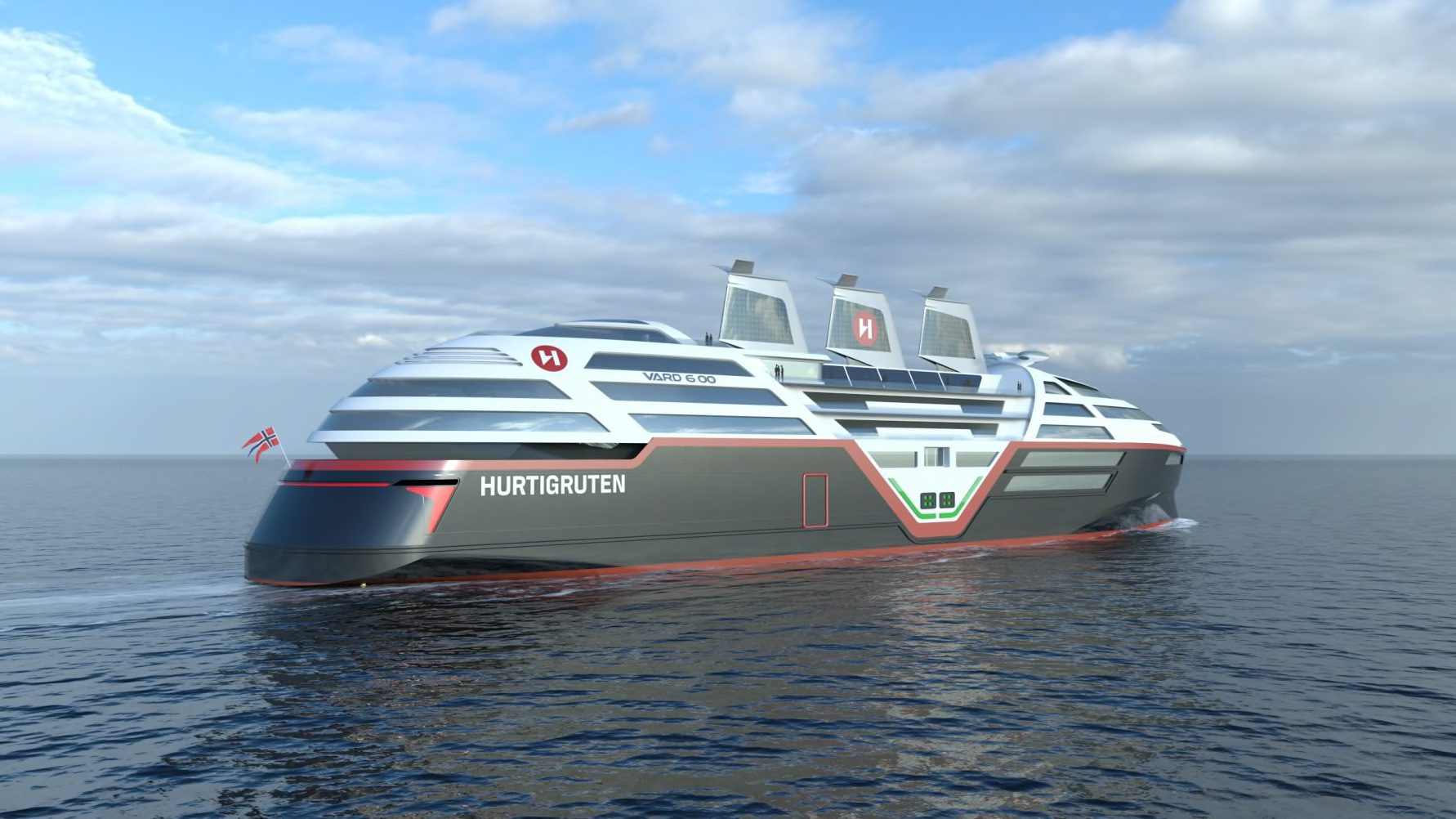
Illustration courtesy VARD/Hurtigruten
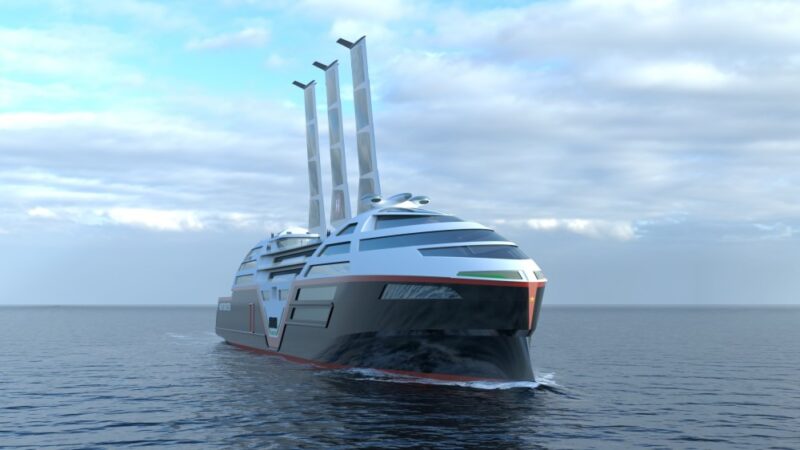
The future vessel is planned to be fully electric, with batteries that can be charged from shore, and will feature wind-assisted propulsion. It is expected to feature a number of cruise sector “firsts”, including retractable sails equipped with solar panels, contra-rotating propellers, and multiple retractable thrusters. Additional technologies include air lubrication, advanced hull coating, and proactive hull cleaning.
The three autonomous wing sails will come with 1500m² of solar panels and a total wind surface of 750m². They will also be retractable, reaching a maximum height of 50 meters when fully extended.
The cruise line plans to use artificial intelligence to collect data and learn the most efficient docking and undocking methods for each of the ports it visits, improving in-port operations, especially in challenging weather conditions.
“We are developing the concept for a highly innovative cruise design and researching the optimal design methods suitable for zero-emission ships,” said Henrik Burvang, Research and Innovation Manager at VARD, which is responsible for the design of the concept. “The streamlined shape, along with innovative hull and propulsion solutions, not only reduces energy demand but also enhances passenger comfort. In the process, we are developing new design tools and exploring new technologies for energy efficiency.”
Guests on board the zero-emission ship will play an active role in minimizing energy consumption through a mobile app that will control cabin ventilation and monitor guests’ water and energy usage.
The new zero-emission ship will have a length of 135 meters (443 feet), featuring 270 cabins capable of accommodating 500 guests and 99 crew members. The ship will also include a large cargo hold for transporting goods and cars.
Hurtigruten is aiming to have an initial ship ready by 2030 and plans to convert its entire fleet into zero-emission vessels.
The Sea Zero project has now entered a two-year phase during which the proposed technologies will undergo further testing and development in pursuit of the final zero-emission ship. The current research and development phase focuses on battery production, propulsion technology, hull design, and sustainable practices that minimize energy use. Developing new technologies for onboard hotel operations, which typically account for up to 50% of a ship’s total energy consumption, is another crucial aspect of the project. The goal is to achieve a 50% energy reduction compared to Hurtigruten Norway’s current ships.
While working on their first zero-emission ship, Hurtigruten Norway is also implementing extensive environmental upgrades on its existing fleet. Two out of their seven ships have already been converted to battery-hybrid-powered vessels, and a third conversion is scheduled for this fall. The remaining five ships are being equipped with various technologies to reduce CO² emissions by 25% and nitrogen oxide (NOx) emissions by 80%. In 2019, Hurtigruten Expeditions, a sister company, introduced the world’s first battery-hybrid-powered ship, MS Roald Amundsen. Currently, three out of their seven-ship fleet are battery-hybrid ships.
The Getting to Zero Coalition is calling on International Maritime Organization member states to preserve a strong and predictable Net-Zero Framework as negotiations over shipping’s global emissions rules head into...
The International Maritime Organization’s Net-Zero Framework emerged largely intact from another round of negotiations this week, despite a push by the United States and several oil-producing countries to weaken or...
September 4, 2026
Total Views: 952
Get The Industry’s Go-To News
Subscribe to gCaptain Daily and stay informed with the latest global maritime and offshore news
— just like 107,419 professionals
Secure Your Spot
on the gCaptain Crew
Stay informed with the latest maritime and offshore news, delivered daily straight to your inbox
— trusted by our 107,419 members
Your Gateway to the Maritime World!
Essential news coupled with the finest maritime content sourced from across the globe.

 Join The Club