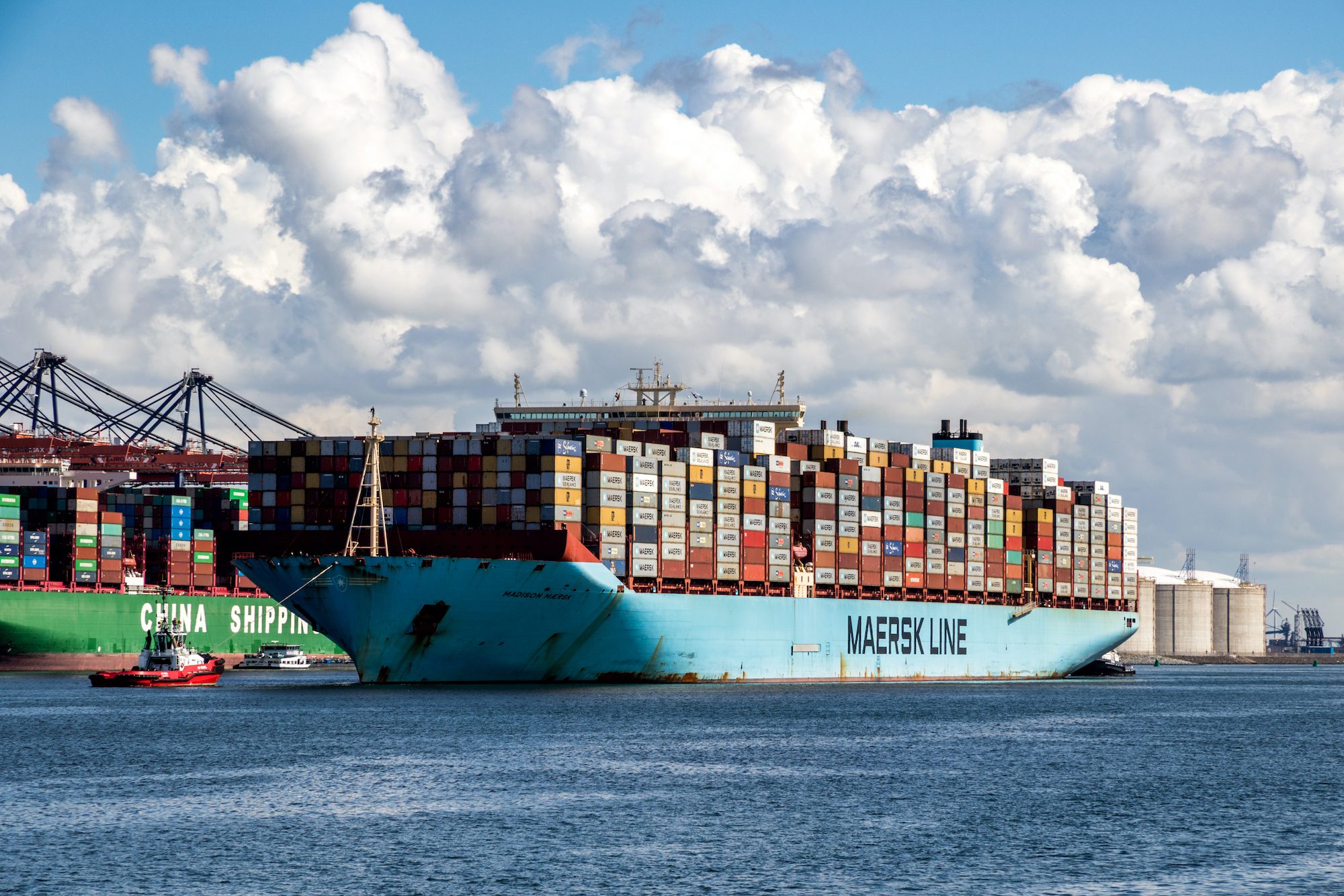
The disruption in the Strait of Hormuz is proving both costly and profitable for container shipping, with Gemini Cooperation partners Maersk and Hapag-Lloyd reporting sharply higher operating costs alongside stronger freight rates and demand.
Maersk on Thursday raised its full-year earnings guidance after a strong second quarter, while Hapag-Lloyd reported an earnings recovery from a difficult start to the year despite absorbing around $600 million in additional costs related to the Middle East conflict.
The results offer an interesting look at how the Hormuz disruption is playing out for two carriers operating within the same network. Rerouting ships and cargo is expensive, but the resulting congestion and capacity constraints are also helping support freight rates.
For Maersk, the balance was decidedly positive.
The Danish shipping group reported second-quarter revenue of $15.8 billion, up 20% from a year earlier, while EBITDA rose to $3 billion and EBIT nearly doubled to $1.6 billion. Ocean was the biggest contributor to the improvement, adding $2 billion in revenue compared with the same period last year.
Maersk said cargo bound for the Gulf was rerouted through alternative ports and inland transportation routes as traffic through the Strait of Hormuz was disrupted. Vessel capacity affected by the changes was quickly redeployed to growing trades elsewhere.
At the same time, spot rates climbed as strong demand collided with increasingly unbalanced trade flows, tight capacity and congestion in Europe, the Middle East, South America and West Africa.
Maersk’s Ocean volumes increased 4.1% during the quarter and average loaded freight rates jumped 22%, while vessel utilization remained high at 96%. Ocean EBIT reached $935 million, compared with $229 million a year earlier and a $192 million loss in the first quarter.
The disruption also played into Maersk’s push beyond traditional ocean shipping.
Revenue in Logistics & Services increased 15% year over year, with Maersk pointing specifically to landbridge solutions connecting ports across the Gulf as a source of growth. Segment EBIT rose to $217 million from $175 million a year earlier.
Hapag-Lloyd, Maersk’s partner in the Gemini Cooperation, put a much clearer price tag on the downside.
The German carrier said the Middle East conflict added roughly $600 million in costs during the second quarter, including higher spending on bunker fuel, insurance, storage, service rerouting and inland transportation.
Despite those headwinds, Hapag-Lloyd said volumes and spot rates improved significantly from the first quarter, helped by strong exports from Asia and better U.S. demand.
Hapag-Lloyd reported second-quarter EBITDA of $829 million, slightly above the same period last year, while EBIT slipped to $176 million from $189 million. Group profit fell to $83 million from $306 million.
In Liner Shipping, revenue increased to $5.7 billion as transport volumes rose to 3.5 million TEU from 3.4 million TEU. The average freight rate increased 9% year over year to $1,475 per TEU. Liner EBITDA came in at $773 million, while EBIT declined to $153 million from $167 million.
The roughly $600 million Middle East cost hit was more than three times Hapag-Lloyd’s reported group EBIT for the quarter, underscoring just how expensive the disruption has become even as market conditions improve.
Still, Hapag-Lloyd said the Gemini network has held up well through the turmoil.
“The second quarter was better than the first, driven by significantly higher spot rates and robust demand,” Hapag-Lloyd CEO Rolf Habben Jansen said. “Our Gemini network remained resilient and continued to outperform the market, setting the industry benchmark for schedule reliability.”
The results show the unusual economics of the Hormuz disruption. Carriers are spending heavily to reroute ships and cargo, while those same disruptions are tightening effective capacity and helping lift freight rates.
There is also a notable difference in how the effects are showing up across the two Gemini partners.
Hapag-Lloyd lists inland transportation and service rerouting among the costs associated with the Hormuz blockage. Maersk, with its much larger logistics operation, says landbridge solutions around the Gulf are contributing to growth in its Logistics & Services business. The companies have different business structures, making a direct comparison difficult, but the contrast highlights the potential value of Maersk’s long-running strategy of expanding beyond port-to-port container shipping.
Maersk CEO Vincent Clerc described the quarter as another example of a “new era of heightened volatility,” with trade imbalances putting increasing pressure on ports and inland transportation networks.
“From ports to inland transportation, we are seeing increased congestion and disruption across multiple geographies,” Clerc said. “Our global team’s ability to capture opportunities in these difficult markets has enabled us to deliver significant volume and earnings growth across our businesses.”
Maersk raised its full-year underlying EBITDA guidance to $10.5 billion to $12.5 billion from $8 billion to $10 billion, while underlying EBIT guidance was increased to $4.5 billion to $6.5 billion from $2 billion to $4 billion. The company also now expects positive free cash flow.
Hapag-Lloyd raised its own outlook in July following the improvement in market conditions. The company expects full-year EBITDA of $2.7 billion to $3.7 billion and EBIT of $100 million to $1.1 billion, while warning that volatile freight rates and the Middle East conflict continue to create considerable uncertainty.
For both Gemini partners, the second quarter shows that the Hormuz crisis is cutting both ways: adding hundreds of millions of dollars in costs while helping create the tighter shipping market that is supporting their recovery.

 Join The Club