South Korea’s push to help rebuild the American shipbuilding industry is moving beyond investments in existing shipyards and toward the development of entirely new production capacity.
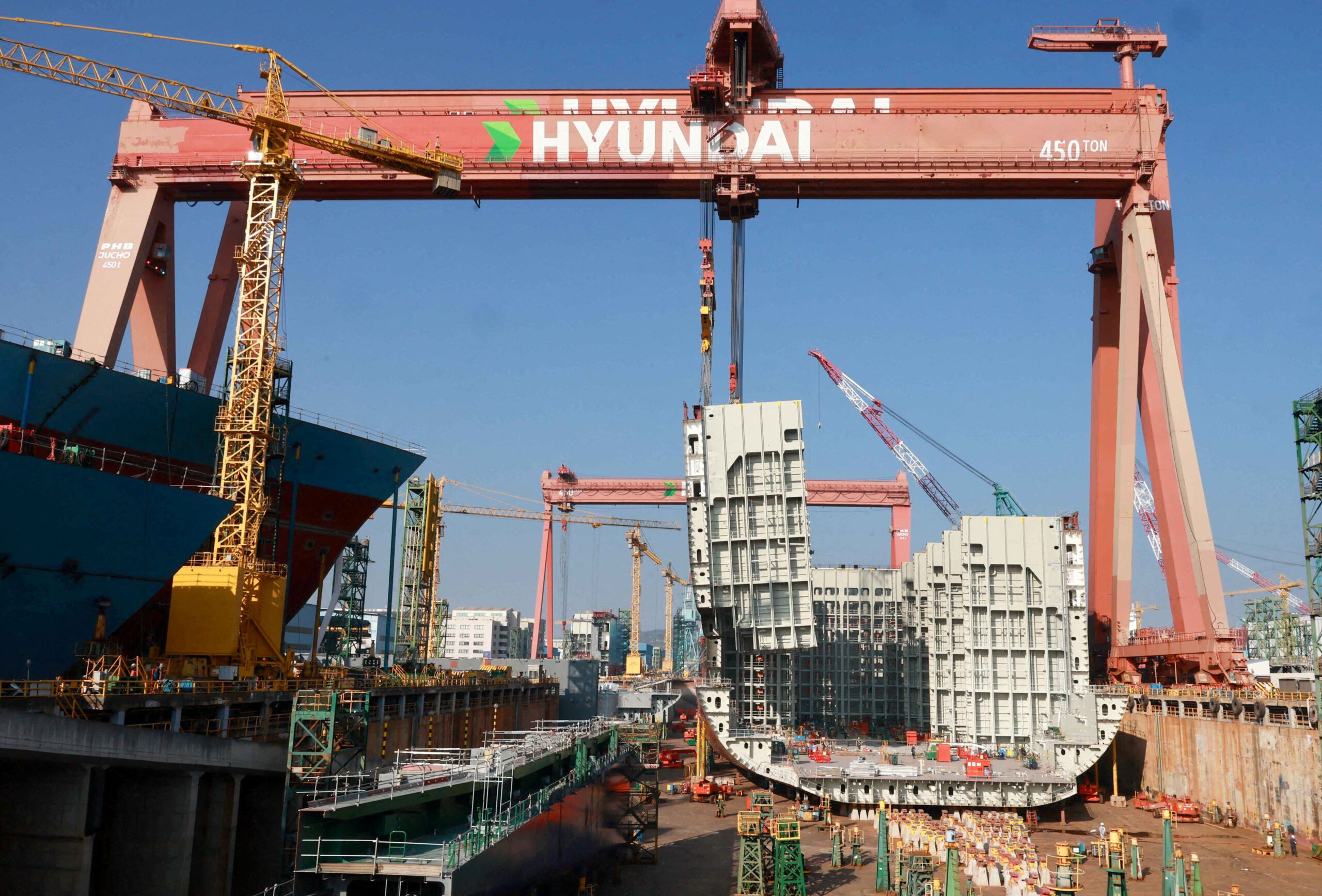
The latest example comes from HD Hyundai, one of the world’s largest shipbuilders, which has announced plans to develop a new U.S. shipyard in partnership with American engineering and construction giant Kiewit.
The proposed joint venture, HD Kiewit Shipbuilding, would combine South Korean shipbuilding technology with American engineering, fabrication and construction expertise. The companies are targeting construction beginning in 2027, with full-scale operations by 2029 and the potential to create up to 3,000 jobs.
But the significance extends beyond another planned shipyard. The project represents a potentially important step in South Korea’s $150 billion commitment to rebuilding U.S. shipbuilding capacity under the Make American Shipbuilding Great Again, or MASGA, initiative.
It also highlights two different approaches emerging among South Korea’s shipbuilding giants: Hanwha is investing heavily in expanding an existing American shipyard, while HD Hyundai is pursuing an entirely new production facility built around modern manufacturing technology.
Building New Capacity
HD Hyundai and Kiewit first announced a strategic partnership in July, laying the groundwork for cooperation on U.S. shipbuilding projects, including the fabrication of ship blocks and modules.
The latest agreement takes that relationship considerably further. Rather than simply supplying technology or helping modernize existing facilities, the companies envision a purpose-built shipyard on an existing industrial site with deepwater access to the Gulf of Mexico.
Although the companies have not formally identified the location, Kiewit already operates a major offshore fabrication complex in Ingleside, Texas, near Corpus Christi, where it has spent decades constructing large offshore energy structures.
The facility has the waterfront access, heavy industrial fabrication experience and infrastructure needed for major marine construction projects. Kiewit has previously fabricated enormous offshore production modules there, including the 35,000-ton topsides for Shell’s Appomattox platform.
The companies signed their initial shipbuilding partnership agreement at Kiewit’s Ingleside headquarters in July.
For HD Hyundai, the attraction is clear. Kiewit brings established U.S. industrial capabilities, while Hyundai brings the vessel design expertise, production systems and shipyard management experience developed through decades of building ships at scale in South Korea.
The companies intend to introduce HD Hyundai’s “Future of Shipyard” model, which incorporates digital twins, automated production systems, robotic welding and other advanced manufacturing technologies intended to improve productivity and reduce costs.
That approach could be particularly important in the United States, where labor shortages, aging infrastructure and production inefficiencies have contributed to some of the world’s highest shipbuilding costs.
The venture is initially targeting U.S. Navy auxiliary vessels, commercial ships and the fabrication of ship blocks and modules for other American shipbuilders.
The latter could prove especially important. Supplying prefabricated sections to existing yards would allow the venture to contribute to U.S. shipbuilding programs without necessarily waiting for an entire vessel construction program of its own.
South Korea’s Expanding American Footprint
The HD Hyundai–Kiewit project is the latest in a series of increasingly ambitious moves by South Korean shipbuilders to establish a permanent presence in the United States.
Hanwha got an early start with its $100 million acquisition of Philly Shipyard in 2024, becoming the first major South Korean shipbuilder to take ownership of an American shipyard.
In August 2025, Hanwha unveiled a $5 billion infrastructure plan aimed at transforming the Philadelphia facility into a high-volume production center.
The plan includes additional docks, new quays, expanded block assembly capacity and advanced manufacturing technology. Hanwha has set an ambitious goal of increasing annual production from fewer than two vessels to as many as 20.
The company has also begun building a commercial order pipeline, including plans for 10 Jones Act-compliant product tankers and LNG carriers, while pursuing opportunities in U.S. naval construction.
HD Hyundai, meanwhile, has been building its own network of American partnerships.
In July, it signed an agreement with Fraser Industries to explore shipyard modernization, including integrated design, production and management systems.
Other South Korean shipbuilders are pursuing similar arrangements. Samsung Heavy Industries has established partnerships involving advanced shipbuilding technology, automated production and workforce training, while Hanwha Ocean has expanded its cooperation with U.S. defense and engineering companies.
Those agreements gained additional momentum in July with the launch of the Korea–U.S. Shipbuilding Partnership Center in Washington, D.C.
The center was established to coordinate investment, technology transfer, workforce development and industrial cooperation under the $150 billion MASGA initiative, which emerged from the broader U.S.–South Korea trade agreement reached in 2025.
Its opening was accompanied by 15 agreements involving shipbuilders, technology companies, research institutions and other organizations from both countries.
The proposed Hyundai–Kiewit yard offers one of the clearest examples yet of how that cooperation could translate into new industrial capacity.
The Challenge of Competing With Asia
The investments are arriving at a time when the gap between American and Asian shipbuilding capacity remains enormous.
According to new BIMCO analysis, Chinese shipyards now control 64% of the global shipbuilding order book, compared with 19% for South Korea and 6% for Japan.
China also secured 74% of the compensated gross tonnage contracted worldwide over the past year, further strengthening its dominance across major commercial vessel sectors.
The figures illustrate the scale of the challenge facing Washington as it attempts to restore domestic shipbuilding capacity after decades of decline.
The United States is not starting from the same industrial position as its Asian competitors. South Korean and Chinese shipyards benefit from mature supplier networks, experienced workforces, established production systems and the economies of scale that come from building large numbers of ships.
Rebuilding those capabilities in the United States will require more than new docks and modern equipment.
An April report from the U.S. Government Accountability Office found that American Navy and Coast Guard shipbuilding programs have consistently suffered from cost overruns and delivery delays, with workforce shortages and infrastructure constraints among the major contributing factors.
The report also warned that efforts to expand naval and commercial shipbuilding could increase competition for many of the same skilled workers and suppliers.
That makes the involvement of established industrial contractors such as Kiewit particularly noteworthy.
Unlike a traditional shipbuilder entering a new market, Kiewit already has an American workforce, complex fabrication experience and relationships across major industrial supply chains.
Combined with HD Hyundai’s advanced production methods, those capabilities could offer a more practical starting point for expanding American shipbuilding than attempting to create an entirely new industrial operation from scratch.
From Investment Pledges to Actual Ships
Still, significant questions remain about the proposed venture.
HD Hyundai and Kiewit have not disclosed the project’s expected investment cost, identified the final shipyard location, announced construction contracts or provided production capacity targets.
The proposed 2029 opening also leaves a relatively narrow window to develop a facility capable of undertaking complex commercial and naval construction.
And while the companies have identified naval auxiliaries and commercial vessels as potential markets, neither has announced specific vessel orders for the new yard.
That distinction matters. New shipbuilding capacity will only be sustainable if it is supported by a dependable pipeline of orders, a competitive cost structure and a workforce capable of maintaining production schedules.
For Washington, the challenge is to ensure that the growing number of international partnerships becomes a durable American industrial base rather than a collection of high-profile investment announcements.
For South Korea, the opportunity is substantial. American shipbuilding ambitions could create a long-term market for Korean technology, engineering expertise and industrial investment, while helping strengthen ties between two major maritime allies.
The proposed HD Hyundai–Kiewit venture is another indication that the relationship is moving from government-level commitments toward concrete industrial projects.
Whether those projects can deliver ships competitively, on schedule and at the scale Washington hopes to achieve will ultimately determine how much of America’s shipbuilding revival becomes reality.

 Join The Club