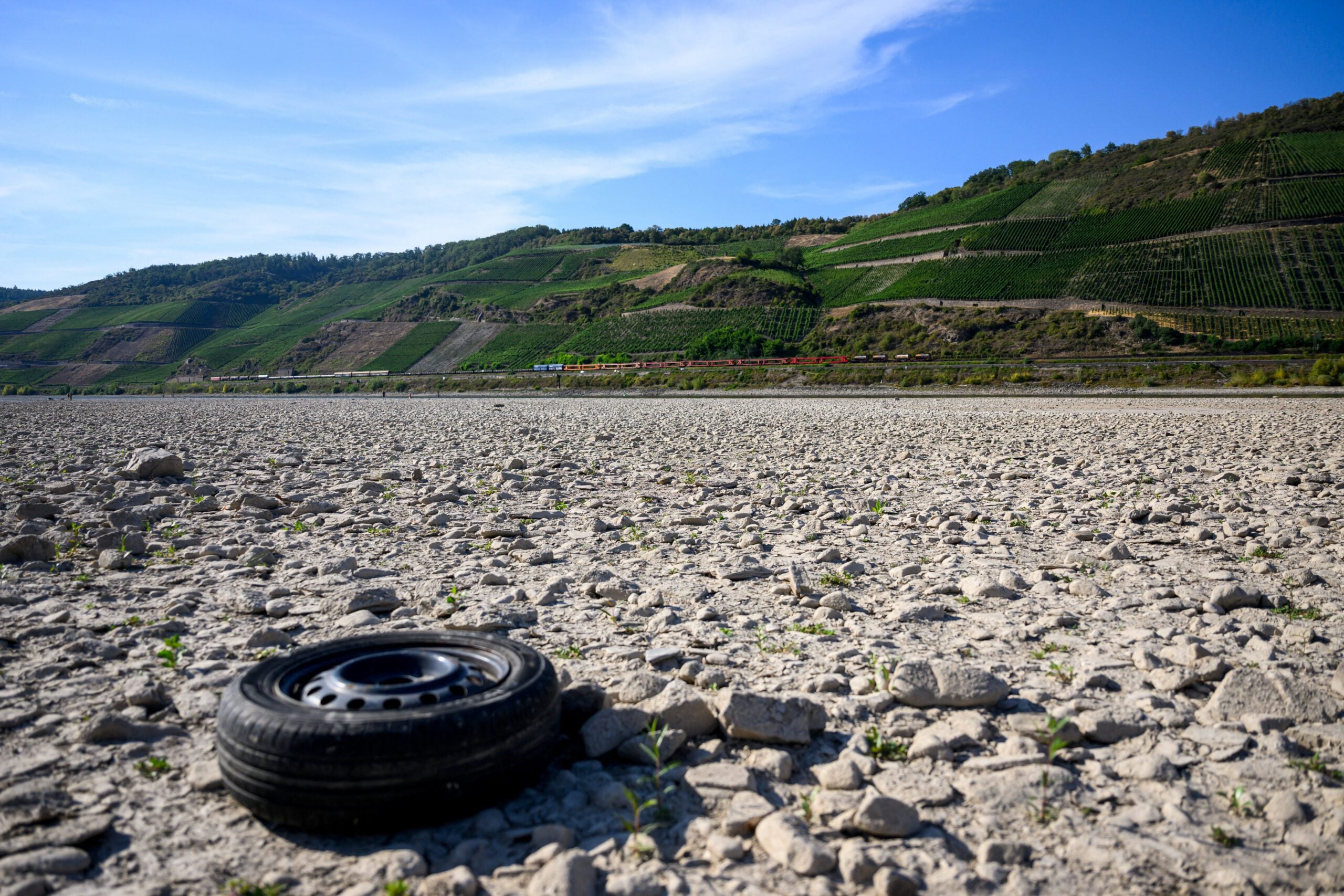
(Bloomberg) — Germany’s economy is being threatened by a chronic lack of water in the Rhine, according to Transport Minister Steffen Bilger.
Speaking just days after the country’s key logistics artery saw levels drop to record lows, Bilger highlighted the “very challenging situation” and warned that the difficulty of using the river will shift more traffic onto land routes.
“Every extra centimeter of water means more shipments and less cargo on rail and roads,” he said after a meeting with industry representatives in Bonn, which sits on the river.
The Rhine connects the Port of Rotterdam — Europe’s busiest for seaborne trade — with three important German industrial hubs: the steel center of Rhine-Ruhr, Rhine-Main encompassing the Frankfurt area, and the Ludwigshafen chemical complex.
A month of low water levels can reduce German production by as much as 1%, equivalent to a roughly 0.25% hit to gross domestic product, according to Bloomberg Economics.
“We have a very challenging situation and it’s very challenging for our economy,” Bilger said.
Speaking alongside the minister, Steffen Bauer, the chief executive of the port of Cologne, which is just north of Bonn, warned that officials need to be prepared for this becoming a regular occurrence.
“Such a situation will be more frequent in the future and we need to learn how to handle it,” he said, adding that things are still manageable for now.
The issue of low river levels offers an early test for Germany’s newly appointed transport minister.
Following the severe drought of 2018, officials adopted an action plan to improve the resilience of Rhine shipping.
While forecasting has improved, progress on planned infrastructure measures has stalled and “things have gone a bit dormant again,” North Rhine-Westphalia Transport Minister Oliver Krischer told German radio earlier on Thursday.
“Unfortunately, we’ll just have to accept for now that supply chains are under strain,” said Marc Schattenberg, an economist at Deutsche Bank.
He’s skeptical of deeper dredging to aid shipping channels, warning it could speed river flows and create environmental problems. While some cargo can shift to rail or road, transport costs often rise significantly.
Still, German industry has built larger inventories of critical raw materials and expanded logistics options since the last major drought, leaving it better prepared this time, according to Bloomberg Economics.
Bilger agrees, telling reporters that “we stand here in a better situation than a few years ago.”
He was named transport minister just last month as part of a cabinet reshuffle that drew widespread criticism. Previously a senior lawmaker in Chancellor Friedrich Merz’s Christian Democratic Union party, he wasn’t the first choice for the post.
© 2026 Bloomberg L.P.

 Join The Club