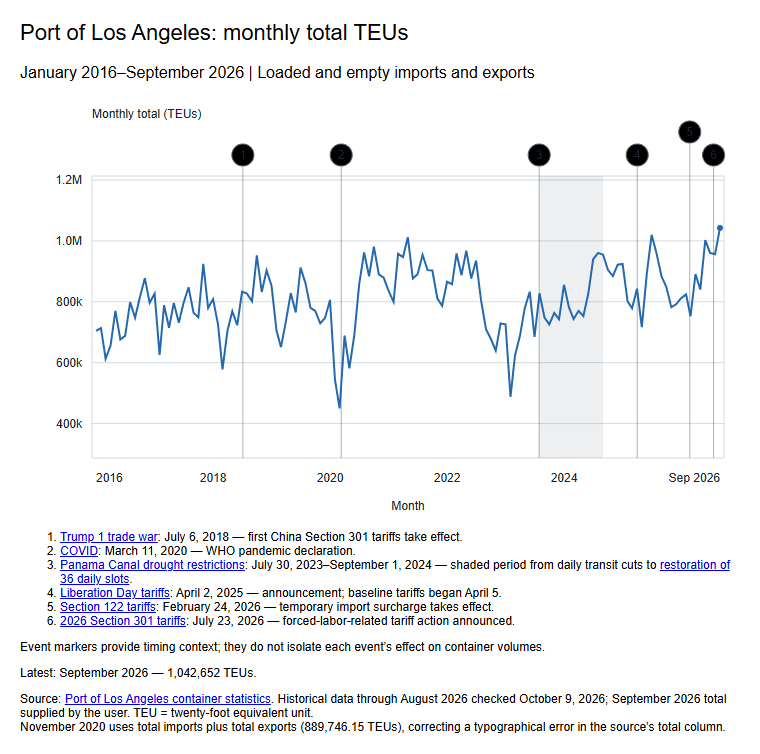
By Lori-Ann LaRocco – The Port of Los Angeles reported its best single month in its history. In a media briefing, port executive director Gene Seroka announced the port processed 1,042,652 TEUs, 23k TEUs more than the July 2025 record.
This was the highest volume processed by any port in the Western Hemisphere. It was also the 10th time the port moved more than half a million loaded imports in a single month. It is the only U.S. port to have achieved this.
September marks the port’s fourth straight month of historic volumes. The port processed 540k loaded TEUs, which was the best inbound tally ever.
“The strong volume was the major retailers frontloading ahead of tariffs,” said Seroka. “But outbound volumes remain softer than normal, which reflects the ongoing challenges facing American farmers and manufacturers. “
A tealeaf on future demand for Asian products: the amount of empty containers. The port processed 371,000 empty containers- the highest monthly total in port history.
“September puts us on a strong pace as we head into the final quarter of 2026,” said Seroka. “These numbers are extraordinary.”
The strong results buck the trend of an import slowdown reported by Global Port Tracker and the National Retail Federation (NRF) and Hackett Associates.
Seroka said U.S. companies still face short-term supply chain planning challenges.
“Importers are making decisions quickly based on tariffs, costs. cost, and demand,” said Seroka. “For now, purchase orders back in Asia remain solid, and our customers are moving that cargo when the opportunity is there. So, while November and December are a little bit hard to predict, we’ve got solid momentum heading into the final stretch.”
Willy Shih, professor of management practice in Business Administration, Harvard Business School, added, “Companies are moving from purely optimizing for cost to optimizing for options. They are asking, ‘ How do I create more optionality so I can move around? How do I hedge for tariffs or things like that with front-loading rather than maybe relocating? We saw that with all the front-loading over the last year and a half; supply chain diversification is happening, but it’s growing much more slowly than people would like. That type of thing takes time.”
China accounts for about 40% of total cargo volume for the Port of Los Angeles and 60% for the Port of Long Beach.
The U.S.-China trade war has pushed China to diversify manufacturing across Southeast Asia. Both Noel Hacegaba, CEO of the Port of Long Beach, and Seroka use Vietnam as an example of this trade expansion. Both port heads expect another frontloading wave before the U.S.-China trade truce expires on January 10th.
“While China’s share of our business at the port has dropped from 60 to 40%, we’ve continued to grow, as that sourcing starts to really take effect in Southeast Asia,” said Seroka. “When I’m in Hong Kong, Guangzhou, and Shanghai over the next 10 days, one thing I’ll be checking is: what do these purchase orders look like? Is there a rate of cancellation, or are orders steady 90 to 120 days out?”
The upcoming El Nino season is also expected to divert more containers to the Port of Los Angeles as ocean carriers avoid the Panama Canal.
Seroka says they are preparing for another repeat of diversions.
In 2024, during the last historic El Niño, the port moved 10.3 million TEUs, its second-best year in 117 years. Seroka said four key events drove those higher volumes: Red Sea diversions, drought-related capacity cuts at the Panama Canal, uncertainty over the East and Gulf Coast labor dispute, and tariff frontloading in late 2024.
“We are seeing more containers shifting to Los Angeles away from the Panama Canal,” said Seroka. “Also, a factor is the price of vessel fuel doubling over the last eight months because of the war in Iran and the four other conflicts in the Middle East; longer transits burn more fuel at higher prices. Those costs are passed on to importing and exporting companies. Shorter, quicker transits to get to market are the order of the day for many.”
Ahead of the El Nino season, the canal authority began instituting draft restrictions in advance of the dry season. In an interview with gCaptain, Ricaurte Vasquez said they anticipated the weather phenomenon to last longer and be more severe than the last historic El Nino.
Seroka said he is already preparing for a repeated El Nino container surge. Expecting around a 5% uptick in cargo in containers moving to the ports of Los Angeles and Long Beach.”
Seroka credits port stakeholders with handling high volumes and shifting global trade routes that are bringing more volume to Los Angeles. But he cautions that rising energy costs are affecting the local trucking community.
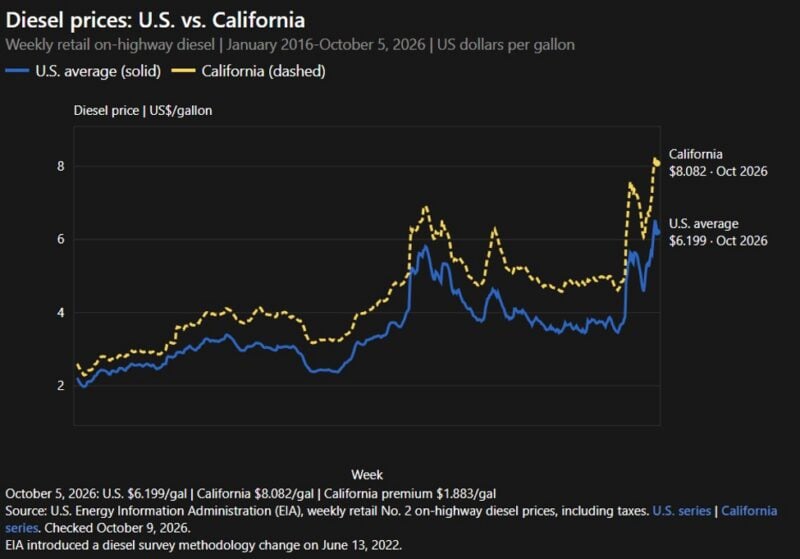
“Diesel is absolutely impacting trucking,” Seroka told gCaptain. “Diesel prices are up 62% since February 28th. More than half of the truckers registered to do business here are small businesspeople with five rigs or fewer. And this is not necessarily a price hike that can be passed on. If you’re a small business competing with larger companies that can absorb some of this shock, that’s a tough spot to be in.”
Two-thirds of the containers leaving the Port of Los Angeles travel by diesel truck. Diesel prices in California are the highest in the nation at $8.36 per gallon as of October 9, 2026, according to AAA’s state price comparison. Below is the EIA data released on Monday.
Seroka warns that diesel costs raise the cost of moving merchandise, and that the price increase eventually shows up in stores.
“Fuel at the pump here is up 36 percent since the end of February,” said Seroka. “All these costs get passed on to the American families. That’s fact. And at a time when the American economy is moving forward, what could this economy’s growth have looked like without the tariffs, trade policies, and energy price hikes? This conversation is not over yet. Affordability for American families is front of mind every day and night. We’ve Got to find our way out of this.“
The Port of Los Angeles handled a record 1,042,652 twenty-foot equivalent units (TEUs) in September, marking the busiest month in its 118-year history as strong consumer demand and shifting global...
U.S. container imports are finally beginning to slow after an unusually long peak shipping season that stretched through the summer and into early fall, according to the latest Global Port Tracker report from the National Retail Federation (NRF) and Hackett Associates. The slowdown comes after months of stronger-than-expected cargo volumes at major U.S. ports, as retailers continued bringing in merchandise despite tariffs, inflation and higher transportation costs. Ports covered by Global Port Tracker handled 2.3 million twenty-foot equivalent units (TEUs) in August, up 0.4% from July but down 0.7% from a year earlier. August now appears to have been the busiest month of 2026, marking a shift from last month’s forecast that September would take the top spot. “Even with any fluctuations in final data, we’re likely past the busiest part of the year,” said Jonathan Gold, NRF vice president for supply chain and customs policy. “The truth is that the peak season started early and was stretched out through the summer and early fall, with the difference from month to month often amounting to little more than a rounding error,” Gold said. The latest forecast puts September imports at 2.28 million TEUs, down from the 2.31 million TEUs projected a month ago. October is expected to ease further to 2.25 million TEUs before volumes fall to 2 million TEUs in November. Despite the expected slowdown, imports are still running well ahead of last year in some months. September volumes are forecast to rise 8.2% year over year, followed by an 8.5% increase in October. The revised outlook follows a peak season that has repeatedly defied expectations. Retailers moved merchandise into the country earlier this year to get ahead of tariff changes and supply chain uncertainty, initially raising expectations that imports would peak early and decline through the summer. Instead, volumes remained elevated, with shipping delays and resilient consumer demand helping extend the traditional peak season. The strength has been evident at individual ports. The Port of Los Angeles recorded its busiest three-month stretch on record during June, July and August, while the Port of Savannah reported a record September earlier this week, handling 504,015 TEUs, up 3.7% from a year earlier. Hackett Associates founder Ben Hackett said the economic outlook remains mixed, with consumers continuing to spend despite signs of weakening confidence. “Despite this, consumers appear to remain confident and cautious at the same time, with consumer confidence indexes sliding to multi-year lows while consumer spending continues to be robust in the face of increasing inflation,” Hackett said. For the full year, Global Port Tracker now expects imports at major U.S. container ports to reach 25.8 million TEUs, up 1.4% from 25.4 million TEUs in 2025. That is slightly above last month’s forecast of 25.7 million TEUs. Looking ahead, January 2027 imports are forecast at 2.07 million TEUs, down 1.9% year over year, followed by 1.92 million TEUs in February, up 1%. For retailers, the extended shipping season means much of the merchandise needed for the holidays is already in the country, reducing the need for another major import surge before year-end. “Most holiday merchandise has arrived, and the remainder of the year is just a matter of last-minute replenishment and preparation for early 2027,” Gold said.
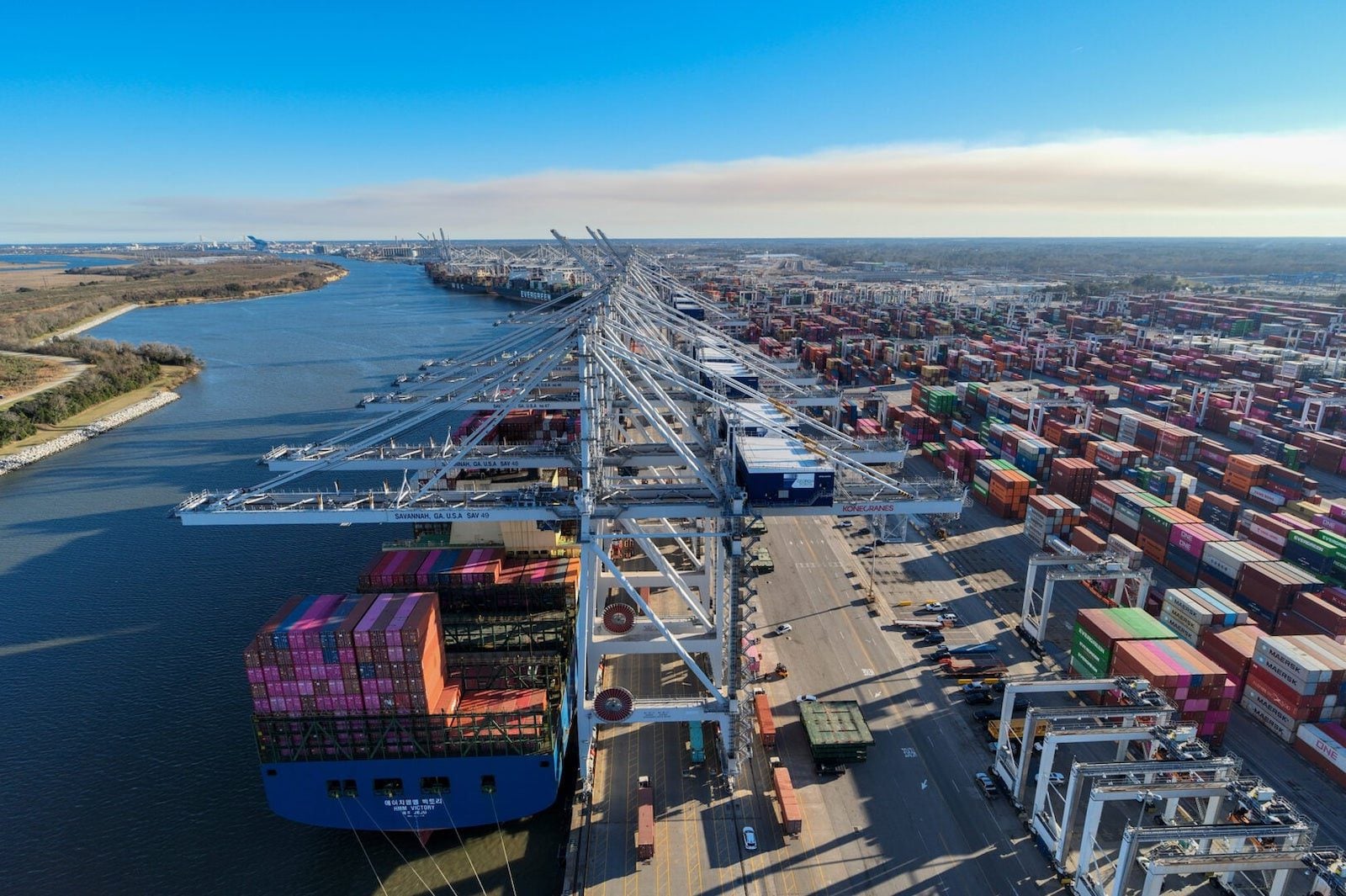
The Port of Savannah handled a record 504,015 twenty-foot equivalent units in September, up 3.7% from a year earlier as strong imports and a later-than-usual peak season boosted volumes.
October 7, 2026
Total Views: 949
Get The Industry’s Go-To News
Subscribe to gCaptain Daily and stay informed with the latest global maritime and offshore news
— just like 106,308 professionals
Secure Your Spot
on the gCaptain Crew
Stay informed with the latest maritime and offshore news, delivered daily straight to your inbox
— trusted by our 106,308 members
Your Gateway to the Maritime World!
Essential news coupled with the finest maritime content sourced from across the globe.

 Join The Club