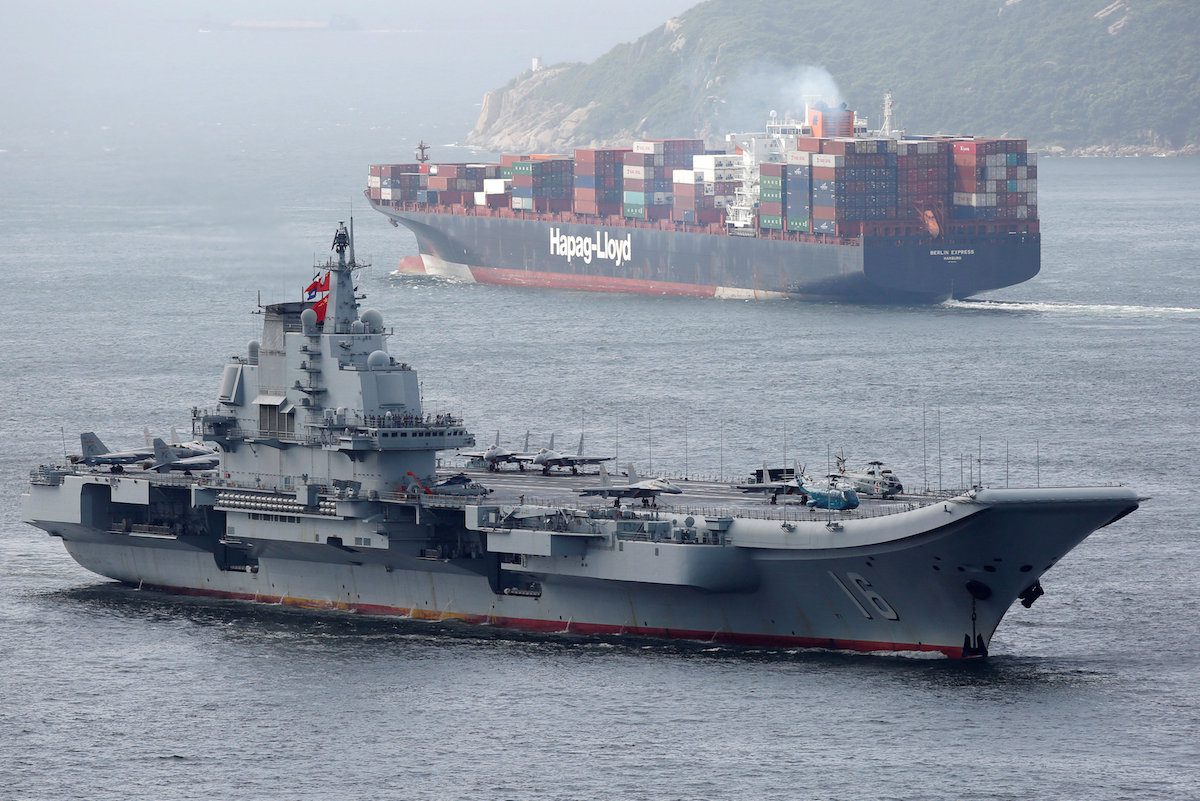
China’s aircraft carrier Liaoning sails into Hong Kong, China, July 7, 2017. REUTERS/Bobby Yip
By Greg Torode HONG KONG, July 7 (Reuters) – China‘s first aircraft carrier sailed into Hong Kong waters on Friday, its latest show of growing military might at a time of rising regional tension.
Tourists and residents gathered to catch a glimpse of the massive carrier on its maiden visit to Hong Kong, part of celebrations marking 20 years since the handover of the city from British to Chinese rule.
The Liaoning was accompanied by two destroyers and other ships from its strike group, with jet fighters and helicopters visible on the flight deck alongside hundreds of crew dressed in white uniforms.
Anchoring off Lantau island in the harbor’s outer reaches, the carrier was flanked by a protective cordon of marine police craft and a locally-based Chinese navy corvette.
Police boats sounded horns to prevent private vessels getting any closer than a few hundred meters of the Liaoning.
“The Liaoning’s visit shows that China is a militarily superior country,” said Jack Chan, a retired businessman, who was watching the aircraft carrier from an oceanfront park.
Thousands of Hong Kong residents queued for hours on Monday for just 2,000 tickets for access to the vessel this weekend. Many left empty handed.
China‘s first domestically built carrier was launched in April but is not yet operational.
‘MILITARY POWER’
Even though the former Russian naval ship is being used as a training vessel for China‘s rapidly modernizing navy, its recent voyages through tense regional seas have been closely followed in Hong Kong, which is more used to hosting U.S. carriers and other foreign warships.
“Liaoning’s visit definitely gives the central government a chance to display its military power. It’s quite a positive and smart strategy to step up publicity overall,” said Sean Moran, a tourist from the United States, as the ship passed on a blustery morning.
U.S. consulate officials told Reuters they had yet to be invited on board the Liaoning. The U.S. navy often hosts People’s Liberation Army officers on ships visiting Hong Kong, sometimes flying Chinese military chiefs to aircraft carriers.
The Liaoning’s most recent drills at the weekend included operations in the Taiwan Strait that were closely monitored by Taiwan’s military given recent tensions with Beijing, which regards the island as a breakaway province.
With its Soviet-era takeoff ramp distinguishing it from the ordinary Hong Kong traffic of container ships and bulk cargo vessels, the 55,000-tonne Liaoning steamed down the congested East Lamma channel shortly after dawn.
Significantly smaller than the U.S. carriers that have long stopped in Hong Kong, the Liaoning started life as one of the Soviet Union’s last carriers under construction, before being sold by Ukraine as a stripped down hulk to private Chinese interests in 1998.
The vessel was later refitted in a Chinese shipyard in what was seen by foreign military analysts as a key early test of China‘s naval modernisation.
The Liaoning began sea trials as China‘s first aircraft carrier in 2011 and has more recently conducted fully integrated drills with its complement of J-15 jet fighters and a variety of support ships.
(Additional reporting by William Ho, Pak Yiu and Bobby Yip; Editing by James Pomfret, Robert Birsel)
Iran warned a U.S. destroyer on Wednesday to change course after it approached waters being monitored by the Islamic Republic, leading the U.S. ship to turn away, Iranian state media reported. The U.S. Navy and U.S. Central Command, which overseas U.S. forces in the Middle East, had no immediate comment on the report.
Russia on Wednesday began major navy drills involving more than 150 vessels and 15,000 military personnel in the Pacific and Arctic oceans and in the Baltic and Caspian seas, the defense ministry said.
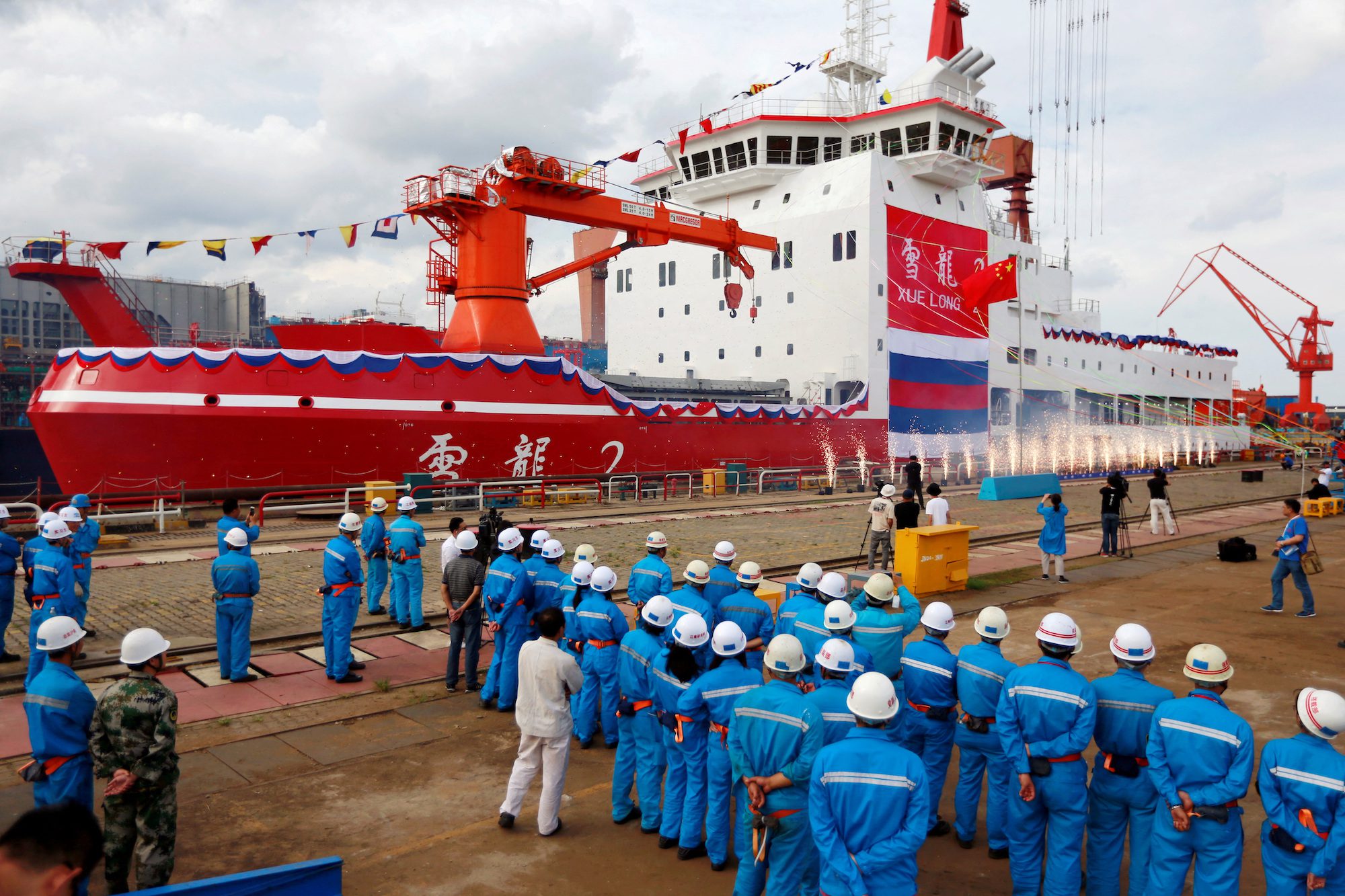
China’s first home-built polar icebreaker Xue Long 2 has arrived in the Arctic for its summer 2025 research mission. The vessel departed from Shanghai around two weeks ago on July 5. After passing through the Bering Strait in proximity to Alaska and entering the Chukchi Sea, the icebreaker has now turned east, traveling into the Beaufort Sea to the north of Alaska.
July 22, 2025
Total Views: 3370
Get The Industry’s Go-To News
Subscribe to gCaptain Daily and stay informed with the latest global maritime and offshore news
— just like 108,951 professionals
Secure Your Spot
on the gCaptain Crew
Stay informed with the latest maritime and offshore news, delivered daily straight to your inbox
— trusted by our 108,951 members
Your Gateway to the Maritime World!
Essential news coupled with the finest maritime content sourced from across the globe.
This website uses cookies to improve your experience while you navigate through the website. Out of these, the cookies that are categorized as necessary are stored on your browser as they are essential for the working of basic functionalities of the website. We also use third-party cookies that help us analyze and understand how you use this website. These cookies will be stored in your browser only with your consent. You also have the option to opt-out of these cookies. But opting out of some of these cookies may affect your browsing experience.
Necessary cookies are absolutely essential for the website to function properly. This category only includes cookies that ensures basic functionalities and security features of the website. These cookies do not store any personal information.
Any cookies that may not be particularly necessary for the website to function and is used specifically to collect user personal data via analytics, ads, other embedded contents are termed as non-necessary cookies. It is mandatory to procure user consent prior to running these cookies on your website.

 Join The Club