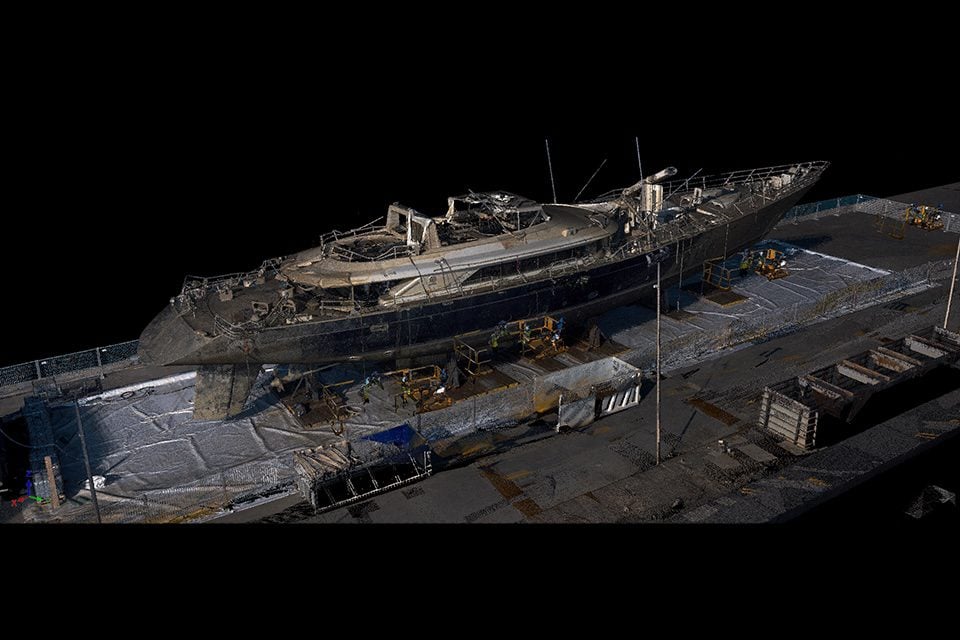
British marine accident investigators are calling for changes to superyacht safety regulations after the sinking of the luxury sailing yacht Bayesian exposed gaps in vessel stability standards, liferaft requirements and crew training that could put other large sailing yachts at risk.
The recommendations, contained in the UK Marine Accident Investigation Branch’s (MAIB) final report released Thursday, follow the August 2024 disaster off Sicily that killed seven people, including British technology entrepreneur Mike Lynch and his daughter.
While investigators found that Bayesian had an unrecognized vulnerability to extreme winds, the report goes further, identifying shortcomings in the regulatory framework governing large sailing yachts and recommending changes aimed at preventing similar accidents.
At the center of the findings is a gap in the standards used to assess yacht stability. Neither the Large Commercial Yacht Code (LY2), under which Bayesian was built, nor the subsequent Red Ensign Group Yacht Code required certain monohull sailing yachts to be assessed for the risk of being knocked onto their sides by high winds when operating without sails.
Investigators found that the yacht’s towering mast and furled sails still generated substantial wind forces, even while the vessel was anchored. However, its approved stability information did not account for that risk, leaving the crew unaware of a potentially catastrophic vulnerability.
The MAIB has recommended that the Red Ensign Group study the vulnerability of monohull sailing yachts certified under its Yacht Code and amend the regulations based on its findings. It also wants improved stability information and operational guidance for crews preparing for extreme weather, whether underway or at anchor.
The investigation identified another significant safety concern involving lifesaving equipment.
None of Bayesian‘s liferafts automatically floated free and inflated when the yacht sank. Although their hydrostatic release units operated, the rafts remained trapped by their stowage arrangements. A crew member was forced to manually release one, allowing the 15 survivors to remain afloat until they were rescued.
Investigators found that the liferaft arrangements met the regulatory requirements applicable when the yacht was originally surveyed. However, those standards did not adequately address what happens when a large sailing yacht is knocked onto its side.
The MAIB is now recommending amendments to the Red Ensign Group Yacht Code requiring liferafts aboard sailing vessels vulnerable to knockdown to be capable of floating free, inflating and separating from the vessel as it sinks.
The report also identified a separate deficiency in Bayesian‘s original stability approval. Investigators determined that the yacht did not meet LY2’s minimum downflooding-angle requirement, leaving it vulnerable to progressive flooding at lower heel angles than the code permitted. The MAIB classified that finding as a safety issue that did not directly contribute to the accident.
Beyond vessel design, investigators are calling for improvements in marine weather forecasting and professional training.
Thunderstorms had been forecast near the yacht’s anchorage, but the available warnings did not adequately communicate the potential for destructive downbursts. Within just 14 minutes, relatively calm conditions gave way to winds of at least 68 knots, knocking the yacht onto its side in less than 15 seconds.
The MAIB has recommended that the UK’s Maritime and Coastguard Agency review yacht officer training requirements to better address thunderstorms, downbursts and extreme wind gusts.
It has also urged the Met Office to raise the treatment of rare but potentially catastrophic weather events with the World Meteorological Organization, while calling for updated guidance in Admiralty nautical publications.
In a separate safety flyer issued to the yachting industry, the MAIB urged yacht owners, managers and crews to examine their vessels’ vulnerability to extreme weather and ensure their operating procedures adequately address the risks.
“Our investigation found that Bayesian had a vulnerability to high winds that was not recognised,” said Rob Loder, the UK’s Chief Inspector of Marine Accidents.
Loder urged regulators, training providers and weather services to act on the investigation’s recommendations to prevent another tragedy.
The proposed changes are not yet binding regulations. According to the final report, no safety actions had been taken by other organizations at the time of publication.
The MAIB has also prepared a paper detailing the hazards identified in the investigation for consideration by the International Maritime Organization’s Sub-Committee on Implementation of IMO Instruments, potentially extending the safety discussion beyond the superyacht sector.

 Join The Club