MELBOURNE, March 7 (Reuters) – The oldest known message in a bottle was found on an Australian beach 132 years after being thrown from a German ship in the Indian Ocean as part of an experiment to track currents, experts said.
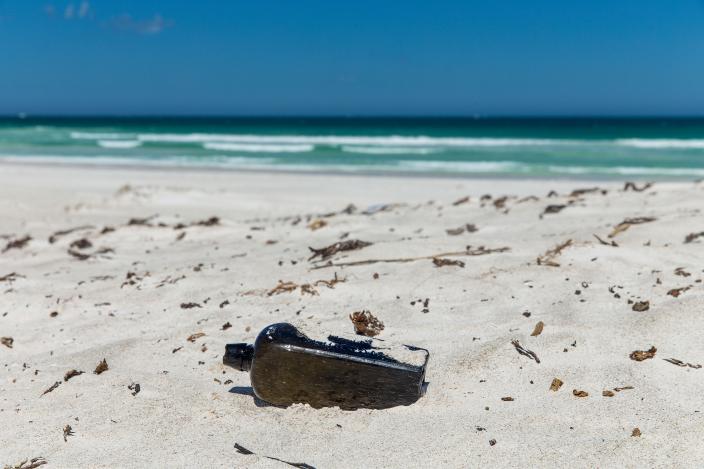
The Dutch gin bottle, with no cork or top, was spotted by Tonya Illman in January in remote sand dunes 180 km (112 miles)north of Perth, the capital of Western Australia state.
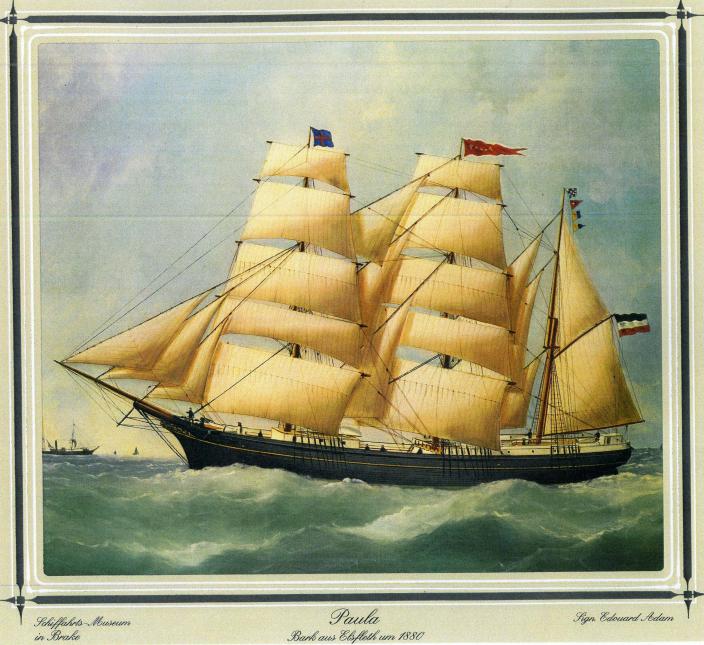
Inside, her family discovered a note tightly rolled up and tied with string, carrying the date June 12, 1886, and the name of the ship, Paula.
“We took it home and dried it out, and when we opened it, we saw it was a printed form, in German, with very faint German handwriting,” Illman said.
Her husband searched online to find that, in an experiment run from 1864 to 1933 by the Deutsche Seewarte, or German Naval Observatory, ship captains would throw bottles overboard, each with a message giving the date, the ship’s name, its location coordinates, home port and destination.
“It was clearly very exciting, but we needed a lot more information,” said Illman’s husband, Kym. “We wanted to know if what we had found was historically significant or a very inventive hoax.”
The family took their find to the Western Australian Museum, which got experts in Germany and the Netherlands to confirm the bottle was made in Holland in the 19th century, the paper matched the era and the vessel Paula had sailed from Cardiff to Makassar in 1886, as the message stated.
The message is dated 12 June 1886 and was jettisoned from the German sailing barque Paula as part of a long-term German oceanographic experiment to better understand global ocean currents and find faster, more efficient shipping routes. Image credit: Western Australian Museum
German experts turned up the ship’s journal, with a captain’s entry from June 12, 1886 showing that a drift bottle was thrown overboard. The coordinates, 950 km (590 miles) from Australia’s west coast, matched those on the note.
The handwriting in both journal and note also matched. The find has been authenticated by the German Federal Maritime and Hydrographic Agency (BSH) and Germany’s National Meteorological Service (DWD).
“The forms have changed a lot over the years, but in the 1860 period, the form is exactly what you have,” the BSH said in a report.
Researchers think the bottle probably washed up on the coast within a year of being thrown overboard, to be buried in sand until a storm uncovered it.
The message and the bottle will be on display for two years at the museum in the Australian port city of Fremantle.
“It’s quite stunning, I’ve never experienced anything that corroborates so fully as this,” said Ross Anderson, a specialist in maritime archaeology at the museum. (Reporting by Stefica Nicol Bikes; Writing by Sonali Paul; Editing by Clarence Fernandez)
Karl Bell-(The Conversation)– Maritime folklore has long been shuffled to the margins of nautical history, presented as the quaint, colourful oddities of a former age. Yet this body of beliefs, practices...
By Will Dunham June 25 (Reuters) – Our species arose in Africa roughly 300,000 years ago and later trekked worldwide, eventually reaching some of Earth’s most remote places. In doing so, our ancestors surmounted geographic barriers including...
By Emma Pinedo MADRID, May 10 (Reuters) – Members of three South American indigenous communities have asked Spain and UNESCO to declare a Spanish galleon that sank 300 years ago with a...
May 11, 2024
Total Views: 2228
Get The Industry’s Go-To News
Subscribe to gCaptain Daily and stay informed with the latest global maritime and offshore news
— just like 106,659 professionals
Secure Your Spot
on the gCaptain Crew
Stay informed with the latest maritime and offshore news, delivered daily straight to your inbox
— trusted by our 106,659 members
Your Gateway to the Maritime World!
Essential news coupled with the finest maritime content sourced from across the globe.

 Join The Club