Updated: September 29, 2011 (Originally published September 28, 2011)
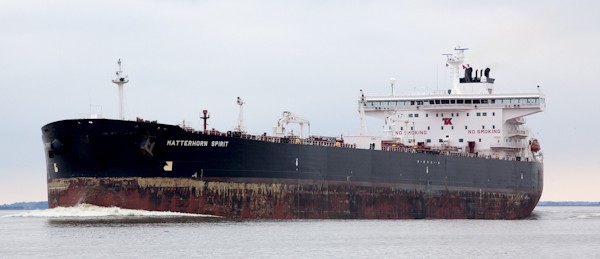
Teekay's Matterhorn Spirit southbound on the Delaware Bay, image by Rob Almeida/gCaptain
SINGAPORE (Dow Jones)–Asia’s petroleum tanker markets will likely stay anemic due to persistent oversupply, though falling bunker prices could support charterers’ bottom lines.
With China’s weeklong National Day holidays coming up next week, conditions are unlikely to improve given that many players will be out of the market, shipbrokers said.
The spot rate for a 260,000-metric-ton Very Large Crude Carrier from the Middle East to Japan was assessed Monday at Worldscale 44.96, down from the week-earlier level of W45.26, according to the Baltic Exchange.
However, due to collapsing bunker prices, cash returns for owners were assessed $378 stronger at minus $1,826.
“It has been at the bottom for about almost two months. Looking at the current market, surplus tonnage will continue so I don’t see any kind of upside,” a Japanese broker said.
Although the fixing of October-loading cargoes is in full swing, rates continue to be depressed due to high availability of vessels, broker Simpson, Spence & Young said in a research note.
Broker Meiwa International said in a note that one week into fixing of vessels for October, 36 cargoes are already set to be lifted. This compares with 95 lots for the whole of October in 2010.
The rate for a VLCC from West Africa to China edged up to W42.87 from W42.57, while the 80,000-ton Aframax rate from Southeast Asia to the east coast of Australia also rose slightly, to W91.22 from W92.11.
Freight rates for vessels carrying clean petroleum products have also fallen to their lowest levels in around two months, as naphtha demand remains slow, with end users hesitant to buy spot cargoes because of signs of a softening global economy.
“There is just not enough demand…for this week at least, I think rates will still be weak,” a Singapore-based broker said.
The rate for a 55,000-ton LR-1 cargo from the Middle East to Japan dropped to W128.38 Monday from W133.08 a week ago, while the rate for a 75,000-ton LR-2 cargo for the same route eased to W120.96 from W122.29.
The rate for a 30,000-ton tanker from Singapore to Japan slipped to W152.71 from W152.86.
Iran’s oil exports slipped modestly in January, but the data points to durability rather than decline. A mature dark fleet ecosystem continues to move crude through opaque networks, with activity increasingly concentrated in Malaysian waters even as U.S. sanctions enforcement expands across new regions.
Tsakos Energy Navigation CEO Dr. Nikos Tsakos says geopolitical turmoil and the rapid expansion of shadow tanker trading have created a severe shortage of high-quality vessels, pushing charter rates to levels rarely seen in the industry. Speaking during a recent investor presentation, Tsakos said nearly a third of the global tanker fleet has been sidelined by sanctions, leaving oil majors scrambling for compliant tonnage and reshaping global energy trade routes.
International Seaways, Inc. (NYSE: INSW) has acquired sole ownership of Tankers International, one of the world’s leading shipping pools, while simultaneously expanding the platform beyond its traditional VLCC focus to...
January 27, 2026
Total Views: 583
Get The Industry’s Go-To News
Subscribe to gCaptain Daily and stay informed with the latest global maritime and offshore news
— just like 107,213 professionals
Secure Your Spot
on the gCaptain Crew
Stay informed with the latest maritime and offshore news, delivered daily straight to your inbox
— trusted by our 107,213 members
Your Gateway to the Maritime World!
Essential news coupled with the finest maritime content sourced from across the globe.

 Join The Club