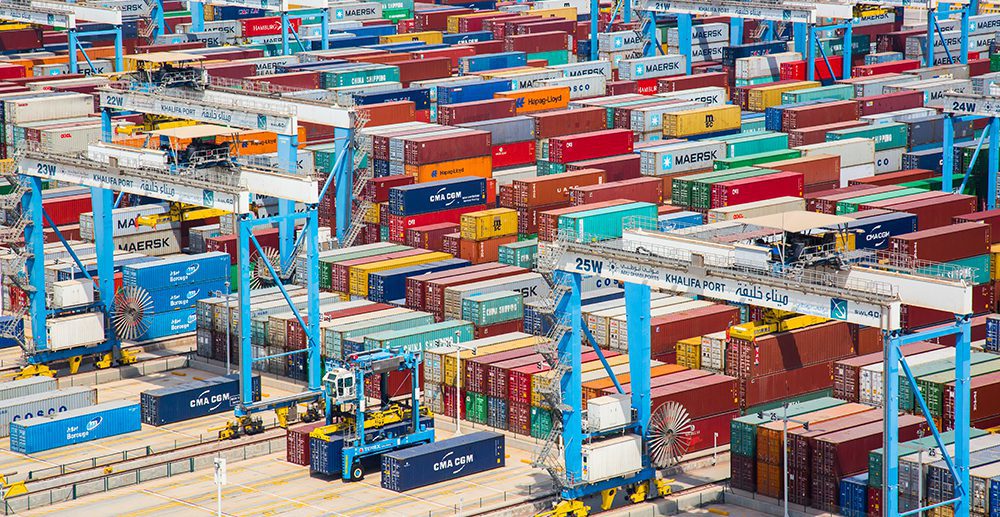
(Bloomberg) — Abu Dhabi wealth fund L’imad Holding is offering to buy out minority shareholders in the city’s port operator valuing the firm at 31.8 billion dirhams ($8.66 billion), potentially bolstering the emirate’s efforts to build out infrastructure that could help it bypass the Strait of Hormuz.
L’imad plans to make a cash offer for the shares in Abu Dhabi Ports Co. it doesn’t already own at 6.25 dirhams apiece, a 23% premium to the stock’s last closing price. The shares rose by the daily limit of 15% to 5.86 dirhams on Monday after the offer was announced. The wealth fund — chaired by Crown Prince Sheikh Khaled bin Mohamed — already owns more than 75% of the company through its subsidiary ADQ.
The transaction, which is subject to approvals, will allow the company to pursue investments and acquisitions without the funding constraints or short-term return expectations of public markets, according to the statement.
The deal will also likely give the government greater control over a key logistics and infrastructure group spanning ports, maritime services and economic zones. It would also allow the sovereign investor to make longer-term strategic decisions as the Iran war continues to disrupt traffic through the vital Strait of Hormuz.
Created last year, L’imad soon absorbed ADQ, one of the world’s fastest-growing sovereign investors with assets spanning everything from a stake in Sotheby’s to Abu Dhabi’s flagship airline and other marquee local holdings. It inherited not just those assets, but a broader mandate that’s expected to place it at the heart of Abu Dhabi’s push to bolster defence and infrastructure investments amid the regional war.
The AD Ports deal underscores L’imad’s growing role, and comes weeks after it said it would de-list the $81 billion utility known as TAQA. The twin transactions run counter to an approach followed by officials for the past few years, when the emirate used blockbuster initial public offerings to transform its stock market into one of the Gulf’s fastest-growing exchanges. Strategic assets that had long sat inside government portfolios were listed to deepen capital markets and attract foreign investors.
AD Ports was among a flurry of new share sales during that period — the offer raised $1.1 billion in 2022 and the stock has since risen close to 60%. The shares have gained 6.9% this year, erasing the sharp losses suffered during the early weeks of the Iran war, and outperforming Abu Dhabi’s benchmark equity index, which is up less than 1% this year.
Still, the offer price is below the targets of all but one of the eight analysts tracked by Bloomberg. EFG Hermes, one of the deal’s arrangers, has the highest target at 8.50 dirhams a share.
Tahir Abbas, head of research at Ubhar Capital, said the offer was attractive but didn’t provide “an overly generous premium” given AD Ports’ long-term growth prospects.
“For investors holding out, dilution is a risk given management’s indication that equity funding will be used for the substantial capital expenditure program, including Fujairah,” he said. “The key trade-off is the certainty of 6.25 dirhams today versus retaining upside but accepting potential dilution.”
The firm has expanded rapidly in recent years as Abu Dhabi has sought to build its position as a global trade and logistics hub. It operates ports and terminals and has pushed into shipping, logistics and maritime services through a series of acquisitions and investments at home and overseas.
Since the start of the war, Iranian attacks on vessels in the Strait of Hormuz have pushed Gulf countries to look at a wide range of workarounds to ship out their oil, natural gas, metals and chemicals, goods which are essential to the global economy.
L’imad is increasingly emerging as central to the UAE’s plans as it has sought to build oil pipelines and expand other ports that could bolster its efforts to keep selling a range of commodities while importing necessities. In a June interview, the UAE’s Minister of Foreign Trade Thani Al Zeyoudi said the country is moving toward having “zero Hormuz dependency.”
Al Zeyoudi said at the time that a key part of the UAE’s plan would be a major expansion of the eastern ports of Dibba, Fujairah and Khor Fakkan, which sit outside the strait on the Gulf of Oman coast. The UAE will also build at least one other new harbor on the same coastline, he said.
Abu Dhabi Ports forecasts capital expenditure of up to 5 billion dirhams in 2026 and 2027, with more than 75% of the planned spending up until 2030 earmarked for infrastructure assets, primarily ports and free zones.
The Gulf country has already benefited from being able to partially bypass the strait, using an existing pipeline to keep some crude moving through ports on its east coast..
In May, L’imad said it will join BlackRock Inc. unit Global Infrastructure Partners, Singapore’s Temasek Holdings Pte. and Abu Dhabi National Oil Co.in an investment venture targeting $30 billion of infrastructure projects, underscoring the central role the new sovereign wealth fund is likely to play in the emirate’s ambitions.
Rothschild & Co. has been appointed financial adviser for the AD Ports tender offer. Emirates NBD Capital and First Abu Dhabi Bank are acting as joint lead managers, while EFG Hermes UAE is co-lead manager.
© 2026 Bloomberg L.P.

 Join The Club