Editor’s Note: This is the longest piece gCaptain has ever published. 13,000 words. It’s messy in places, uneven in tone, and intentionally uncompressed—because that’s what a week inside today’s Pentagon felt like. Read it as a field report, not a polished magazine feature: imperfect, human, and written close to the moment. Or it’s probably better not to read it at all. Like geopolitics today, it’s messy, it’s emotional, it’s raw, and it’s probably outdated six minutes after I hit publish. But it is true.
by Captain John Konrad (gCaptain) This year, stories scorching the Trump administration, and Secretary of War Pete Hegseth most of all, have streamed out of the Pentagon like a rattling ribbon of rounds from an A-10’s Gatling gun. Some struck true. Others, bright and misleading, floated across the national conversation like tracer fire—attention-grabbing arcs built on classified whispers and convenient fictions. They lit up the sky, then detonated into yet another political firestorm.
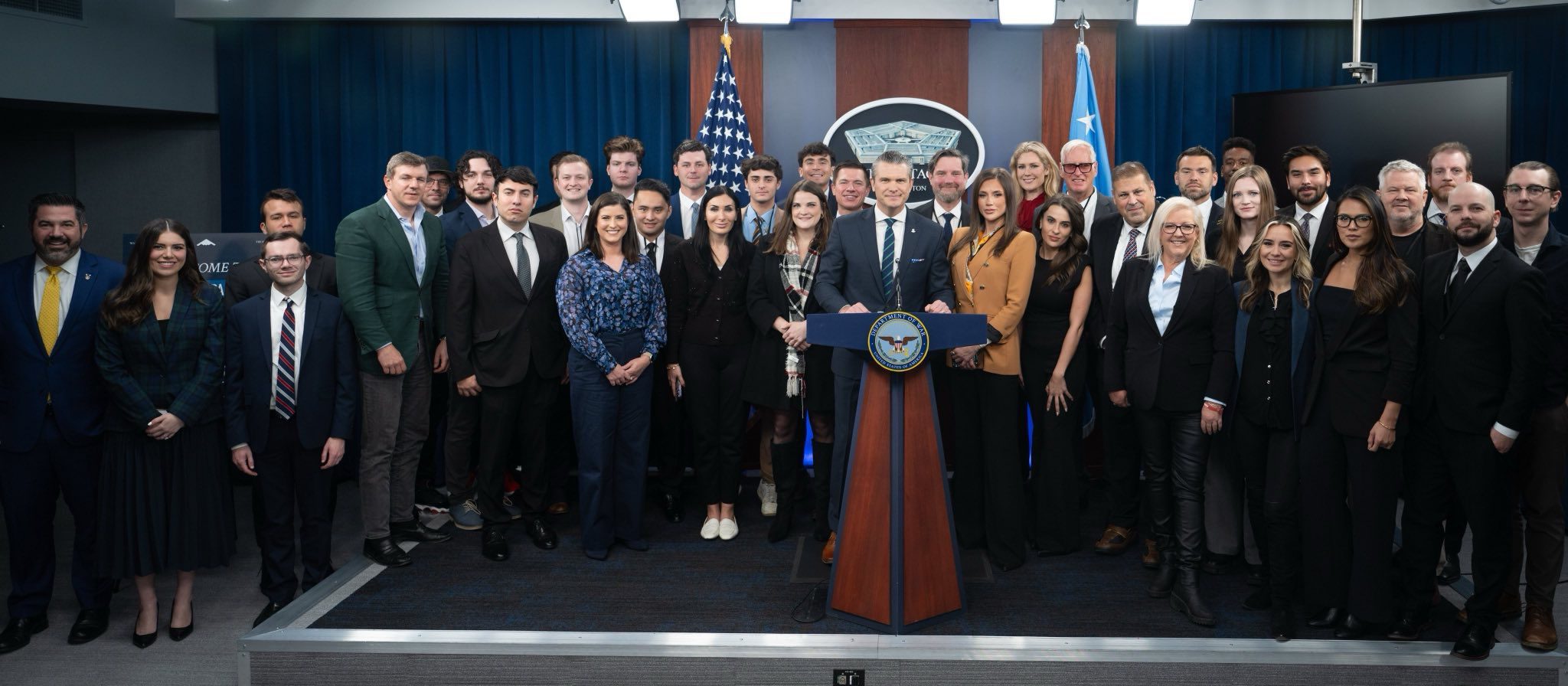
The Department of War answered with new rules: notify us before handling classified material, and stop lurking outside senior officials’ doors like paparazzi waiting for a misstep. On paper, the changes were procedural. In practice, they poured gasoline on already smoldering tensions. Most outlets stalked out in protest, loudly slamming the doors behind them. And into that sudden vacuum, the Department invited a new cohort of hand-selected journalists to apply for credentials.
To my surprise—and to the surprise of many others—gCaptain was first on the list. Not because of politics, but because we sit squarely in the narrow, neglected intersection of maritime commerce and national power. So on Monday morning, still shaking off the cold, I picked up the first of the newly issued press passes. By the end of the week, I was deep inside the Pentagon’s concrete maze, embedded with senior officials in an administration trying to rewrite decades of doctrine while the world watched through fogged glass.
But the further I walked into those fluorescent-lit corridors, the more I sensed that the headline battles weren’t the real story. Beneath the political theater and press hysteria pulsed a quieter, more consequential current—one that cut straight through America’s capacity to project sea power and control the arteries of global trade.
I had come looking for specifics: shipbuilding delays, contested logistics, eroding freedom of navigation. Yet inside the building, the air itself seemed charged with a kind of institutional dissonance. Outside, every policy shift triggered instant outrage or adulation. Inside, the work was slower, steadier—a bureaucratic ballet misunderstood by those watching from the bleachers. And while I was trying to take notes, my X account was taking fire. Missiles from pundits, potshots from traditional media—an unrelenting barrage that made it nearly impossible to anchor myself to the maritime questions that mattered.
In nearly twenty years of running gCaptain, I’ve never been caught in a media crosscurrent like this one. The whole tempest crested when Saturday Night Live aired a sketch featuring a drunken, red-faced caricature of Secretary Hegseth menacing “dorky” Pentagon reporters. It was absurd, surreal—and instantly swallowed whole by the news cycle, as if parody and policy had become interchangeable.
Trying to chart a steady course through the noise felt hopeless. So I defaulted to something I learned long before I ever held a press pass.
When I stepped aboard a new ship as captain or chief mate, I never opened with criticism—even when the deck plates practically vibrated with mistakes. First, I watched the system breathe. I learned who truly held power, not just who wore the stripes. Only then could I make changes that mattered.
I can’t pretend I have the power to change the Pentagon. But I do helm the most widely read maritime news site on earth. And in an industry drifting toward chaos, perception matters. Interpretation matters. The lens through which we view sea power matters more now than it has in decades.
Because the maritime world is destabilizing at a velocity we have not seen in modern memory. At the IMO’s recent UN Carbon Tax vote, the United States abandoned its old seablind stance and stepped decisively into maritime economic warfare. Meanwhile, the U.S. Navy’s once unchallenged command of global sea lanes now feels uncomfortably conditional.
For the first time in my life, the United States matters again at sea—not as an unquestioned hegemon but as a reawakened actor in an increasingly chaotic arena. Chaos that stretches from the Black Sea to the Red Sea to the South China Sea, faster than even the most powerful navy can deploy hulls to meet it.
Readers of The Box know Malcolm McLean’s humble steel container lifted more people out of poverty than any invention since the Haber–Bosch process multiplied crops and filled bulk carriers across the globe. And anyone who reads gCaptain—or Peter Zeihan—knows the rules-based maritime order has been fraying since at least COVID, and tearing outright since the invasion of Ukraine. Navigation is no longer guaranteed. Seas once considered safe now shimmer with danger. And the global economy, for decades buoyed by a rising tide, has fractured into pockets of prosperity and pits of decline.
That is the canvas on which this entire story is painted: chaos at sea, upheaval in the markets, uncertainty in every corridor of global trade.
And into that moment—just as I was leaving Washington—the United States unveiled a new National Security Strategy.
At the Reagan Defense Forum, Hegseth declared, “The United States military will no longer be distracted by interventionism, regime change, undefined wars, climate change, woke moralizing, and feckless nation-building. Instead we will put our nation’s practical and concrete interests first.”
A thunderous thesis. But what does it mean in practice?
The New York Times offered one interpretation: that America was shedding its role as global guardian of freedom and recasting itself as a power guided by pragmatism—less interested in judging authoritarians and more interested in deterring migration and collecting checks.
I think that’s unfair. But it’s also gentler than most of the rhetoric echoing through the media landscape.
And what I saw inside the Pentagon last week—what I’ve seen on every trip to D.C. since the election—tells a story that diverges sharply from both Hegseth’s fiery declaration and the media’s caricatures. It also diverges from the alarm I’m hearing from European naval experts, who read the same signals and see only shadows.
This is a story that doesn’t align neatly with any of those narratives.
It lives somewhere between them—quiet, consequential, and unfolding behind the beige walls where America still tries to steer the world’s seas.
Those stakes shaped every conversation that followed—inside briefing rooms, conference halls, and the private offices where policy quietly hardens into action.
“Should” Communication Turns Violent
At the Marine Money conference in New York last month, the air was thick with something far heavier than finance—American politics. From the fresh-faced interns hunting free hors d’oeuvres to the billionaires holding court at corner tables, the conversations kept circling the same storm: the United States is making business harder for everyone.
Every speaker, no matter how obscure their topic, was peppered with the same pointed questions about American intentions—its policies, its power, its relevance. Many Europeans in attendance still insist the U.S. plays no role in maritime trade beyond devouring imports. But one answer cut through the chatter.
“Yes, I would move to the United States,” billionaire shipowner George Economou said when asked where he’d start over in 2025. “It’s the only place on earth where 340 million people control twenty-six percent of the world’s GDP.”
A backhanded compliment—but a brutally honest one. America doesn’t just influence the global maritime system; it anchors it. We produce a tidal wave of wealth and command a degree of leverage no constellation of smaller nations can counterbalance. And while anti-American sentiment is spreading across Europe and Canada—and festering especially deep in maritime circles—it doesn’t alter a simple truth: the future of the global economy hinges on how the United States chooses to wield that wealth and weight.
European commentators can scold Trump as uncooperative, and Der Spiegel can draw cartoons portraying America as the villain, but that posture collides violently with how Americans—especially those in power today—actually view the world.
Before we get lost in the corridors of the Pentagon, we need to pause here. Because America doesn’t just matter to the world; it matters most to Europe. The United States is a major consumer of European goods, yes, but it also built many of the legal, financial, and commercial systems that Europe still relies on. And baked into those systems—quietly, almost invisibly—are levers of control that have gathered dust but never disappeared.
Dollar-denominated trade, international banking rules, maritime insurance frameworks, military basing agreements, voting power inside global bodies—these are not accidents. They are artifacts of an American-designed order. Even at the International Maritime Organization, two of the largest registries—Liberia and the Marshall Islands—are not sovereign nations but U.S. corporations contractually tethered to the Pentagon.
So when European diplomats grumbled that America used “harsh tactics” to sink the IMO’s UN Carbon Tax proposal, they missed the larger reality: the United States didn’t have to negotiate. We could have simply pulled the levers we built into the system after WW2. Diplomats are enraged, but they forget that the representatives of two of the largest flags of convenience are in fact US corporations. The levers exist because the system was designed that way, not because Washington enjoys pulling them.
America may look heavy-handed on the helm, but the truth is the opposite. For decades, we’ve been reluctant stewards—easing off, slowing down, even running ourselves aground to avoid embarrassing smaller nations. That era is ending.
The best way to understand this shift is through ships.
The United States is a supertanker in restricted waters. There’s no law of raw tonnage compelling smaller vessels to yield, but physics has a vote. A VLCC cannot zig-zag around every sailboat without burying its bow in the mud. Past administrations have slammed engines astern or even stayed tied to the pier to avoid collisions. Trump’s America will still follow the rules, still give warnings, still help mariners in distress. But we will not throw the wheel hard over every time a thirty-foot sloop insists it has the right-of-way.
That is the shift. That is the new policy. The United States will no longer alter course simply because a single nation darts across our bow.
This doesn’t mean we want collisions. It doesn’t mean we won’t maneuver when there’s sea room. But it does mean the burden shifts to the smaller vessel to heed our signals. When Denmark steered the EU straight into the path of America’s opposition at the IMO, we radioed, we warned, we offered another channel—exempting U.S.-flag ships entirely. Europe refused. So the supertanker kept its heading. The proposal went under.
And this will not be the last casualty.
None of this springs from malice. I’ve navigated narrow waters on large ships and reported on maritime mishaps for two decades, and I’ve seen the same emotional pattern play out again and again among small-boat skippers: arrogance and anger. They assume the big ship will move. When it doesn’t, they shake their fists as the wake swallows them.
What’s changing now is simple: the responsibility to avoid collision shifts to the smaller vessel. If the supertanker can’t turn, don’t cut across its bow—no matter how righteous you feel. If every small boat bands together and blocks the channel, Trump might wait—or he might plow ahead—or he might divert entirely, leaving the harbor to run out of oil. All options remain, but none of them end well for those waving their fists.
From where I stand, what’s most unsettling is how many Europeans seem determined to sail directly into America’s bow wave, shaking their fists and shouting should as they go. It feels less like diplomacy and more like self-destruction.
Years ago, I spent a week with Marshall Rosenberg, the pioneer of Nonviolent Communication. He believed the most dangerous word in the English language—the spark that lights playground fights and world wars alike—is should. Not the should heard, but the should uttered and ignored.
And today, the word echoes everywhere: Trump should stop being a dictator. Trump should treat allies with more respect. Trump should stop being petty. Trump should do this. Trump shouldn’t do that. America should turn left, should slow down, should sacrifice, should submit.
The anger isn’t triggered when America refuses—it’s triggered when those shouting should realize their demands no longer steer the ship.
Trump believes a president should put America first. It’s not selfish; it’s an attempt to stop running the vessel aground because of other nations’ “shoulds.” Yes, the anger and vitriol this produces is corrosive, but it will dissipate the moment the world switches from “what you should do” to “what we can do together.”
So how do we prevent the death spiral? Young Rosenberg was a teacher and while breaking up a fight a kid puched him in the nose.
“You SHOULDN’T have done that,” he fumed dragging the kid to the principal. Anger boiled over him for days while he thought of all the things the kid and himself should and shouldn’t have done. All these shoulds provided the foundation for a false narrative in his head.
Then, with the wound not fully healed, another kid in another fight popped him in the nose and broke it. It hurt ten times as much but Rosenberg didn’t feel any anger or emotion.
Why? Because he knew the kid. He knew the kid was younger than his big frame, knew the kid got bullied l, knew the kid’s family was struggling to make ends meet, knew the kid was always kind to the young kids and was working hard to curb his anger.
What I am trying to say is Trump wants every nation on earth to prosper, he wants peace around the world, he wants America to lead everyone to greatness again.
That is what I came to the Pentagon seeking: the correct narrative. Not the caricatures. Not the European fears. Not the American pundit fantasies. The true picture—quiet, complicated, consequential—from which peace and prosperity might actually be rebuilt.
Because in the end, we have only two ways to secure global stability:
Stop shouting should. Or tell the genuine story of the people steering the ship.
I chose the latter.
I can’t tell you that you should calm down, but I can give you a deeper perspective to the people shaping and executing policy. I can let you decide if they are that first or second boy who threw a punch.
The Secretary of War
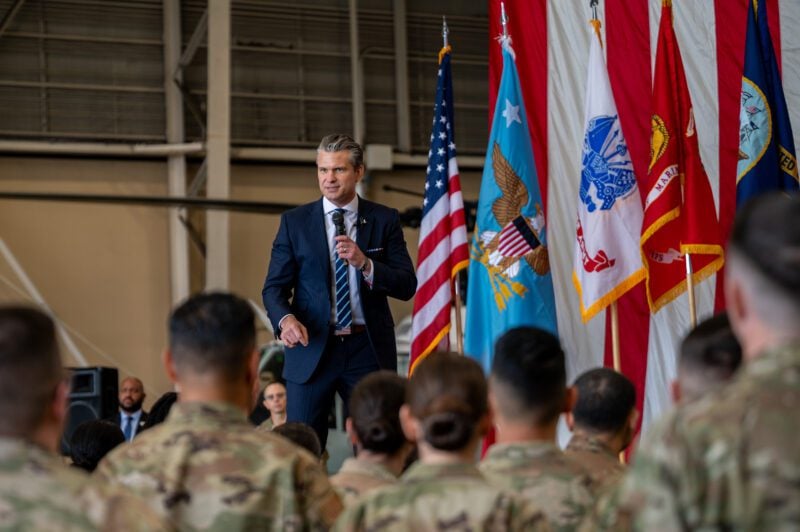
U.S. Secretary of War Pete Hegseth speaks to U.S. service members stationed in the region during a troop engagement at Yokota Air Base, Japan, Oct. 29, 2025. While transiting through Yokota, Hegseth engaged with U.S. troops to emphasize service members’ roles in deterrence and reviving the warrior ethos. (U.S. Air Force photo by Airman 1st Class David S. Calcote)
Pete Hegseth arrives with a record that is neither clean nor simple. He has spoken openly about drinking too much earlier in his life. About chasing women. About mistakes that followed him long after combat ended. He also carries the unmistakable compression of someone shaped by war, disciplined, impatient, intolerant of drift. All of that is true at once, and none of it cancels the rest.
For observers outside the United States, men like this are difficult to read. American culture tends to flatten combat veterans into caricature: either broken or brutal. The reality is less cinematic and more uncomfortable. Long exposure to violence does not produce moral clarity; it produces focus. Judgment narrows. Tolerance for delay erodes. The world becomes a place where hesitation looks dangerous and softness feels irresponsible. I recognized that compression immediately… not as virtue, and not as vice, but as something familiar.
When I met Hegseth, the Saturday Night Live caricature evaporated. What replaced it was presence. He is genuinely charismatic—not in the practiced, lubricated way of a politician, but in the gravitational way of someone who seems fully occupied by the moment in front of him. Conversations tightened. People leaned in. The room moved faster without feeling rushed. He understood the questions, even the ones that were not easy to understand.
I spent less than two hours with him. That is not enough time to know a man. It is enough time to observe how others orient around him.
Several officials I spoke with described the same trait they admired as a liability. Meetings moved quickly. Decisions landed hard. Progress was expected, and patience was not always extended. For some, that clarity felt liberating. For others, it felt like being evaluated constantly by standards they hadn’t agreed to.
His thousand watt lightbulb of charisma can bath you in warmth one minute and be a blinding spotlight too.
That pattern is not unique to Hegseth.
It reminds me of my father, who is buried less than a thousand feet from where I met the Secretary of War. Like Hegseth, my father earned multiple Bronze Stars. Like Hegseth, he had seen what people are capable of doing to one another—and what happens when no one intervenes in time.
My father was hard. Unforgiving at times. Often brutal. His love was real, but it was not gentle, and it was never unconditional in the way people like to imagine love should be. It came with expectations and consequences. He believed strength was something you built before you needed it—because once darkness arrived, preparation was already over.
Men who have seen true darkness do not come back unchanged. Combat teaches you that the world does not offer warnings and does not forgive hesitation. For some veterans, that lesson evolves into a permanent state of readiness. Everything becomes training. Every weakness looks like a future failure. Every comfort feels like a liability.
The instinct behind that hardness is love—but a specific kind of love. Protective. Demanding. Intolerant of fragility. They push because they believe softness kills. They are hard on their children not out of indifference, but out of fear—fear that one day those children might face the same darkness without the armor they themselves had to forge the hard way.
That love does not redeem the damage it can cause.
Intention does not cancel impact. The same pressure that builds resilience can fracture trust. Some children grow stronger under it. Others learn only how to endure. Often both outcomes coexist in the same person. The men who apply that pressure rarely know which lesson they have taught until years later, when the consequences surface.
I recognize that pattern. Not as virtue. Not as sin. But as consequence.
That same force operates in Hegseth. It is not sentimental. It is not soft. It is not especially interested in being understood. It manifests as urgency, expectation, and a low tolerance for failure, especially in people he believes matter. But it also manifests itself in trust and a willingness to stand beside you when mistakes are made.
After meeting him, I walked the Pentagon grounds and climbed the hill to Arlington. Standing at my father’s grave, grief came first. Love followed close behind. Not the comforting kind. The demanding kind—the kind that insists you be ready, even when readiness hurts.
I am not crowning Hegseth a saint, a savior, or a redeemed hero. I am not claiming access to his interior life. Ego, ambition, and appetite for power are present, as they are in anyone who reaches this level.
What I can say is narrower and more defensible.
His mind is quick. His attention is disciplined. His expectations are high. Whether that combination produces clarity or collateral damage depends on context—and on the people around him who are willing to slow him down when slowing down is necessary.
One thing surprised me.
When I speak about the merchant marine—a neglected, unglamorous corner of American power—most senior officials glaze over. Generals. Admirals. Policy staff. The eyes drift by the second sentence. Hegseth did not. He tracked immediately, asked pointed questions, and grasped the fundamentals with a speed that distinguished him sharply from those around him.
That does not mean he will prioritize it.
It does mean he fully understands it.
And in a building where misunderstanding has become routine, that difference matters but what is truly apparent is that he cares.
For observers outside the United States, men like this are difficult to read and even harder to describe. It’s going to sound corny, but his faith appears to be true, and the primary teaching of Jesus isn’t kindness or warmth or even empathy. It is love.
Love of family, love of nation, love of fellow man, love of God. Love is what redeems the sinner. Some use this love as a liferaft on a shipwrecked sea, not fully feeling it but gripping tightly so they don’t sink into darkness. Others truly open their heart and embrace it. My dad did. I think Pete did as well but I only met him for two hours. That’s not enough time to tell.
This may sound over the top. The thousand-watt lightbulb. The love. The faith. But one factor is undeniable: the soldiers, the sailors, the marines, the airmen love him back. They have, not all but certainly most, trust in him.
As the great military strategist John Boyd said, “People, then ideas, then technology.” He’s not perfect, but the people, our servicemen, appreciate his leadership. “I work for them,” he says often.
The Great Flattening
And if you’re still with me, let’s talk about the orbit—the gravitational field around Hegseth where the old Pentagon and the new Pentagon are quietly colliding.
To understand the old Pentagon, you practically needed fluency in hieroglyphics and a working knowledge of string theory. It was a labyrinth of layers—endless echelons, each with its own rituals, rivalries, and reporting chains. A place where competing interests didn’t just exist; they calcified. Decisions were filtered, flattened, and funneled through so many hands that momentum itself seemed to evaporate.
Large organizations usually run in three ways: top-down, flat, or mission command.
Top-Down: This has been the U.S. military’s default setting for centuries—rigid, hierarchical, tightly controlled. It excels at protecting state secrets and keeping missions airtight. But it moves like a medieval cathedral built on bedrock. Impressive. Immovable. Slow to change.
Flat: Hegseth is not abolishing rank—it’s still the military—but he is clearly nudging the building toward a flatter orbit. Silicon Valley likes to pretend anyone can walk into the CEO’s office. The Pentagon will never work that way. But suddenly, an E-5 in Oklahoma can DM an Assistant Secretary on X—or send an email that actually gets read. Senior leaders are accessible. Complaints, ideas, warnings… they are being heard.
That was unthinkable in the old regime.
Mission Command: Then there is mission command—the system the Army insists it practices but the Marine Corps has actually mastered. It pushes trust down the chain as far as it can go. Leaders set intent; subordinates execute with initiative. Mistakes are accepted inside broad boundaries. Training and trust are the fuel.
This is where I believe Hegseth is steering the ship.
In speeches to generals and admirals, he repeats the same two refrains: “We have your back.” “I work for the services; they don’t work for me.”
Those aren’t slogans. Those are the cornerstones of mission command and the core of servant leadership.
The Hard Part
The reason the Army has never been able to fully adopt mission command is simple: transitions are messy. When you shift from rigid hierarchy to distributed trust, there is always a season of chaos before the system stabilizes.
But if Hegseth can pull it off—even partially—the Pentagon could begin to operate like a massive low-speed diesel engine. Not a linear pipeline of orders, but a living machine of flywheels and gears, capable of self-regulation, rapid acceleration, and sudden shifts in direction. Powerful, resilient, and adaptive.
That’s the promise.
But this is the Pentagon—where every misstep becomes a magnified scandal, where Congress waits to pounce, where the press is primed for blood, and where mistakes are not abstract—they are lethal.
And right now? The upper echelons of the building—the four-stars, the senior civilians, the core of Hegseth’s circle—are operating in a flatter, more responsive orbit. Information flows. Decisions move. The system hums.
But just one or two layers down, the military is still marching top-down.
The question—the one that will determine whether this transformation succeeds or stalls, is how Hegseth will pull those deeper subsections into his orbit of trust-based leadership.
The Boyd Option
There is another model: John Boyd’s “creation and destruction.” You blow up old structures and rebuild from raw parts. You destroy, then reassemble. You shatter, then synthesize.
I didn’t see much of that.
For all the breathless headlines—“mass firings,” “purges,” “Pentagon upheaval”—the actual number of Generals, Admirals, and offices removed is small. Surprisingly small.
The Reality
Hegseth is not nearly as ruthless—or as radical—as both critics and cheerleaders claim.
The upside? Operational capability remains intact. The Department of War is, so far, just as lethal and mission-ready as the old DoD.
The downside? We are not witnessing a generational reinvention or catastrophic collapse. The Pentagon is not breaking apart. It is not being rebuilt from scratch.
It is tilting, slowly, toward a new gravitational center.
A new orbit.
One that could either stabilize the building—or send it spinning before it finds its balance.
A Bridge Too Far
Deputy Secretary of Defense Steve Feinberg swears in Under Secretary of Defense for Policy Elbridge Colby with an oath ceremony at the Pentagon, Washington, D.C., April, 9, 2025. (DoD photo by U.S. Air Force Tech. Sgt. Jack Sanders)
The question now is who, exactly, is managing these shifting orbits? Aside from Hegseth, the most powerful gravitational body in the building is Elbridge Colby. With his mane of gold hair and a relaxed but meticulous manner inherited from a patrician lineage—his grandfather once ran the CIA with a steel spine and a controversial hand—Bridge, as his friends call him, now shapes policy for the Pentagon.
If Hegseth is the warfighter—scarred, straightforward, forged in the noise and heat of combat—then Bridge is his mirror opposite. A man with no battlefield ribbons but a battlefield mind, one that maps geopolitical chaos the way some people see musical notes. Where Hegseth roared through life as a jock, Bridge has always been a wonk: raised on books, baptized in briefing papers, and trained since childhood to treat service to the nation not as an option but as an obligation. Hegseth’s love rises from ashes like a phoenix; Bridge’s flows from his Catholic faith and the quiet expectations of an old American family.
Here I must pause and disclose: Bridge is a friend. We’ve traded texts for years, shared the occasional phone call, and I was one of the few invited to his confirmation hearing—few because JD Vance was there.
Three things drew me to Bridge. First, his almost old-world love of country—a bone-deep belief that America must succeed. Second, the voracious reading habit we share. And third—and perhaps most unexpectedly—NAFO.
NAFO began as a joke, the North Atlantic Fella Organization, a swarm of Shiba Inu avatars dunking on Russian disinformation during the early days of the Ukraine war. It was playful, punchy, almost endearing. But by year two it had mutated—flooded with dark money, fueled by moral absolutism—and the “Fellas” began mercilessly harassing anyone who didn’t proclaim 1,000 percent fealty to Ukraine. Bridge’s America First stance, and his insistence that China, not Europe, posed the greatest long-term danger to U.S. security, made him a target of astonishing hostility. Friends worried for his safety. I worried too.
Part of the problem is Bridge’s greatest strength: he is always searching for chinks in his own strategy, always willing—too willing—to engage critics. He reads everything, listens to everyone, even those who despise him. And when his East Asia “strategy of denial” drew scrutiny from Middle East–focused groups—including the Israel lobby—the fury intensified. The media attacks were loud; the congressional pressure was quiet but potent. His nomination teetered. But he stood firm, and with the backing of Trump’s inner circle—Vance, Don Jr., Charlie Kirk—he squeezed through.
Bridge isn’t tall, but he carries himself tall. Bright eyes, warm smile, steady presence, even when storms swirl around him. He embodies something core to mission command and its offspring—Boyd’s OODA loops, non-linear thinking, the creative embrace of complexity. What the NAFO crowd never understood is that Bridge was never “anti-Ukraine.” His strategy of denial could, in fact, dramatically improve Ukraine’s long-term security. But he thinks in spirals, not lines. Every problem sits somewhere in the vast M.C. Escher–style Rubik’s Cube inside his head. And linear thinkers cannot follow him through its folds, so they assume he opposes what he simply refuses to oversimplify. He caught flak for that—an avalanche of it.
But he didn’t bend. Through the smears, the cybermobs, even through ordeals in his personal life, Bridge’s spine held. Every criticism became another colored square on that inner cube, another data point in the constant act of refining his strategy. My respect for him comes from knowing that such resilience is not something you inherit—it is built. Built through hard reading, hard thinking, hard truths.
Among the Pentagon journalists, he was the person everyone wanted to interview second only to Hegseth. But I didn’t have many questions for my friend. Bridge largely went dark after the SignalGate fiasco, and I expected to dig for answers—until I realized he wasn’t changing course. His grand strategy remains exactly what he published in his books and interviews long before taking office. He is executing it now.
If you’re a linear thinker—as most pundits and politicians are—his moves seem confusing, sometimes contradictory, even threatening. But if you embrace complexity, if you allow chaos to have contours, his presence at the center of American policy is comforting. Because he is one of the few people who can see the whole board.
What impresses me most is how Bridge practices mission command while staying laser-focused on the largest, hardest piece of his Rubik’s Cube: China. Which brings us to Southern Command.
Southcom—responsible for Central and South America—is undergoing seismic shifts. Assets are flowing there at a remarkable pace, including the nation’s newest and most powerful carrier strike group. Bridge cares deeply about the region. He wants every corner of the world to succeed. But Southcom does not occupy the same cerebral space for him that East Asia does. It lacks the fractal complexity, the existential weight.
Ukraine commands global attention and promises political reward to whoever delivers a resolution—perhaps why the Secretary of the Army is camped there rather than solving the Army’s massive personnel crisis at home. The Middle East is layered, lethal, and central to the White House. South America moves with the fastest velocity of change, offering tremendous future payoff. But Bridge’s strategic heart is elsewhere.
That doesn’t mean he’s absent. Far from it. It means that under his mission command model, he empowers capable deputies. And because Southcom is currently a magnet for national assets—drawing in ships, aircraft, intel capabilities, even that carrier strike group—the policy chief managing the region holds extraordinary influence at this moment. In some ways, more present-tense power than Bridge himself.
And Bridge is fine with that. Because he is building something larger—something long-term—something that demands a mind capable of mapping chaos without being consumed by it.
Warfighters and Wonks
Policy is a big deal in this administration, and to understand why, you need to understand how strikes used to happen. In previous eras there were a dozen pathways to a missile leaving a wing or a submarine. Some were shockingly simple. The president could, in theory, just order a strike. Rarely did this happen in isolation, but Washington has long whispered that Dick Cheney could convince George W. Bush to authorize kinetic action with only a few quiet voices in the room. In that model the president calls the Secretary of Defense (SECDEF) hands the target list to the regional four-star, and the four-star chooses what platform, carrier jets, bombers, cruise missiles, will deliver the blow.
The CIA has its own channel. I’ve never been fully clear on how many doors have to swing open for them, but it’s a microscopic circle… POTUS, VP, SECDEF, the National Security Advisor, the director of national intelligence, a regional commander. It’s the quietest corridor in all of Washington.
Then there’s the reverse pathway: the regional commander spots a problem—a militia building momentum, a terror cell forming, a foreign power testing red lines—and sends word up the chain. SECDEF calls a meeting with the president. The president calls in the national security team. Objections are raised. Counter-objections follow. Eventually things move.
But the most common, and the most dangerous, pathway is the one that starts small and swells into a three-ring circus. A think tank issues a report about emerging threats. Diplomats whisper about instability. A headline flashes something alarming. Someone at the National Security Council distills the “problem” into a two-page memo. Intelligence agencies gather more data. More people get looped in… State, CIA, DoD, senators who demand previews, NATO generals dialing in prime ministers. The Situation Room fills. The president gives the go-ahead. Soon the press secretary needs talking points, speechwriters draft statements, and a friendly journalist or two gets an early whisper so they can begin constructing the intellectual scaffolding for why the strike was “necessary,” “urgent,” or “inevitable.”
This machinery consumes staggering amounts of time and energy, but worse, once the gears start grinding, they are nearly impossible to stop. Administrations try to bypass it—Rumsfeld famously exploded at Condi Rice for authorizing strikes without his blessing—but the momentum of bureaucracy is a tidal force.
Here’s the lesser-known truth: the Joint Chiefs of Staff have surprisingly little formal authority in this process. Their job is to ensure assets are positioned and feasible. They move the carrier or the guided-missile submarine. They monitor execution. They advise the president if something simply cannot be done. But in recent years the JCS has expanded like a balloon—more people, more power, more pull. And while the regional commander technically outranks the Chiefs in operational authority, try getting what you need without bowing to their demands. Good luck.
What starts as a tactical issue metastasizes into a D.C. carnival. A NATO general tries to influence an EU prime minister. A senator realizes a carrier strike might mean more carriers built in his state and, therefore, more campaign contributions. Department heads want a seat at the table. Ambassadors weigh in. Analysts perform acrobatics to justify their priorities.
I’m exaggerating slightly—only slightly—because most people in Washington do genuinely want what’s best for the country. But they are competitive, ambitious, and permanently plugged into systems that reward involvement and punish irrelevance. So once the circus begins, everyone rushes into the ring.
And that brings us to the real danger.
Because Colby—one of the few people in the building with a mandate to determine whether a strike aligns with national strategy—has the quietest voice in the loudest room. Policy is the soft instrument, the flute drowned out by the brass. When the circus gets going, the policy chief becomes background noise. And the nation ends up authorizing operations that contradict the president’s own goals.
This is how Obama failed to meet his campaign promise to leave Afghanistan. This is how simple withdrawals turn into decade-long wars. This is where the “swamp,” “deep state,” or whatever name you give it, shows its true form—not as a cabal but as a runaway machine.
It’s also why strategy has been ignored for years, why branches like the Navy barely bother producing honest strategic documents, why the United States hasn’t published a comprehensive maritime strategy—one that includes the Navy, Marines, Coast Guard, the Merchant Marine, maritime trade, shipbuilders, and heavy industry—since Nixon. It’s why our merchant fleet has collapsed and why no U.S. naval ship has been built on time or on budget this century.
And every time the circus comes to town, another thing happens: budgets flow toward those in the ring and away from those outside it. NAVSEA, the Navy’s shipbuilding bureaucracy which gets a seat in the room, now employs an unbelievable 83,000 people. MARAD, the agency responsible for commercial shipbuilding which never does, has a few hundred at most in D.C. and most Americans couldn’t tell you what it stands for. NAVSEA is paralyzed by too many hands on the wheel; MARAD is paralyzed by having almost no one to steer.
Meanwhile, one nation has a strategy they follow with religious discipline. One nation stays out of the circus entirely. One nation invests in capacity instead of commentary.
China.
And that is why they have 400 times the shipbuilding capability of the United States.
The Wonky Warrior
Joseph Humire, Deputy Assistant Secretary of Defense for Western Hemisphere Affairs, and U.S. Army Lt. Col. Kyle Brown, commander of 2nd Battalion, 12th Infantry Regiment, 2nd Stryker Brigade Combat Team, 4th Infantry Division, assigned to Joint Task Force-Southern Border, discuss how Stryker armored vehicles capabilities assist U.S. Border Patrol in securing the southern border near Nogales, Ariz., July 28, 2025. This visit facilitates and informs policy to enhance resources for future implementation across the southern border. JTF-SB executes full-scale, agile, and all-domain operations in support of U.S. Customs and Border Protection to protect the territorial integrity of the United States and achieve 100% operational control of the southern border. (U.S. Army photo by Pfc. Sean Hoch)
The man is Joseph Humire, Assistant Secretary of War. Early forties, broad-shouldered, bearded—a former enlisted Marine built like someone who has spent a lifetime carrying weight that wasn’t his alone. In any previous administration, someone at his level—third or fourth rung down the org chart—would have been politely ignored, drowned out, or never invited into the briefing room at all. But hierarchy in Washington isn’t linear; it’s gravitational. And right now, Humire is dense enough to bend space.
He reminds me a little of JD Vance, or rather the JD Vance before Yale polished him into a political instrument. Both grew up outside the Beltway aristocracy, both have large frames and penetrating eyes, both enlisted in the Marine Corps, both attended respectable but unglamorous universities. Both have a deep emotional self. But where Vance vaulted into venture capital and politics, Humire burrowed into the subterranean world of hemispheric security—cartels, irregular warfare, proxy states, illicit networks, and the soft spots where American power has long been blind.
There’s a certain species of Washington influence that lives below the public waterline, where no cameras go, where policy is shaped before anyone knows there is policy. Humire comes from that world. I’m told he built the Center for a Secure Free Society from nothing—absolutely nothing—into a must-read, must-consult shop for anyone trying to understand Latin America not as a tourist corridor but as a contested battlespace. His work mapped the fusion between transnational crime, hostile state actors, hybrid warfare, and migration flows long before those topics were fashionable.
Then 2025 arrived, and Humire crossed the thin line from theory to real authority. He became Assistant Secretary of War—responsible for the Western Hemisphere. A job that in quieter eras would have been forgettable, a footnote. But these are not quiet eras. And Humire is not a footnote.
His worldview is deceptively simple. In his soft voice and meticulous diction, he lays out the logic: that America’s southern flank is a pressure point adversaries understand better than we do. That the cartels are not merely criminals but components of a larger geopolitical architecture. That migration, money laundering, Venezuelan intelligence, Chinese port acquisitions, Iranian influence ops, and maritime chokepoints are not separate problems but one problem wearing many masks. In Humire’s telling, this is asymmetric war by other means, and the consequences reach straight into Norfolk, San Diego, and every shipyard struggling to build or repair a hull.
His theories would sound dramatic if the moment weren’t so dramatic.
My own view of him wasn’t shaped in a crowded press briefing or some choreographed Pentagon panel. Quite the opposite. Meeting Humire required strings pulled quietly, carefully—an escort through the Pentagon after most of the building had emptied to enjoy cookies and hot chocolate at the Christmas tree lighting. The hallways were dark, the kind of dark that hums, illuminated only by the faint red glow of holiday bulbs reflecting off epoxy floors. The whole place felt like a cathedral locked after hours.
We walked through the labyrinth—badges scanned, doors clicked open and shut—until we reached his office: large enough to signal authority, cluttered enough to signal someone who works, not someone who wants to be seen working. Paper everywhere. Folders stacked like fortifications. A screen glowing with something possibly classified. Possibly not.
And he was still working. Not posing. Not rehearsing talking points. Not angling for quotes. He seemed almost irritated that anyone outside the policy ecosystem would want an interview. He didn’t want attention; he wanted impact. No, he wanted to solve problems. Big, hairy, consequential problems few others understand. There was an electricity in the room—quiet electricity, the hum of a man who knows he is exactly where he’s supposed to be and that puts a smile on his face.
I’ve met a lot of people in Washington, and most of them crave the camera. Humire seemed happiest in the one place where no one was looking: a Pentagon office after hours, Christmas decorations blinking somewhere down the hall, the hemisphere balanced precariously in stacks of paper on his desk.
When the meeting ended, my escort and I stepped back into the empty corridors. My mind was racing. The work of the man I just met—the one the public doesn’t know, the one the press barely covers… wrote the policy that, after accepted by trump, resulted in a nuclear-powered carrier strike group steaming through the Caribbean. He is the architect behind the hemisphere’s new geometry.
And then, because no Pentagon story ends cleanly, I walked out the wrong exit door. A siren shrieked—an awful, metallic banshee wail that ricocheted down the corridor. My escort lunged, slammed the door shut, and hissed, “Thank God it wasn’t the other one—the one that sends security running.”
We stood there for a moment, breathing the cold recycled air, the sound fading, the reality settling.
Joseph Humire might be the quietest man in the Pentagon.
But quiet men sometimes make the biggest moves.
Off The Record
The Pentagon is, in a very literal sense, a giant Faraday cage. Signals die in its bones. The building hums with classified data but starves your phone. We had Wi-Fi in the briefing room, but it logged me out every time I picked up my device—just long enough to post on X, never long enough to see what came roaring back.
So when I stepped out of Humire’s office and finally out of the Pentagon, the outside world hit me like a rogue wave. My phone exploded with notifications—full-blown meltdown. Glenn Greenwald was hammering me. Gavin Newsom was retweeting snark. Progressive influencers were piling on. All over a single tweet I’d managed to push out between briefings: “Hegseth answered my questions. It’s off the record so no details but I am very pleased with his leadership!”
Inside the building, the statement felt innocuous. Outside, it detonated.
As a journalist, I’m always frustrated by off-the-record conversations. Of course I want the quotes. I want the lines that will make headlines and turn into viral fire. I want the soundbites from Hegseth, the frameworks from Colby, the hemispheric warnings from Humire. But here’s the inconvenient truth: these men have already published more than I could ever extract in a single interview. Their agendas—if you’re looking for hidden ones—are sitting in plain sight on bookshelves, in think-tank papers, in years of testimony and theory.
So I found myself asking: what exactly is the point of interviewing them? What is the point of threading my way through background checks, fingerprints, badge offices, scanners, escorts, and the bureaucratic gauntlet required to get a Pentagon press pass?
The point is that published work is just the visible tip of the iceberg. To understand what Hegseth, Colby, and Humire are actually doing, you have to probe beneath the surface. You have to ask not about specific strikes or classified intelligence—questions they would swat away—but about how their frameworks lock into the real, shifting, fracture-prone world. And you have to test for motivations, the substructure beneath the policy.
With this team, I could find none—none of the usual Washington sleight of hand, none of the hidden ambitions dressed up as strategy. In almost twenty years of covering national security, this is the most transparent group I’ve encountered. At least off the record, if not always on. They are—strangely, almost unnervingly—exactly who they have told the world they are.
That doesn’t make great copy. It doesn’t drive clicks. It won’t spawn the fiery threads Glenn Greenwald hopes for or the snark Gavin Newsom enjoys amplifying. But it is unusual. And one thing decades in the Merchant Marine taught me—standing watches with people whose mistakes can drown you, working under captains whose motives determine whether the ship lives or dies—is how to spot the people who say they support you but don’t. The people whose promises evaporate when pressure rises.
This team doesn’t give me that feeling. They are not simple. They are not saints. They are not always perfectly honest in the granular details—no senior officials ever are. But they are authentic to the bodies of work they have built, and that is something astonishingly rare in Washington: people who match their doctrine.
And in a town built on smoke and mirrors, authenticity, flawed, human, imperfect authenticity, is a kind of power of its own.
You Can Handle The Truth
Secretary of War Pete Hegseth and Swedish Minister of Defense Pål Jonson participate in a bilateral exchange at the Pentagon, Washington, D.C., Dec. 4, 2025. (DoW photo by U.S. Air Force Staff Sgt. Milton Hamilton)
Back in the briefing room, the air had turned electric—journalists, cameras, microphones, and assistant secretaries colliding in a kind of choreographed chaos, a newsroom mosh pit with badges. Through that swarm wove Colonel Ricky Buria, moving with the preternatural efficiency of someone who has spent his life navigating rooms where everyone thinks they’re in charge. He walked straight up to me, locked eyes, and offered a firm, dry handshake. Marines don’t do limp anything—not handshakes, not words, not wars—and his direct eye contact had that unmistakable Marine quality. It wasn’t intimate. It wasn’t aggressive. It was like a thousand-watt Morse lamp signaling I SEE YOU, and it always knocks me slightly off balance.
He thanked me for my support of the Marines—my father, a Vietnam combat medic, once swore he’d physically prevent me from joining, but I’ve always loved the Corps. Before I could respond, Buria apologized; there wasn’t time for our scheduled interview. Then he turned and strode toward Matt Gaetz, disappearing into the crowd with a kind of deliberate straight-backed urgency that suggested he was already thinking several moves ahead.
Look at his face and you see a seriousness that isn’t showmanship and isn’t the tightened façade that political appointees plaster on when they want to appear tough. It’s something subtler—situational awareness, the kind Marines cultivate like muscle memory. Civilians call it “head on a swivel,” but that phrase makes it sound frantic. With Buria, it’s the opposite: small shifts of a shoulder, a slight inclination of the head, posture perfectly upright while his peripheral vision drinks in the room. He processes the world differently. Faster. Deeper.
Let me pause to say: I love the Marines. I’ve worked with Navy supply officers and Army logisticians—some of the best on earth—but Marines are different. Every Marine is a rifleman, including the logisticians. During the long decline of America’s Merchant Marine, the Army shrugged, the Navy sighed, but the Marines always listened. They cared. They offered help where they could. They showed up.
The Gaetz interview that followed was a minor disaster—not because Buria lacked intellect or will, but because Gaetz has spent eight years sharpening his knowledge on the House Armed Services Committee and knows how to deploy that information like artillery. The clip went viral, and online commentators claimed Buria looked drunk, disorganized, maybe even high. Their evidence? A slight slur in his voice, a stutter in the delivery.
The truth is exactly the opposite.
What those commenters don’t understand is that Buria is a warrior, a pilot, a Marine. Marines don’t slur because they’re drunk; they slur because they’re slowing the pace down so their mind can run at Mach speed. The stutter wasn’t confusion. It was the sound of OODA loops—Observe, Orient, Decide, Act—firing at full speed as he recalibrated in real time. It’s the mental equivalent of adjusting trim, throttle, and pitch in the same breath. A pilot’s cadence, not a drunk’s.
His mistake—and the mistake many in this administration keep making—is that they have little interest in theatrics. They don’t spend time polishing soundbites. They aren’t trying to charm the old Pentagon press corps. They’re trying to be accurate. They want information in the public domain to be correct, not pretty. Buria was doing what Marines do: slowing his mouth to speed his mind, trying to give Gaetz something useful.
But some magic takes longer than a one-minute TikTok window, and Buria didn’t have the time. Or maybe he knew and took the shot anyway—because Marines don’t turn down challenges.
There is a precision to the man’s appearance that reveals something deeper. The squared shoulders, the anchored tie, the posture like he’s standing on the edge of a flight deck in a crosswind. His eyes don’t simply look; they compute. It’s the same expression I’ve seen on ship bridges at 0400 when a radar starts painting traffic where none should be—alert but contained. Discipline, not fear. Civilians see a suit. Marines see armor in another operating environment. Whether he’s wearing ribbons on a uniform or sharp lines on a jacket, the message is the same: readiness is a habit, not a moment.
And there’s a duality to him—a Marine forged in deployments and operations, and a Washington official navigating policy with admirals, generals, and civilian power brokers. Most men contort themselves to fit one world or the other. Buria doesn’t. He inhabits both like they’re simply different theaters requiring different loadouts.
But what truly sets him apart is that by all normal trajectories, he shouldn’t be here.
He entered the Naval Academy before 9/11, at a time when America wondered whether we even needed a military. Then the towers fell, the wars began, and the experts predicted Iraq and Afghanistan would be over before young Ricky Buria graduated in 2004. He was selected as a Marine aviator but assigned to the EA-6B Prowler—a dinosaur of a jet that didn’t kill enemies so much as scramble their world through electronic warfare. He flew combat missions anyway. Years later he transitioned to the MV-22 Osprey, that half-airplane, half-helicopter hybrid that remains one of the most technically demanding aircraft ever fielded.
Then the Marines transformed themselves—Force Design 2030, shedding tanks and snipers, enraging retired commandants. Buria, as an Aviation Plans and Policies Action Officer in D.C., was in the blast radius of every argument. But even that chaos would pale compared to what came next.
The Biden administration prioritized minority hires in top defense roles. Buria, high-performing, deeply experienced, and yes, a person of color, was tapped to serve as Secretary Lloyd Austin’s military aide in the aftermath of the Afghanistan withdrawal and during early Red Sea failures, just as the soon-to-implode Gaza Pier was underway. He was poised for stardom; another election cycle might have made him a general.
But November 5th came. Trump won. And then Trump selected an Army major—Pete Hegseth—as Secretary of War. A man who promised to clear the ranks. Fire the cabals. Reshape the military. Rewrite doctrine.
Firings and transfers came fast, and Buria should have been swept out. But he wasn’t. Hegseth promoted him—promoted—to chief of staff. That decision triggered fury. Pentagon insiders launched investigations into Hegseth’s team; some were escorted out of the building. Buria survived. SignalGate exploded across the media and many demanded his head. Buria survived. Forces inside the White House moved to replace him. Buria survived.
How?
Because he maintained standards. He kept his head on a swivel. He ran OODA loops. He adapted, improvised, overcame—the Marine trifecta. And he did it not for self-preservation but because he genuinely believes service matters more than registration cards, party lines, or personal trajectory.
He wasn’t posturing. He was executing.
Look closely at any photo of Hegseth with diplomats or generals. Off to the side, always in frame but never seeking it, stands Buria. Not dramatic, not theatrical—just quietly formidable. A man who has done the things the others on stage merely brief about. The rare figure who doesn’t need a star on his collar for everyone in the room to understand the gravity he carries.
In short, he’s a Marine. He will always be a Marine. And through all the seismic shifts since he applied to the Naval Academy during the so-called peace dividend, only one force in the American military has held its standards through every storm: the Marine Corps.
Buria is the product of that institution. And he brings its ethos—unyielding, adaptive, relentlessly real—to the building where America makes decisions that shape the world.
And that’s Buria. He is the hard man holding the pentagon, the military, to higher standards and he accomplishes this with a razor sharp intellect, keen observation skills, and eargerness to drive change. Adaptable change.
America First
Previous iterations of the Pentagon behaved like a vast, lumbering bureaucracy—shrugging off policy thinkers, relaxing standards, and clinging to a rigid top-down worldview even as the world beneath them cracked and shifted. This Pentagon feels different. It has streamlined operations, raised expectations, and begun to embrace complexity instead of fearing it. It is as if someone lifted the hood on a long-idling engine, replaced the corroded parts, and allowed the gears to spin again.
And here’s the strangest part: Pete Hegseth—the man liberals and much of the media portray as the Pentagon’s wrecking ball—is not the dominant figure in the building. He’s not storming around shouting orders like the Saturday Night Live caricature. Instead, he’s doing something more unusual and far more consequential: he’s empowering his team to move faster than the bureaucracy normally allows, to pivot around policy instead of personality.
As far as I can tell, it wasn’t Hegseth who ordered the newest U.S. supercarrier into the Caribbean. The spark originated in policy. It began with Joseph Humire, who articulated exactly why the Western Hemisphere matters at this moment in history—why adversaries are probing America’s southern flank and why power must flow toward the source of danger. That policy was then reviewed and approved by Elbridge Colby, who, if he had his way, would probably station every flattop we have in the Western Pacific. But he saw Humire’s logic and signed off.
Only then was it presented to President Trump. Only then did Southern Command sketch out operational options that aligned with that strategy. Only then did Hegseth and the Joint Chiefs figure out the logistical choreography necessary to move one of the most formidable weapons systems on earth into position.
So when allies complain that Hegseth is draining Europe or the Pacific of naval assets, it’s not him punishing anyone. It’s not personal. It isn’t even ideological. It’s the policy shop shaping options, the President selecting a direction, and Hegseth doing what he says he does: working for the warfighter and providing top-level support to those executing strategy—not dictating strategy himself.
If this sounds unfamiliar to modern Washington, it shouldn’t. From Nelson to Napoleon, Patton to Nimitz, the greatest commanders held standards high, aligned themselves to clear policy and strategic objectives, then embraced rapid pivots to keep massive formations adaptable and lethal. Victory wasn’t won through rigidity but through coherent direction married to flexible execution.
But this style comes with one defining drawback.
It’s unpredictable.
When you move enormous forces according to strategy rather than habit, you are constantly realigning around shifting realities. You make big moves. You pivot fast. You adjust to new intelligence, new opportunities, new threats. And almost everyone—foreign leaders, media commentators, bureaucrats who built their careers on the old model—wants the status quo to remain frozen. They mistake adaptation for chaos, responsiveness for recklessness.
To outside observers, Trump’s decisions look erratic, even dangerous. They see a president who changes his mind, who shifts without warning, who makes moves that seem illogical. But the problem isn’t Trump. The problem is the lens through which they’re viewing him. They’re looking at a living strategy through the optics of a decaying system. They don’t see the framework, the policy engine, or the architects driving it.
And here’s the truth no one outside the building understands: often Trump himself doesn’t know the decision in advance—and that is by design.
In the old model, a policy chief like Colby—if he wasn’t drowned out entirely by the bureaucratic circus—would brief the President only after the internal machinery had already decided which ideas were “viable.” By the time anything reached the Oval Office, the cake was half-baked.
Colby doesn’t play that game. He encourages his team to present the President with multiple strategic pathways that share one overarching objective: put America first. Not metaphorically—literally. Then Trump chooses.
And once the President selects a strategy, everything changes.
In previous administrations, the moment a plan left the Oval Office, think tanks, senators, lobbyists, foreign service officials, intel chiefs, and a whole menagerie of Beltway fauna would descend on the National Security Council to tug at the plan, dilute it, reshape it, or kill it entirely. Every actor demanded their piece, their clause, their carve-out, their exception. Strategy, once released into the wild, rarely survived the stampede.
That era is over.
Trump doesn’t ignore these players—he’s altered significant strategies to accommodate strong objections from Congress and foreign allies—but he no longer allows them to hijack the core plan. They may comment. They may object. They may warn. They may advise. But they are no longer permitted to quietly amputate or rewrite the strategic heart before it beats.
The wonks are in charge again—but not the conference-circuit wonks with PhDs, hotel per diems, and NATO summit panels funded by NGOs with agendas buried in their footnotes. Not the pseudo-experts who present PowerPoints about imaginary futures.
The wonks in charge now are the ones who can take the boundless complexity of geopolitics and distill it down to America’s core interests—those who can see the world not as a chessboard or a cocktail party but as a dynamic system requiring clarity, courage, and constant recalibration.
And for the first time in decades, the Pentagon is beginning to operate according to that principle.
Staten Island Dad
U.S. Marine Corps Sgt. Maj. Carlos A. Ruiz, the 20th Sergeant Major of the Marine Corps, hosts the 2025 Sergeant Major of the Marine Corps Symposium in Washington D.C., and Annapolis, Maryland, July 14-18, 2025. From across the force, over 60 senior enlisted leaders and their spouses gathered to discuss troop welfare, manpower, training and education, leadership, and policy. Throughout the week, the symposium received remarks from a range of senior leaders and speakers including Secretary of Defense Pete Hegseth, Senior Advisor to the Secretary of Defense for Strategy, Mr. Eric J. Geressy, the 39th Commandant of the Marine Corps, Gen. Eric Smith, the 37th Assistant Commandant of the Marine Corps, Gen. Christopher J. Mahoney, the Deputy Assistant Secretary of Defense for Military Community and Family Policy, Mr. Stephen Simmons, the Under Secretary of Defense for Personnel and Readiness (PTDO), Mr. Jay W. Hurst, the 14th Sergeant Major of the Marine Corps, retired Sgt. Maj. Alford L. McMichael, and Mindset Coach Todd Durkin. (U.S. Marine Corps photo by GySgt Jordan E. Gilbert)
Eric Geressy is what happens when a kid from Staten Island spends a lifetime of kicking doors and burying friends gets promoted into the E-ring, puts on a tie and takes the job of Hegseth’s Chief of Strategy.
He’s the Secretary of War’s senior advisor for strategy, but nothing about him reads like a traditional strategist. No PhD in international relations, no fellowship at a think tank with a view of K Street. His credentials are stitched to his chest: Silver Star, now Distinguished Service Cross, three and a half decades of scars, and the quiet posture of a man who has done the ugliest parts of America’s foreign policy at muzzle-flash range.
In Iraq, he was the first sergeant at Combat Outpost Blackfoot when the world collapsed around him—six hours of coordinated attack, RPGs and small arms raking the outpost, medevacs under fire, roofs turning into killing fields. The official history focuses on the heroic bullet points, but the subtext is brutal: when everyone else’s plans came apart, Geressy’s job was to not. He moved through that chaos like an overloaded router, routing information, violence, and medical care to where they needed to go, keeping the company alive by sheer force of will and extremely disciplined violence.
That’s the guy who now sits in a Washington office with “Strategy” on the door.
Geressy is the kid from Staten Island who did good and never fully kicked the working class New York accent or attitude but his interview with Gaetz went worse than Buria’s for an entirely different reason. While Buria tried to slow down to pace Gaetz and stuttered as the OODA loops ran through his mind, Geressy stood strong and erect, comfortable in his lane and response. Gaetz asked him why the military trains and equips the military’s of left-wing governments in Latin America.
Geressy doesn’t lean in. He doesn’t smile. He thinks about the answer but doesn’t second guess his response. “Anything we can do to help the capacity of our partner nations is less things the us forces need to do,” he answered. Gaetz doubled down on politics and Geressy said he worked directly with these forces and “on a military to military level, they are a solid partner.”
If there’s a through-line, it isn’t academic theory; it’s consequence awareness. He’s the anti-PowerPoint strategist: the one person in the room who knows in his bones what every arrow and icon on the slide will cost in limbs and funerals if the plan is wrong. When he looks at the National Defense Strategy, he’s not seeing “lines of effort,” he’s seeing 19-year-olds on night shift at some future COP that hasn’t been built yet.
From the outside, that makes him an odd fit in the new War/Defense ecosystem of influencers, staff feuds, and ideological knife fights. But it also makes him dangerous in the best way: he is very hard to gaslight with happy talk about “transformation” and “efficiencies.” He has lived what happens when “efficiencies” arrive as empty seats on the aircraft that was supposed to bring more ammo and more medics.
So if you want to write him honestly, he’s not the master of some 5D chessboard of ports and shipyards. He’s the combat NCO who finally got handed the dry-erase marker and told, “Okay, draw it how you think it should actually work.”
Washington wants him to wear the word strategy like cologne.
He wears it, if at all, like body armor.
So what’s his purpose on the team. Why is this man with a storied career but not ivy league intellectual depth the chief of strategy? What even is stratgy? Why is this man in charge of it?
Well Geressey doesn’t need to be magnetic and loved by the troops or a darling or foil of the media. That’s Hegseth’s job. He doesn’t need to be an intellectual powerhouse from all the best schools with an office stacked floor to ceiling with marked up books. That’s Colby. He doesn’t need to have a keen eye in every corner, the ability to grok his surroundings, drive change, and orchestrate grand maneuvers. That’s Buria. And he doesn’t need to get done to the fine details of regional cultures, power dynamics, personalities… he doesn’t need to have a SWOT analysis of every small nation and town in the western hemisphere inside his head. That’s Hurmine’s jobs. And he doesn’t have to stop the buck and make the hard decisions. That’s Trump.
What Geressy is dad from staten island when a young man with blown out pupils, or a slick older man driving a BMW or the wrong man of any type tries to pick his daughter up for a date. Geressy is guy who loathes bullshit, wants the brass tacks and reminds everyone in the room that at the end of this academic exercise are American kids with guns who will shoot, will kill and may come home draped under a flag. Geressy accepts that but the plan better be solid and absolutely must have a clear tangible outcome. Geressy is America’s dad. And he has the most focused team morning for him, legends of realistic options like Kristina Wong whose dad Tom Wolfe dedicated The Right Stuff too.
Everyone who has served and many of us who have worked with military units have gotten an order from the top that makes absolutely no sense. Maybe it has an objective we don’t see and maybe those in the E-ring just don’t understand the ground truth. Geressy is literally that Seargent Major who pulls the Colonel aside and says “this plan is shit and you know it” but instead of that colonel responding with a shrug and “I know but the orders came from up top”, Geressy stands up top. At the tippy top. And as a Staten Islander I worked with once told me “If the plan looks like shit and smells like shit, you don’t have to bend over and taste it.”
Geressey aint’ bending over to taste nothing.
The Final Countdown
f you want to understand where American power is actually headed, discard the laziest assumption first: that this Pentagon is tearing up the law in a rush toward unilateral violence. What I saw this week was not abandonment of legal constraint—but an almost claustrophobic awareness of it.
That realization landed hard, because the outside narrative says the opposite. Within hours of the new Pentagon press corps assembling, social media erupted with claims that the building had been repopulated with loyalists… journalists selected to nod, not probe. That accusation contains just enough truth to mislead.
Yes, the new press corps tilts conservative. That was intentional. Many were recruited by name, based on prior work, public positions, and demonstrated seriousness about national security. The room is uneven by design: veterans and civilians, seasoned reporters and newcomers, combative personalities and quiet listeners. Every credentialed outlet could apply. Problem they faced was very few left-leaning organizations chose to.
This asymmetry has fueled parallel delusions. On the right: why tolerate legacy reporters who have spent years trying to undermine Trump? On the left: why expect this new media cohort to do anything but recite talking points? Both sides misunderstand the same thing.
Trump does not fear adversarial media. He depends on it.
Not because he enjoys abuse—though he tolerates it better than most—but because contention is the engine of his political method. Conflict generates attention. Attention breaks apathy. And apathy, more than any foreign adversary, is what hollowed out America’s industrial and maritime foundations over the last generation.
Shipbuilding didn’t collapse because of secret sabotage. It collapsed because no one cared loudly enough, long enough, to stop it.
Inside the Pentagon, that logic was unmistakable. Once the briefings began, the tone snapped from ceremonial to confrontational. Questions came in rapid succession—Afghanistan, the Gaza pier, DEI, command accountability. There was no deference, no choreography, no polite delay. If the expectation was compliance, it did not survive first contact.
What surprised me was not the aggression of the questions, but the density of the answers.
Lawyers were everywhere. Uniformed JAGs. Civilian counsel. The Secretary’s personal attorney available for extended questioning. The first substantive briefing focused not on force posture or deterrence, but on legal authorities governing domestic deployments. Additional legal expertise could be summoned on request. This is not an institution sprinting toward illegality. It is one acutely aware that every move will be dissected—in courtrooms, committees, and history books.
That caution frustrates many of the administration’s most vocal supporters. I heard it repeatedly, sometimes from people inside the building itself. Why move so carefully? Why not strike harder, faster—particularly against cartels and transnational networks operating with impunity?
The answer is simple and unsatisfying: because power exercised outside durable legal frameworks rarely survives contact with time.
Anyone who has hired a lawyer knows the tradeoff. Ask for more options and the bill explodes. The memos multiply. Movement slows. This administration is willing to pay that cost. It digs through statute, precedent, and long-dormant authorities precisely so it can move later with confidence rather than apology. What it is not doing—at least not from what I observed—is crossing the bright lines everyone in the room understands. There are aggressive interpretations of law, and then there are actions that no competent attorney will defend. The difference matters. And it is being treated as such.
This does not eliminate risk. Mission command never does. When authority is pushed downward, when speed and initiative are prioritized over centralized control, mistakes become inevitable. In war, those mistakes are lethal. That is not a moral argument; it is an operational reality.
The real choice is not between a flawless military and a dangerous one. It is between different failure modes.
A system paralyzed by fear produces its own catastrophes: brittle plans imposed from above, slow reactions to fast threats, tragedies born of rigidity rather than recklessness. Abbey Gate and the Gaza pier were not failures of initiative. They were failures of structure, decisions shaped by process inertia rather than adaptive judgment.
What I saw this week was a Pentagon trying—unevenly, imperfectly, and under immense scrutiny—to rebalance that equation. To accept calculated risk without discarding constraint. To move faster without pretending the law is optional. To invite adversarial scrutiny rather than wall itself off from it. Whether that balance holds is an open question. It will be tested by the next crisis, the next strike, the next mistake. But the caricature—of a Pentagon drunk on power and indifferent to consequence—does not survive exposure to the building itself.
If anything, the tension now runs the other way: how to act decisively in a world that no longer waits, while carrying the full weight of law, accountability, and irreversible consequence.
That tension is not a bug.
It is the countdown.
The Crew
There are many people I haven’t mentioned in this article—people who form the rest of the constellation orbiting Hegseth, Colby, and Humire. Each one exerts a specific gravitational pull, and together they create the strange, volatile, quietly potent ecosystem inside today’s Department of War.
Sean Parnell moves through the building with a kind of magnetic charge, a combat-hardened charisma that pulls people in before they realize he’s also disarmingly transparent, relentlessly authentic. Kingsley Wilson has a bright, cutting mind—the sort of clarity that slices through bureaucratic fog like a searchlight on a pitching bow. Joel Valdez who deeply understands social media. Mathew Lohmeier, tall and chiseled like a Greek sentinel, is startlingly human up close: thoughtful, humble, quietly intense.
Hung Cao, the Navy diver whose story is America’s story, walks the halls with the gravity of someone who has spent his life slipping beneath the surface—water, politics, institutions—and emerging with the truth. Adam D’Ortona unloads honesty on X with the controlled detonation of a man determined to rupture complacency. Stu Scheller does what Stu Scheller has always done: push for change until he hits steel, then keep pushing.
Anthony Tata outlasts every official in every media scrum, answering questions longer than the cameras deserve. Michael Dimino who’s dead set against more forever wars. Emil Michael is somewhere between futurist and field general, dragging the DoW toward innovation by sheer force of will. Michael Duffy is wrestling the tangled monster of procurement—a job that requires the patience of a monk and the persistence of a tugboat pushing a tanker against the tide.
And then there are Stephen Feinberg and John Phelan, the billionaires who, depending on who you ask, are either rescuing the Department of War from a gravitational black hole of runaway spending… or dragging it through the wormhole into a new era. Unlike the caricatured villains pundits describe, they are focused, sober, clear-eyed. They want a department that works.
Dan “Raizin” Caine, whom I did not meet but saw in the building greeting a friend with a big hug. And all the admirals and generals and chiefs and gunnery sergeants and captains and warrant officers—the uniformed branch of the world’s most powerful military.
Yes, there are competing interests. There is some skullduggery, some palace intrigue, even a few well-placed knives glinting between shoulder blades. But considering the tectonic stress this building is under, the magnitude of change pressing against its ribcage, the political forces trying to pry it in all directions at once—it is surprisingly light. Surprisingly humane.
Surprisingly functional.
This team—this collection of Marines, policy architects, intellectual insurgents, billionaires, logisticians, futurists, pilots, warriors, reformers—is held together by something rare in Washington: the belief that America matters, that the world is shifting, and that the Pentagon cannot afford to remain what it was.
They are not perfect.
But they are trying.
Skin In The Game
What you have to understand about all of them is they have real skin in the game. Reading their profiles, you see Silver Stars, Purple Hearts, Bronze Stars with Valor—and on the strictly civilian side, impressive bios that show they reached the top of their fields after plenty of failure.
The team is vastly different but they share two common qualities… they all put America first and they are all loyal to the Commander in Chief.
These dynamic figures are doused in drama in the media but behind the scenes work towards the common America First goal. And they can avoid drama because they all know that Pete Hegseth is not the boss.
The Commander In Chief
President Donald Trump walks out to Sailors in the hangar bay of Nimitz-class aircraft carrier USS George Washington (CVN 73) during a presidential visit while moored pierside on Commander, Fleet Activities Yokosuka, Oct. 28, 2025. During his visit, Trump met with U.S. and Japanese leaders, coined Sailors, and addressed the ship’s crew. George Washington is the U.S. Navy’s premier forward-deployed aircraft carrier, a long-standing symbol of the United States’ commitment to maintaining a free and open Indo-Pacific region, while operating alongside allies and partners across the U.S. Navy’s largest numbered fleet. (U.S. Navy photo by Mass Communication Specialist Seaman Apprentice Anthony Vilardi)
And then there is the Commander in Chief—Donald J. Trump. The man standing at the prow of this strange, fast-evolving fleet.
To understand the new Pentagon, you must understand him not as the media paints him—unhinged, impulsive, a political pyromaniac—but as the team inside the building sees him: a president who relishes decision over delay, clarity over committees, momentum over inertia. A man whose instincts tilt toward action but who, when presented with real strategy, listens more intently than his critics will ever admit.
He is unpredictable, yes—but unpredictability is not the absence of logic. It is the presence of a different logic, one unbound from the linear, procedural choreography that calcified Washington into paralysis. Trump operates through a kind of intuitive geometry: he senses pressure points, adversaries, opportunities, risks—and moves. Fast. Sometimes abruptly. But seldom without purpose.
He relies on people like Colby for structure, Humire for hemispheric vision, Hegseth for moral clarity, Buria for operational grit. He absorbs their frameworks, weighs them against instinct, then makes the call. And once he makes it, the building moves with a unity unseen in decades.
He is not the strategist. He is the chooser of strategy. The pivot point. The decider.
People constantly ask me what the Department of War will do on this issue or that issue tomorrow. I don’t know. That’s up to Trump. And the truth is, Trump probably doesn’t know yet either. He’ll know after the policy wonks compete for his attention and he decides—then the war team gives him options, and he decides again.
What I do know is that the option he selects will not be designed to hurt allies or increase geopolitical chaos—though those might be the results—but to put America’s interests first.
Conclusion
If you have gotten this far, then congratulations and also my apologies.
You’re right to feel whiplash. I wanted to write this as a straight-line feature because that’s what readers reward—clean arcs, tidy spines, a satisfying landing. But that isn’t what I walked through.
What I walked through was a fence line. That’s the reality.
My friends, editor and family all said cut it, streamline this article, or put it aside for a few weeks and let it digest. But this article reflects the Pentagon I saw. Messy at times, imperfect, personal emotion tied up with facts and standards and very real consequences.
On one side: standards. The old, necessary machinery—authority, accountability, discipline, legal constraint, the unforgiving physics of force. On the other: flattening. Faster feedback loops. People lower on the chain suddenly able to push signal upward without being pulverized by layers. A system trying to operate less like a cathedral and more like a network. Failing at aspects of both but succeeding in many places too.
The weird truth is they’re trying to do both at once. They are trying to do it with heart and soul and faith and purpose. It’s both clean and messy.
That is the central tension of this new Pentagon: it wants simplicity and it wants depth. It wants clear rules and it wants to accept chaos as the raw material of reality. It wants to stop the bureaucratic circus from manufacturing outcomes, while also refusing the comforting lie that the world is orderly enough to be “managed” by memos.
And the people who manage it, not the appointees but the people who work there, are tired and confused but they are seeing a light at the end of the tunnel. They are seeing depth and caring. At least I think they are. 26,000 people work at the Pentagon and I only interviewed a small fraction.
In that environment, a linear story becomes a lie.
And the world is falling into chaos. This isn’t the fault of the United States or the Pentagon per se, but when dark clouds emerge, people want simple reassuring voices. When people are battening down the hatches they don’t want to read a 13,000 word article.
That’s why so many around the world are mad at them and particularly Hegseth. Everything else is getting so complicated in their lives they want the bedrock of our nation, our military strength, to stand unmoving and strong. The problem is, as wars throughout history have shown, simple answers don’t save a republic.
Chaos can not be solved simply. It needs warriors who thrive in complexity and are willing to evolve and adapt.
This building doesn’t move in a straight line. It moves in competing currents—policy, personality, lawyers, warfighters, allies, the press, the internet—all of it interacting in real time like weather systems colliding over warm water. You can feel it in the hallways. The same meeting contains a spreadsheet, a moral argument, an operational constraint, a legal tripwire, a viral narrative forming outside the walls, and someone’s private grief. Then everyone stands up and goes to the next room where the rules are slightly different and the stakes are somehow higher.
That’s why this piece swings. Reportage ? sermon ? personal therapy ? internal briefing isn’t a stylistic indulgence. It’s a structural mirror of the place. The Pentagon today is not just an institution; it’s a live conflict between models of reality. The press wants a villain. Allies want reassurance. Partisans want a weapon. Bureaucrats want procedure. Warfighters want clarity. Lawyers want durable authority. And somewhere inside that noise, a handful of people are trying to build a strategy that survives contact with the world as it is—not as we wish it were.
So yes: this article meanders. It loops. It doubles back. It carries too much strategy and emotion, faith and facts… because that’s what the week carried. I’m not proud of every turn of phrase, and I understand if some of it reads like I’m asking you to follow me into fog without a compass. In places, I’m still finding the words for what I saw. In a cleaner draft, I’d shave those edges. In a cleaner world, the edges wouldn’t matter.
But this isn’t a clean world.
If you stopped reading because the prose felt messy, or the tone felt unstable, I get it. I’m not offended. I’m apologizing—genuinely—for the confusion. If you are angry because you feel you wasted your time I understand. Yet I’m also telling you something blunt: if you’re not willing to invest in 13,000 words, you’re not going to understand the Pentagon today.
And if you aren’t willing to invest in the Pentagon and America today you are going to end up saying a lot of “shoulds” and that will lead to anger and resentment which will tear this nation up even further.
Not because I’m precious about length, I wish I could just put this entire thing into AI and have it cut down. Because the article itself is long. But the depth is real. The confusion is real. The contradictions are not errors to be corrected; they’re features of an institution trying to change without breaking, trying to move faster without becoming lawless, trying to flatten communications without dissolving standards. Everyone outside the building wants a simple narrative—either redemption or ruin. Inside, it’s neither. It’s a pressure chamber where the old operating system hasn’t been fully deleted and the new one hasn’t finished installing. There are moments of startling clarity and moments of total cacophony, often separated by a single door.
So this is my closing offer to you:
If you want a clean takeaway, I can give you one. It will be easy to share and easy to misunderstand.
If you want the truer picture—the lived one, the one shaped by fluorescent corridors and dead phones and off-the-record gravity and a thousand competing “shoulds”—then you have to accept an unglamorous fact: reality in that building is not optimized for your attention span. It is optimized for consequence.
And consequence doesn’t come in 900 words.
It comes in long corridors, long arguments, long memories, long shadows—and a countdown that nobody in the room can quite stop hearing.
And I’m sorry I couldn’t put this in a drawer and sit on it. I’m sorry I don’t have the time to edit it more, fact-check, fix grammatical errors, and make the imagery clearer and more impactful.
But that’s the Pentagon today too and increasingly the world around us. If you wait until you fully understand what’s happening, then you have waited too long.
Embrace the chaos. Do some good.
Not everyone has to understand. If only a few dozen readers get this far, they can go out and explain parts of it on their own.
We can’t tie everything up in a red ribbon. That’s the world today. That’s 2025. Please don’t get angry and tell me I should. Anyone who tells you they fully understand what’s happening, anyone who boils down this complexity to 1,000 or even 5,000 words is selling you a lie.
..oh danm, and now the Department of War has seized an oil tanker. Time to hit publish on this and go back to reporting the maritime news.
By Catherine Lucey and María Paula Mijares Torres Oct 11, 2026 (Bloomberg) –President Donald Trump said Sunday that Russia and Ukraine had agreed to an “energy ceasefire” effective immediately. “Both parties...
By Eltaf Najafizada and Courtney Subramanian Sep 27, 2026 (Bloomberg) –Iran stuck to its seven-day proposal for reopening the crucial Strait of Hormuz, saying it won’t soften its conditions, while President...
By Courtney Subramanian Sep 26, 2026 (Bloomberg) –President Donald Trump said Saturday he rejected a deal from Iran to reopen the Strait of Hormuz as Saudi Arabia’s capital came under attack...
September 26, 2026
Total Views: 1420
Get The Industry’s Go-To News
Subscribe to gCaptain Daily and stay informed with the latest global maritime and offshore news
— just like 106,954 professionals
Secure Your Spot
on the gCaptain Crew
Stay informed with the latest maritime and offshore news, delivered daily straight to your inbox
— trusted by our 106,954 members
Your Gateway to the Maritime World!
Essential news coupled with the finest maritime content sourced from across the globe.

 Join The Club