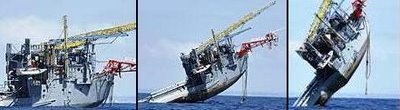
In 2002, when my wife was working aboard the Robert G. Sproul at Scripps Institute Of Oceanography, we had the chance to tour FLIP and it is one of the most interesting vessels I’ve ever seen. The Scripps website tells us alittle about this amazing research platform:
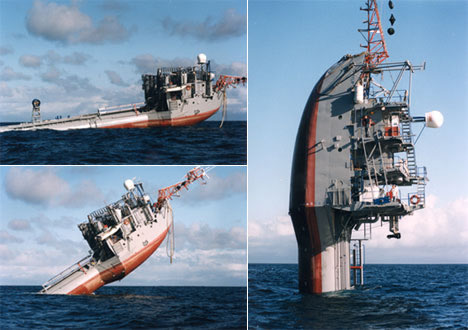
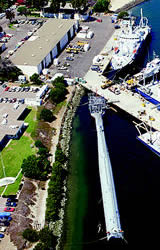
FLIP stands for Floating Instrument Platform: it is actually a huge specialized buoy. One of its creators described it as looking like a 355-foot long ( 108 m) baseball bat. If that isn’t unusual enough, it really flips!
Popular Mechanics featured the FLIP in a recent edition of the magazine. Here are some highlights from the story:
Shaped like a giant baseball bat, the 700-ton FLIP, or Floating Instrument Platform, is a Navy barge operated by Scripps Institution of Oceanography in San Diego. Once towed to a site, the vessel flips to vertical. “It was built in 1962 to refine acoustic targeting for submarine rockets, but scientists quickly realized that it would be useful for all kinds of research,” says Bill Gaines, FLIP’s program director. “So 45 years later, FLIP still serves the oceanographic community.” And it is still one of a kind.
Stability
Tanks 5, 8 and 9, and parts of tanks 6 and 7, remain filled with air to keep FLIP buoyant. Like the Louisville Slugger that the vessel was modeled from, FLIP increases in diameter from bow to stern — a profile that contributes to its stability when vertical. “A design criterion for FLIP was that it move less than one-tenth of a passing wave’s height,” Gaines says.
There is more good information at Popular Mechanics site in the story titled:
(Bloomberg) — The owner of the shipping yard that built the Titanic is entering administration, a type of insolvency procedure in the UK, for the second time in five years. ...
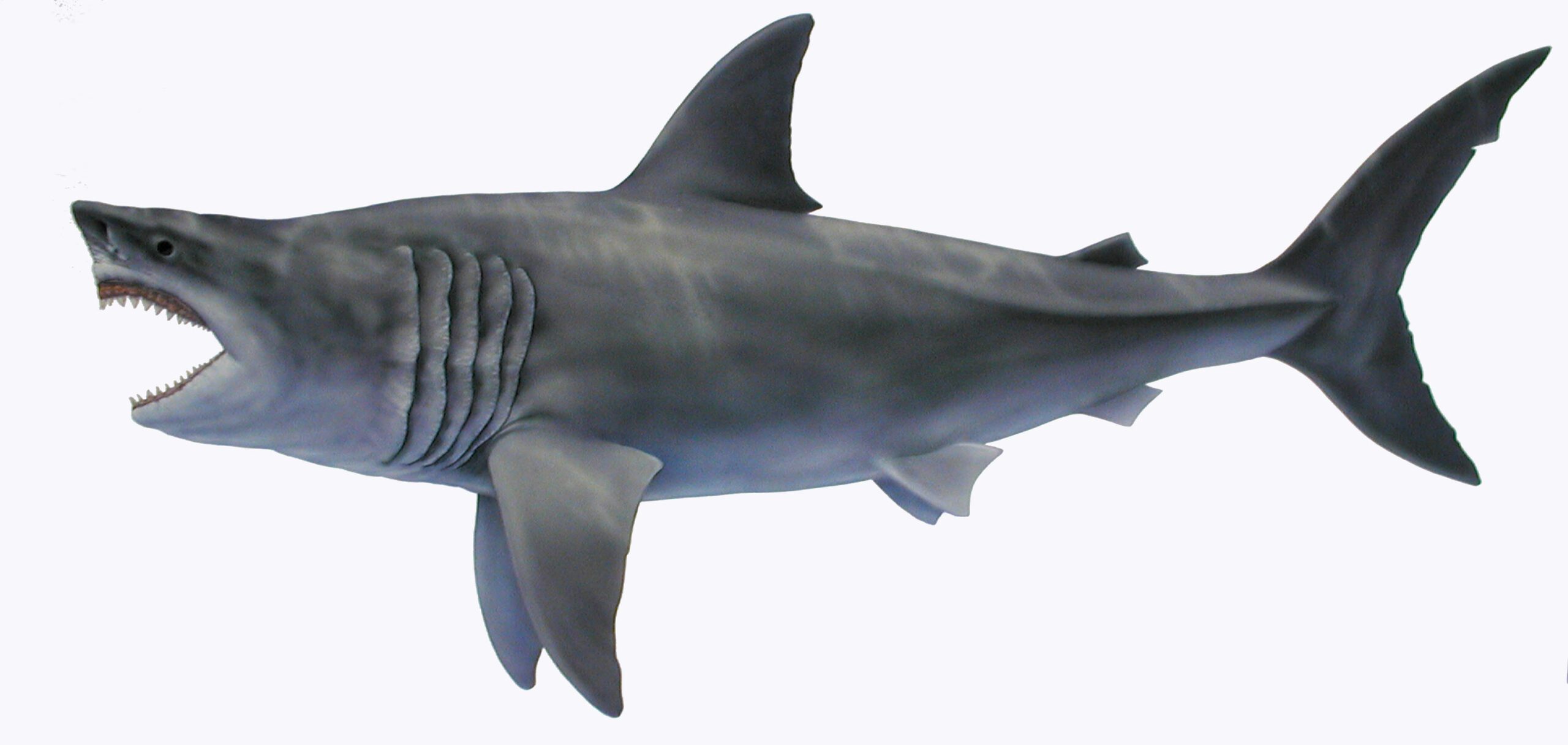
John Long (Flinders University) Imagine the seas off Peru, 6 million years ago. A group of long-nosed dolphins swam through the warm seawater, breaking the surface with occasional enthusiastic leaps...
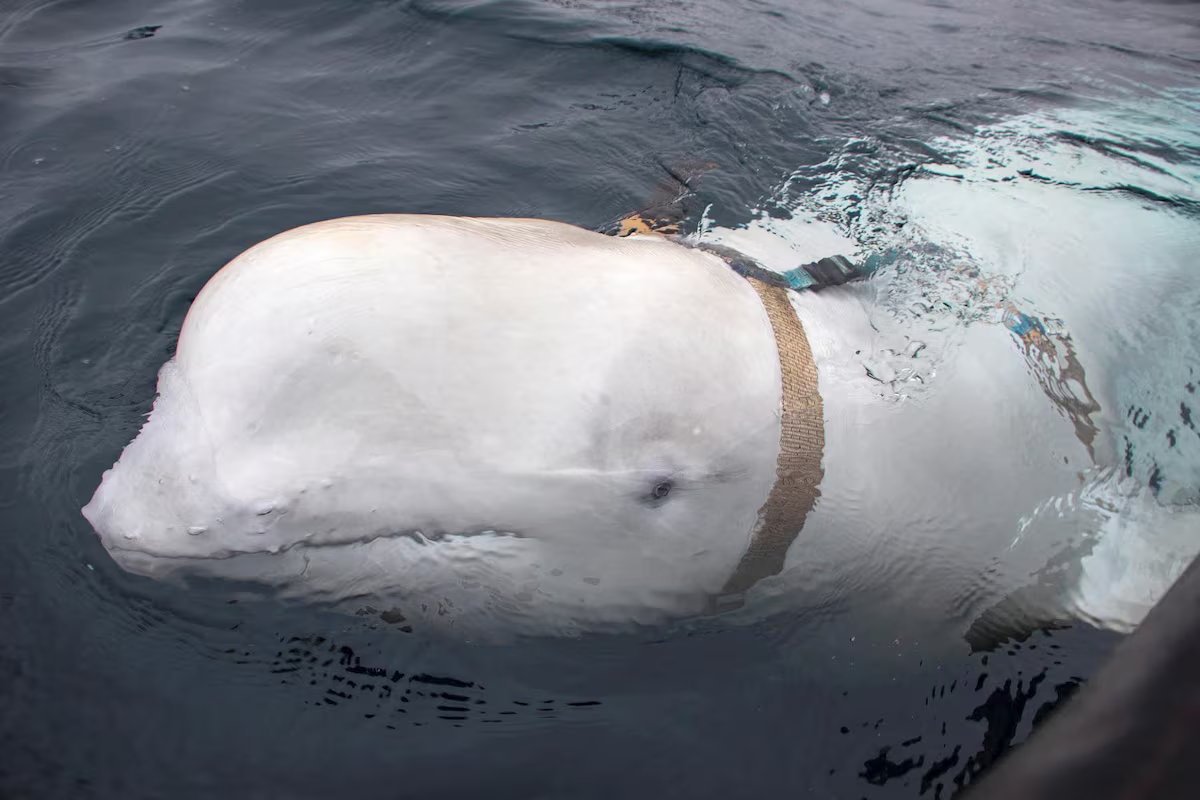
Sept 2 (Reuters) – A beluga whale that was suspected of spying for Russia after being discovered in Norwegian waters five years ago has been found dead, according to the non-profit organization...
September 1, 2024
Total Views: 8399
Why Join the gCaptain Club?
Access exclusive insights, engage in vibrant discussions, and gain perspectives from our CEO.
This website uses cookies to improve your experience while you navigate through the website. Out of these, the cookies that are categorized as necessary are stored on your browser as they are essential for the working of basic functionalities of the website. We also use third-party cookies that help us analyze and understand how you use this website. These cookies will be stored in your browser only with your consent. You also have the option to opt-out of these cookies. But opting out of some of these cookies may affect your browsing experience.
Necessary cookies are absolutely essential for the website to function properly. This category only includes cookies that ensures basic functionalities and security features of the website. These cookies do not store any personal information.
Any cookies that may not be particularly necessary for the website to function and is used specifically to collect user personal data via analytics, ads, other embedded contents are termed as non-necessary cookies. It is mandatory to procure user consent prior to running these cookies on your website.

 Join The Club




 Tanks 5, 8 and 9, and parts of tanks 6 and 7, remain filled with air to keep FLIP buoyant. Like the Louisville Slugger that the vessel was modeled from, FLIP increases in diameter from bow to stern — a profile that contributes to its stability when vertical. “A design criterion for FLIP was that it move less than one-tenth of a passing wave’s height,” Gaines says.