The Arctic’s declining sea ice has meant more opportunities for the shipping industry to expand its use of the region that in decades past was unnavigable for the vast majority of the year.
The Northwest Passage through Canada and the Northern Sea Route, or Northeast Passage, north of Russia and Siberia, are both valued because they could significantly shorten ship transit times between Asia, Europe, and North America.
In February, a similar tanker, the Eduard Atoll, completed its own unescorted trip through the region in the dead of winter, marking another historic first. During that voyage, the vessel sailed South Korea to Sabetta terminal in northern Russia, where it loaded LNG produced at a new $27 billion plant and transported it to France.
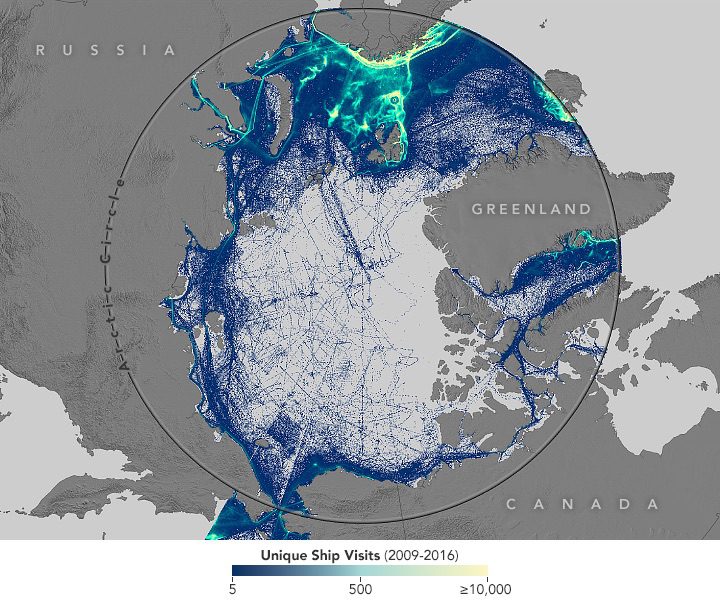
To illustrate this increase in ship activity in the Arctic, a team of scientists has banded together to analyze and map more than 120 million data points in order to track where ships are most using the region.
To make the map, the team, led by Paul Arthur Berkman, director of the science diplomacy center at Tufts University, and Greg Fiske, a geospatial analyst at the Woods Hole Research Center, used data compiled by SpaceQuest, a company designs microsatellites that can monitor the track Automatic Identification System (AIS) signals from ships.
Once the data was plotted, there were some interesting observations to be made.
This map shows unique ship visits to Arctic waters between September 1, 2009, and December 31, 2016. Credit: NASA Earth Observatory
Looking at the data, Berkman, Fiske, and their colleagues found that the mean center of shipping activity moved 300 kilometers north and east—closer to the North Pole—over the 7-year span.
Notably, they were particularly surprised to find more small ships, such as fishing boats, wading farther into Arctic waters. The team also plotted the AIS ship tracks against sea ice data from NSIDC and found that ships are encountering ice more often and doing so farther north each year.
Despite the seemingly growing opportunities for shipping, the increasing number of ships in the region has given rise to serious concerns about pollution, oil spills, and disturbances to marine life, among other possible impacts.
Berkman is the coordinator and lead investigator of Pan-Arctic Options, which provides objective information that can guide the placement of infrastructure and the management of activities such as search and rescue and pollution response.
Now whether or not open Arctic waters will be long-term boon for shipping remains to be seen, but scientists agree that the melting trend does not bode well for the Arctic environment as we have known it.
“Arctic sea ice cover continues to be in a decreasing trend, and this is connected to the ongoing warming of the Arctic,” said Claire Parkinson, a climate scientist at NASA’s Goddard Space Flight Center. “It’s a two-way street: the warming means less ice is going to form, and more ice is going to melt. But also, because there is less ice, less of the Sun’s radiation is reflected off of Earth, and this contributes to the warming.”
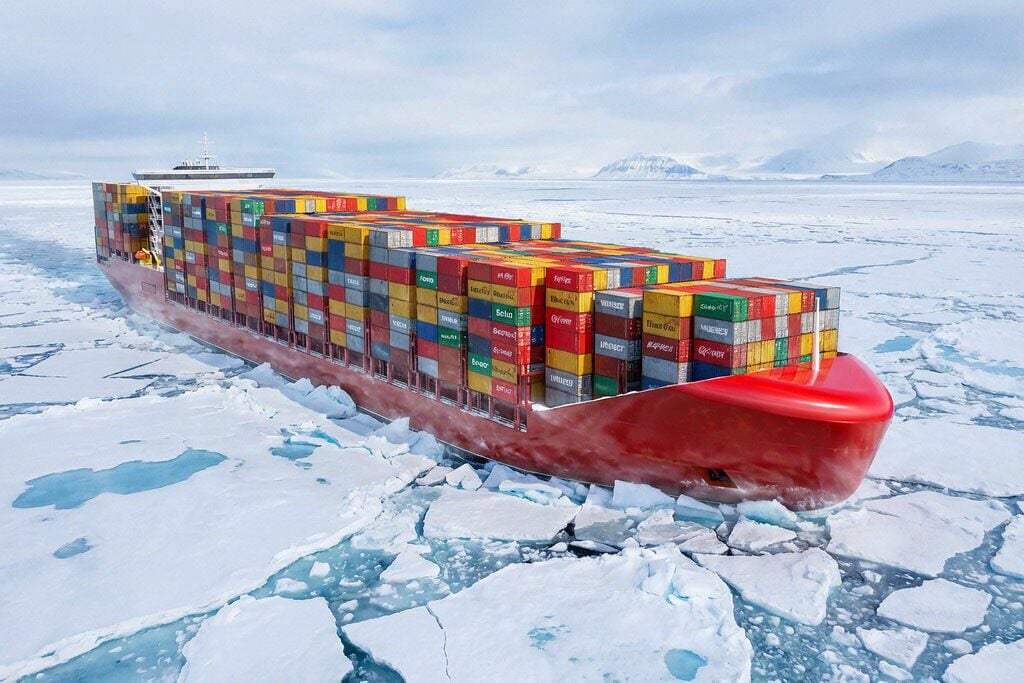
China’s NewNew Shipping Line and Russia’s state nuclear corporation Rosatom are advancing plans to build five large ice-class container ships aimed at making commercial shipping on the Northern Sea Route a year-round operation.
South Korea’s first commercial container trial through the Arctic has attracted just 737 TEUs of cargo, well below the 1,300 TEUs initially targeted for the voyage, highlighting the challenge of generating sufficient demand for a new Northern Sea Route service.
Russia’s newly delivered Arc7 ice-class LNG carrier Alexey Kosygin has spent nearly two weeks circling off China’s eastern coast after delivering a cargo from the sanctioned Arctic LNG 2 project, raising questions over whether the vessel is awaiting repairs at a Chinese shipyard.
August 28, 2026
Total Views: 1407
Get The Industry’s Go-To News
Subscribe to gCaptain Daily and stay informed with the latest global maritime and offshore news
— just like 107,296 professionals
Secure Your Spot
on the gCaptain Crew
Stay informed with the latest maritime and offshore news, delivered daily straight to your inbox
— trusted by our 107,296 members
Your Gateway to the Maritime World!
Essential news coupled with the finest maritime content sourced from across the globe.

 Join The Club