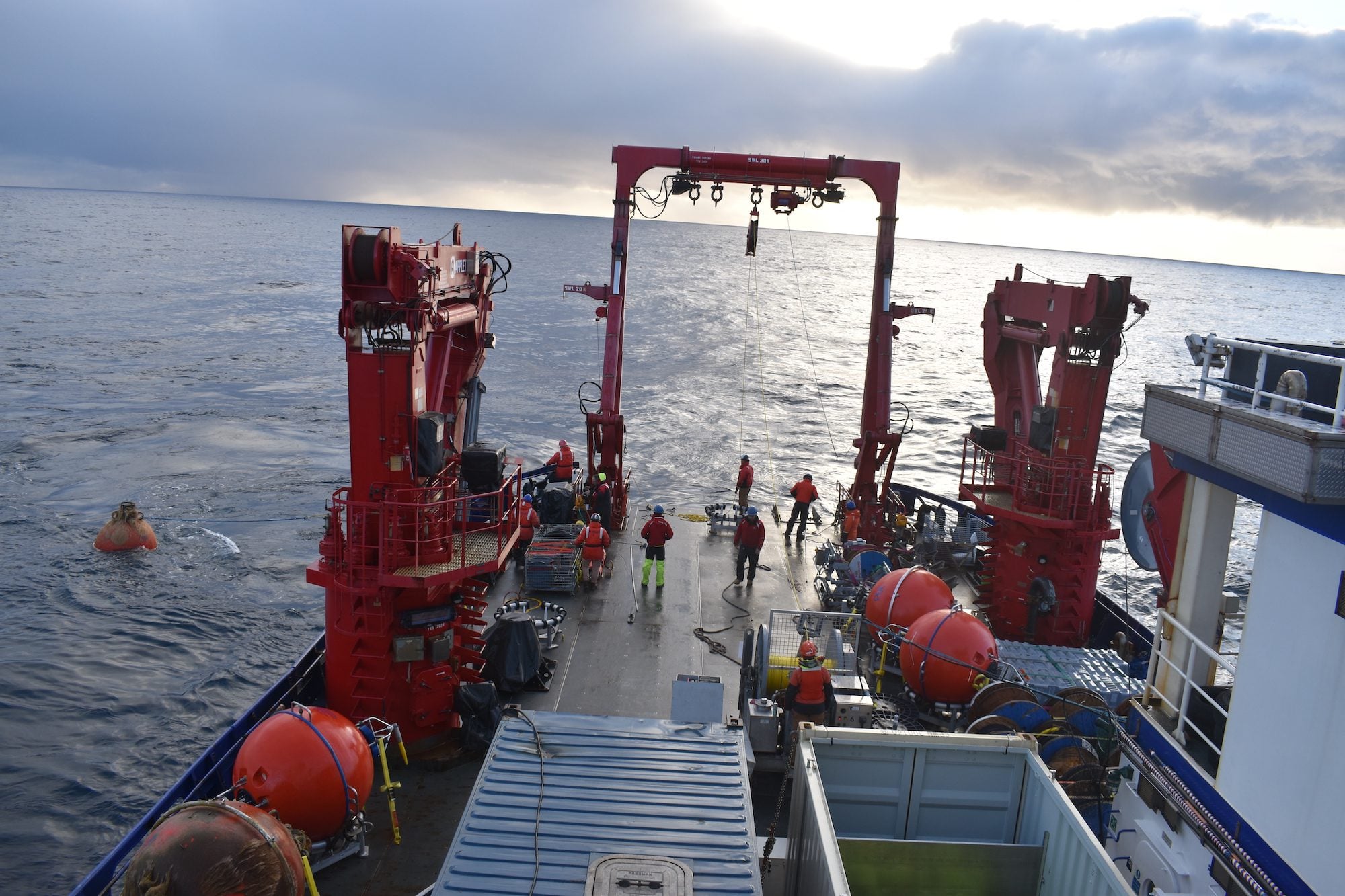
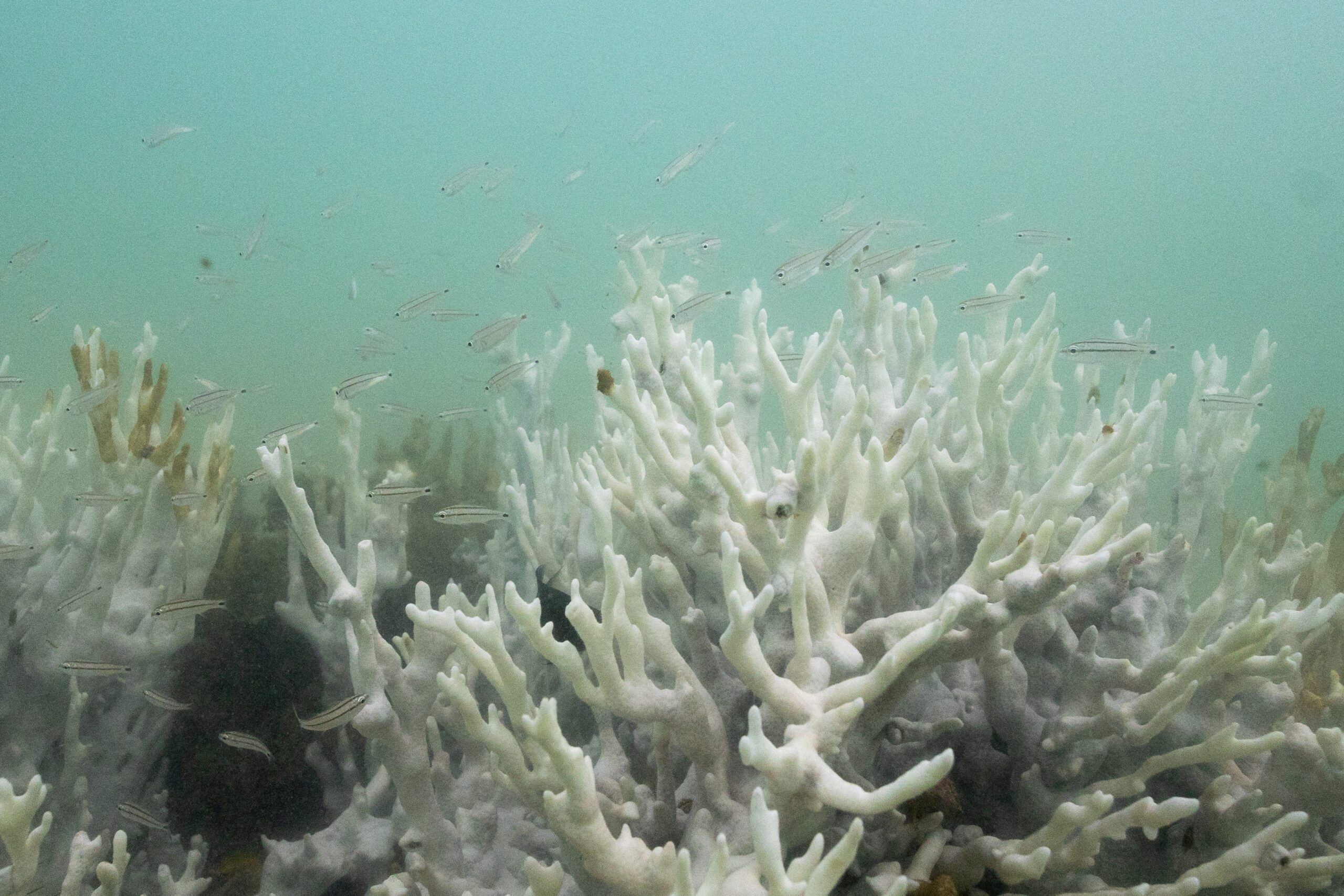
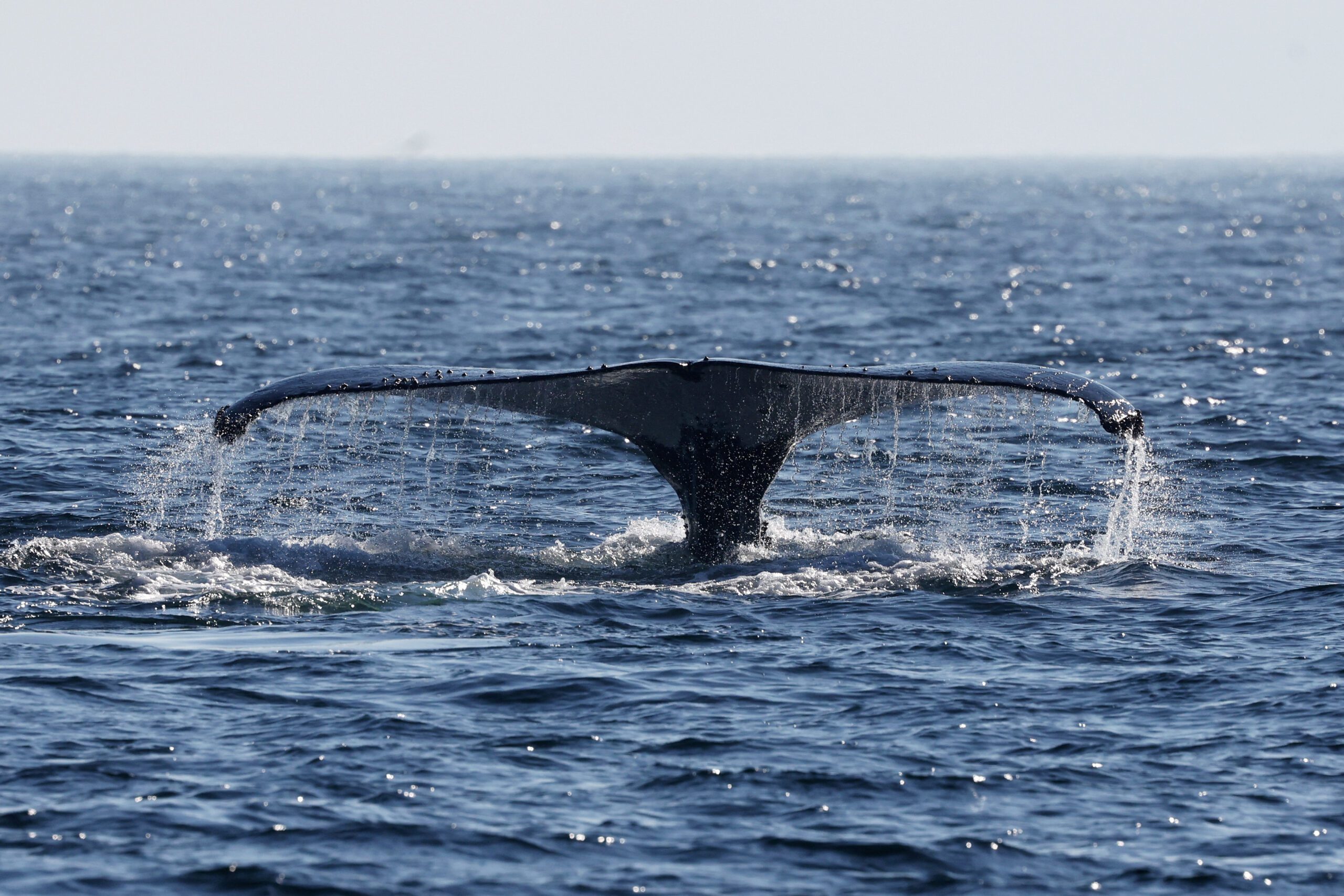
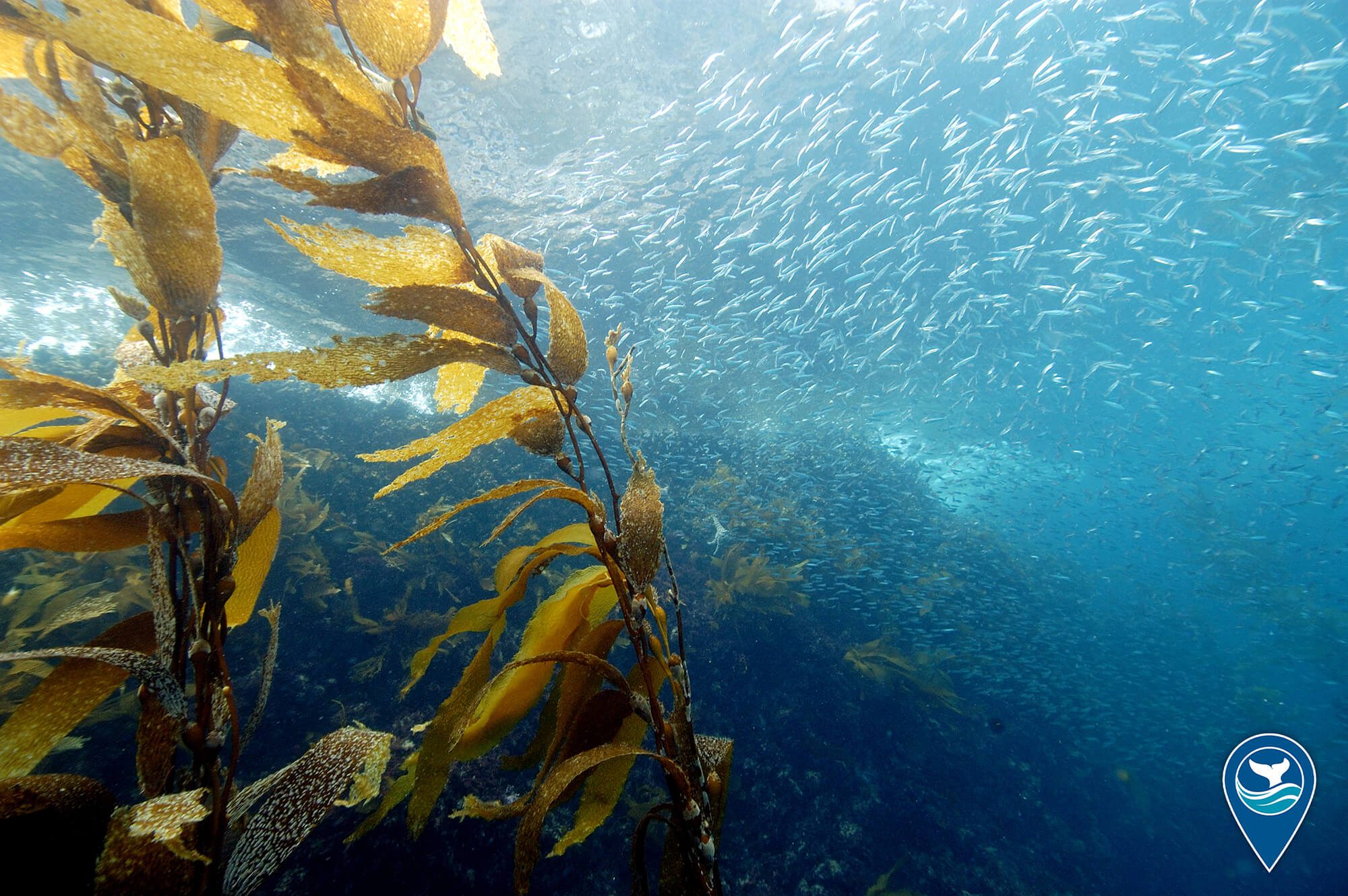
NOAA has teamed up with the Smithsonian Institute to bring the depths of the ocean to the National Mall, in Washington D.C. This past weekend, the Institute inaugurated the Sant Ocean Hall in the National Museum of Natural History: an exhibit that aims to raise awareness of the importance of the ocean and the effect of human activities on marine life. NOAA tells us about the exhibit:
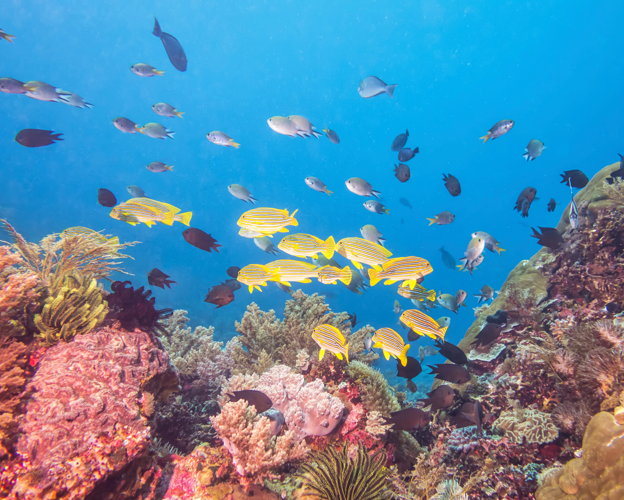
Phoenix, a 45-foot model of a living North Atlantic Right Whale, serves as the Hall’s signature symbol. There are 10 sections in the hall that address a variety of ocean-related topics, including the deep ocean, coral reefs, the Arctic and Southern Oceans and current ocean research. The Coral Reef section has a 1,500-gallon aquarium featuring an Indo-Pacific reef with over 1,000 specimens of more than 50 different species of live fish and other marine life. The hall’s “Journey through Time” section looks into the past with fossils of a large number of ancient organisms; some are more than 500 million years old. In the exhibit’s theater, a 13-minute video, “Deep Ocean Explorers,” takes visitors on a dive through the zones of the open ocean to the deep ocean bottom aboard the submersible, Alvin.
The exhibit is a good fit that fills a void in both the Natural History Museum and others in the area. I will be sure to check that out next time I am over in our Nations Capital.
In other news, just a few hours north in New York, The Intrepid is finally making its way back to the West Side of New York City after two years from being hauled off for renovations. [Continue Reading →]
The Ship Residence - High upon a promontory on South Bass Island in Lake Erie at Put-in-Bay, Ohio, sits the Owners and Captains Quarters of the former Great Lakes Shipping Boat, The Benson Ford. The boat was built by Henry Ford and named after his grandson many years ago. After fifty years of service on the Great Lakes, the Benson Ford was scheduled in 1986 to be scrapped at the Port of Cleveland, Ohio. On the top front section of the boat were the walnut paneled state rooms, dining room, galley, and passenger lounge designed by Henry Ford for his own pleasure while traversing the Great Lakes on business. (Source: Sea-Fever)
Collingwood’s Vessel: a Retirement Home for Elderly Fisherman
Ship Drydock Design - The scheme is a retirement home for elderly fisherman that also houses a working men’s club for members of Newcastle’s fishing community,” Pearson writes. “As a reflection of the separation and torpor of this unique society, the scheme takes the notion of the ship in an architectural context, to create an ersatz environment which interacts with the city around it as if it were a dry docked vessel. The environmental technologies and the ways in which the notional ship has been translated into an architectural system are the focus of this study.” (Source: BLDBLOG)
BIG Maritime Museum Denmark
BIG’s Maritime Museum - BIG [the Bjarke Ingels Group], has recently won a competition [by unanimous decision, even though they apparently didn’t adhere to the design brief - ninjas in true form] to design the Danish Maritime Museum in Helsingør, DK. While searching for an appropriate site for the proposed project, the firm discovered an abandoned 150m long, 25m wide, and 9m deep concrete dry dock within eyesight of Kronborg Castle . (Source: MNY)
The Floating Islands
Floating Islands - A design by Vincent Callebaut Architectures, Floating Islands is a flexible masterplaned multi-energy town. By using current power generators and other green technology this is a futuristic design for green living. Callebaut’s vision is “creation which consists in mixing a scientifical and cultural survey with a computer programmatic approach in order to transcribe in architecture landscape distortions or ecosystem abstractions. Each architectural project at any scale, wants to anticipate through this digital hybridization, the future lifestyles by inventing new imaginary worlds. More poetic worlds. More equitable worlds. More natural worlds. Actually, more humanistic worlds! ”
Performing Arts Center, Seoul
Performing Arts Center, Seoul - ” Whereas the orchestra is in rehearsal, we continue our walk towards the places switched by the sound of the soprano and the violins. The both performing rooms of 1500 seats each are megaliths submerging from the floor. They are located at the extremities of the island and each of them is isolated from the road by two blocks gathering together annex functions like workshops and rehearsal rooms, public sanitary, offices and technical spaces. Their double layer of concrete protects the shows from feared sounds of low frequencies coming from the freeway traffic. They are very white and diffuse a extraordinary light ! The roundness of these hulls makes us think of the most beautiful ships and plays with the shadows of the linen seams which projects itself at the surface. ” (Source)
Nantes Slavery Memorial
Nantes Slavery Memorial, France - Bonder + Wodiczko are received an ACSA award for their work on the design of a memorial to the abolition of slavery [Memorial à l’abolition de l’esclavage] in Nantes, France. Visitors to the memorial will walk along an altered landscape, littered with plaques commemorating each ship that carried slaves into Nantes [the plaques will display the name of the ship, the date, the number of slaves on board, and the number of slaves who lost their lives on the voyage]. Having walked along the length of the glass [which you can see actually slips through the ground plane], visitors descend a monumental staircase into a subterranean passage where these three aforementioned witnesses - the river, the quay, and the sky - meet [through the reflection from the glass] in one confined space. (Source: Architecture.MNP)UPDATE: Reader Submissions
Milwaukee Art Museum
Milwaukee Art Museum - The Calatrava-designed Quadracci Pavilion, the first Calatrava-designed building to be completed in the United States, first opened to the public May 4, 2001. On that date the museum opened the new exhibition galleries, larger museum store and auditorium in the Quadracci Pavilion along with the completely renovated and reinstalled permanent collection galleries. (Via Joe Smith)
Canada Place, Vancouver Cruise Ship Terminal
Canada Place - Constructed for Expo 86 as the pavilion for Canada and was the only venue for the fair that was not at the main site on the north shore of False Creek. It can be reached via the SkyTrain line and the nearby Waterfront Station subway terminus. The striking white sails of the building has made it a prominent landmark for the city, as well as drawing comparisons to the Sydney Opera House in Sydney, Australia. (Google Earth View)
(Note: This post originally appeared on gCaptain Jan ‘08)
Three years ago at the World Expo in Aichi Japan SkySails promised a revolutionary design with the ability to reduce fuel consumption aboard ship by up to 24%. Last week the dream became reality. BBC News tells us:
There is something rather magical about being up on deck of a giant cargo ship as it pushes its way out to sea. Ten thousand tonnes of metal heaving through the water, the ship’s giant masts glistening in the winter sun. But there is something even more magical about being aboard MS Beluga SkySails. On the face of it, this vessel - which is carrying parts of a timber production line to Venezuela - looks like any other cargo ship.
MS Beluga SkySails believes its fuel bill will be cut by £800 ($1,560) a day. “We can demonstrate that you can combine economy and ecology,” Verena Frank of Beluga Shipping explains. “Economy, because you can reduce fuel consumption and fuel costs, and on the ecological side of things, we reduce emissions.”
The kite is controlled by computers. One computer helps it to fly in figures of eight in the sky - maximising the power it produces. Another computer adjusts the kite’s direction. If the project is successful, expect to see even bigger kites soon - some up to 5,000sq m (53,820sq ft) in size pulling ships across the seas and oceans. Read More…
The most technologically advanced drillship in the world is not on lovaton in the gulf of mexico or in a Korean shipyard. Actually it’s not even built yet. Meet the Aurora Borealis, a dynamically positioned, drillship/icebreaker, arctic research vessel designed for the European Union. The official website tells us;
The Research Icebreaker AURORA BOREALIS will be the most advanced Polar Research Vessel in the world with a multi-functional role of drilling in deep ocean basins and supporting climate/environmental research for the next 40 years.
The new technological features will include azimuth propulsion systems, satellite navigation, ice-management support, deep-sea drilling under a closed sea-ice cover and the deployment and operation of Remotely Operated Vehicles (ROV) and Autonomous Underwater Vehicles (AUV) from one of the two moon-pools.
The unique feature of the vessel is the drilling rig, which will enable sampling of the ocean floor down to 5000 m water depth and with 1000 m penetration into the seafloor at the most inhospitable places on earth. The drilling capability will be deployed in both polar regions and AURORA BOREALIS will be the only vessel worldwide to undertake this type of scientific investigation.
Technical Details:
• Powerful icebreaker with ca. 55 MW (diesel-electric)
• Highest classification for icebreakers
• Twin hull
• Two moon pools 7 x 7 m each
• Dynamic Positioning System
• Deep-sea drilling under a closed sea-ice cover
• Drilling rig: max. 5,000 m water depth and 1,000 m core
• Riserless drilling technology
• Modularized mobile laboratory systems - mission specific laboratories
Length over all ca. 180 m | Beam ca. 40 m | Personnel (crew + scientists) 120 | Expedition duration 60 days.
For more information on the Aurora Borealis visit the official website HERE or download the presentation HERE. For the oceanography geeks a more detailed study can be found HERE.
UPDATE: The BBC has just run an excellent article on this vessel which can be found HERE.
Note: This article was originally posted in Jan 08
Robin Storm points us to this photo of this spectacular waterspout off New Zealand’s Kapiti Coast. Be sure to check out the photo slideshow and article and stay tuned for Robin’s upcoming Severe Weather segment on our podcast.
Sea Fever brings us the annual cruise of Massachusetts Maritime Academy’s training ship Enterprise. This cruise has departed each winter for well over one hundred years and serves both as a platform for training future merchant officers and an escape from the regions brutal winter. Sea Fever tells us:
There are three blogs each offering a unique perspective on the experience. Captain Thomas L. “Tom” Bushy writes Sea Term 2008: Captains Blog which covers all of the things that you would expect a master of a training ship to be focused on. Cape Cod Times reporter Hilary Russ writes short posts in The Portal that present a outside the experience perspective of life at sea with cadets. Russ posts often get a decent volume of comments, many from parents of cadets thanking her for keeping them informed. Last but certainly not least, 4th class cadet Christiaan Conover writes MMA Sea Term 2008 blog from the perspective of a young person going to sea for the first time on a commercial ship. Christiaan also has a personal blog and is on Twitter and you can follow him here. These 3 primary bloggers are able to paint a pretty rich picture of life aboard the T.S. Enterprise.
You can also get a video tour of the enterprise by visiting Cape Cod Time’s YouTube page HERE. Here is a preview of the tour:
Take a look at all of the US based training ships HERE.
The notion of cities condensed into a singular structure or hyperstructure, has frequented works of fiction as far back as 1899 with H.G. Wells, When the Sleeper Wakes. The concept garnered wider attention seventy years later when Architect Paolo Soleri published, Arcology: The City in the Image of Man. Massive self sustaining habitats, the pliable infrastructure and small ecological footprint of arcologies avoid the damaging, inefficient urban sprawl of today’s cities and suburbia.