What is your area of expertise? The five year old son of a mechanic aboard my ship is a true prodigy of the arts. The stick figures I have spent over 30 years perfecting are effective at getting a basic message across but those drawn by young Evan, who is still in preschool, have depth and character. Is his ability genetic? His father certainly can’t draw. Is he just naturally gifted? Probably not.
Evan’s ability comes not from a gift of birth but from the gift of his father, encouragement and repetition. Because each time Evan draws a picture his father smiles broadly and suggests an improvement. He then runs back to his room to test a new method and try again. In doing so, Evan learns new methods to improve his skill.
Each of us have certain skills aboard ship and one or two areas in which we excel. And many of these traits, whether it be knot-work or ship handling, stem from the encouragement or envy of a former mentor who took the time to show us the ropes and pushed us to find incremental improvements.
As Master’s it is our responsibility to push the crew to develop skills they will carry for the remainder of their careers. In doing so we not only develop their abilities but, by joining our knowledge with their discovery, we also develop ours.
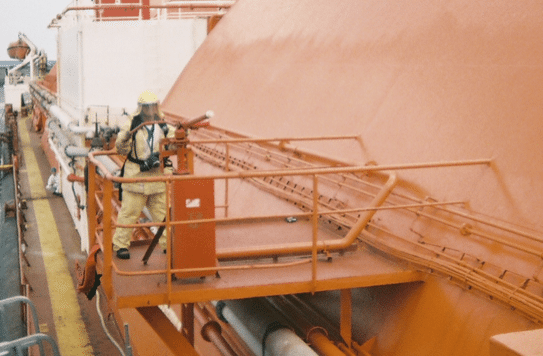
For me one passion has always been emergency response and, in particular, marine firefighting. Over the years I have challenged my crews to innovate and improve their performance at every drill then, during the debriefing, look for new ideas which we can test at the next drill. The results have been impressive. [Continue Reading →]
Tags: · emergencies, marine-firefighting

One of the worst things that can happen on board any vessel at sea is a main space Bravo fire. If you’re in charge of your Damage Control organization, you may have asked yourself if your organization have what it takes to combat such a casualty. Do they realize what coordinated efforts have to happen in order to give this story a happy ending, or is it simple irony that we end each scenario with an Abandon Ship exercise?
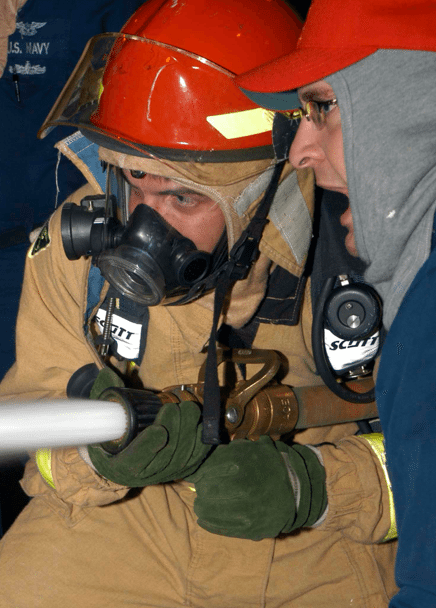
As a damage control leader, you should be constantly on the lookout for better ways to train your fire parties. This training should be as realistic as possible (in other words, just short of setting an actual fire). Your organization should be in constant critique and review, asking yourself a simple question: “Is it good enough, or can I make it better?” The best way to do this is called “Assets and Deficits.” Using this process, we’ll take a step-by-step look at a main space Bravo fire.
You have a fuel leak in the engine room. The leak increases, causing an atomized spray pattern onto an extremely hot engine manifold. The fuel smokes and becomes a combustible mixture in the atmosphere. The leak increases more. Excess fuel has pooled onto the deck and is running down into the bilge. Finally, the fire triangle has balanced enough to start sustained combustion. You now have a fire with an extremely large source feeding it.
Think how you would fight this fire aboard your ship. Think about your assets and deficits, then visit Part 2 of this story: “Discovery.”
This series was written by Timothy Ciciora, Command Master Chief USN, Retired, Atlantic Beach, Florida, author of short stories, including “The Homecoming,” the opening selection in the Marlo Thomas best selling collection, The Right Words at the Right Time – Volume 2
.
Tags: · damage control, fire, Firefighting, marine-firefighting, tips
Like It Or Not; It’s Here
Fighting LNG Ship Fires
Originally Published Sept 2007
By Tom Guldner, Marine Firefighting Inc.
First, let me state that this article is neither FOR nor AGAINST Liquid Natural Gas (LNG) in the USA. Its purpose is to understand what it is and how the vessels crew and Land-Based Firefighters and first responders can deal with emergencies. Opponents of LNG have come up with many false statements about the dangers of LNG while the LNG industry may lead us to believe there is absolutely no danger in handling LNG. We as firefighters (marine or land-based) and as the mariners who work with the LNG vessels must look at this issue in a more unbiased view. Anything is dangerous if used improperly. Even water has been found to be the culprit of many devastating oil tanker explosions when used under pressure to clean the vessels tanks. The static electric charge the water builds up can create a spark which can rip apart a huge oil tanker. We have also seen that water has caused many vessels to capsize and sink when too much of it has accumulated aboard a ship during firefighting operations.
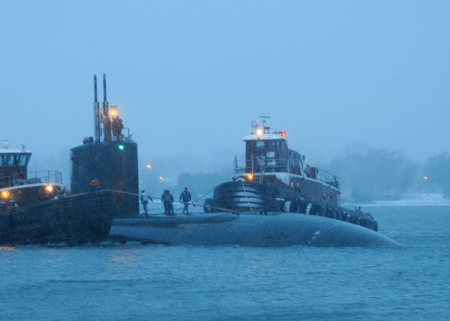
My company, Marine Firefighting Inc., has been involved in providing informational seminars to the tug boat crews who have the task of escorting some of the large LNG ships into US waters. The tug boats being used are specially designed for this task. Each is equipped with state of the art firefighting equipment. MFI has been providing the familiarization with this new firefighting equipment and also familiarization with the properties of the LNG they will be working with.
Much controversy surrounds the Liquid Natural Gas (LNG) industry in the United States. A good deal of the criticism comes from the “Not in my back yard” syndrome. Most of us realize that our energy needs will soon outpace our supplies. With new emerging economies such as China and India the world’s existing oil reserves are going to be drawn upon much more than at any time in our history. LNG has been presented as one of the answers of bridging the eminent energy gap between users and suppliers. However, no one wants to live next door to an LNG plant.
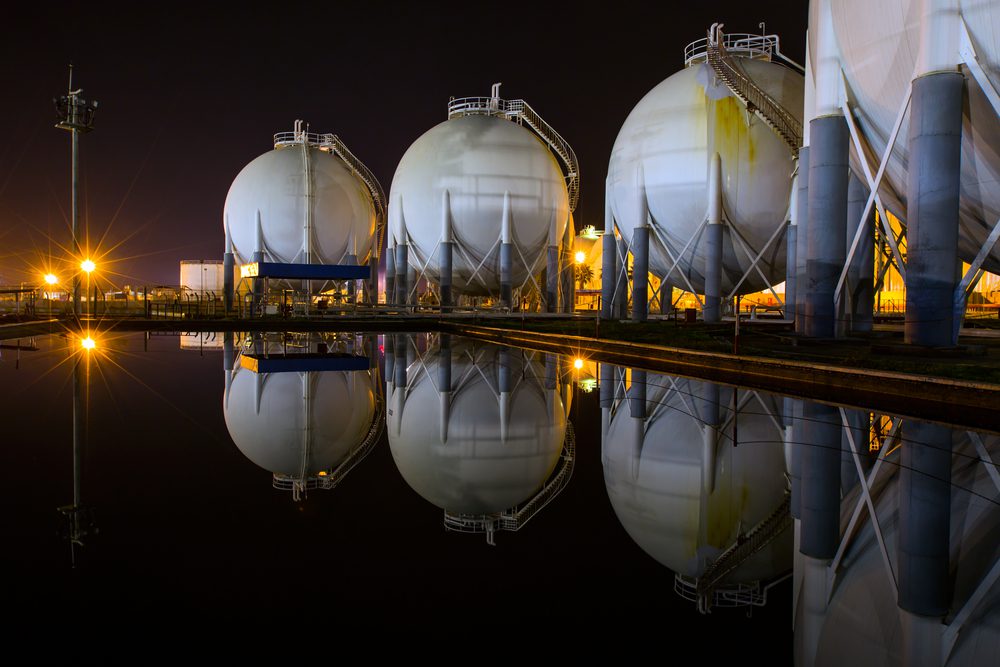
What is LNG? Liquid Natural Gas (LNG) is a colorless, odorless, liquid which is natural gas in a liquid form. Previously, the world’s large supplies of natural gas have not been available to areas remote from these gas wells. The cost of shipping natural gas in its gaseous state was simply too expensive. Liquefying natural gas reduces its volume 600 times (see diagram left.). Because of this reduction in volume it became profitable to export natural gas in its liquid form (LNG). The process of liquefying natural gas differs from the liquefying of other gasses. The main difference is that LNG does not require pressurization to keep this gas in a liquid state as is the case with Liquid Petroleum Gases (LPG) such as Propane. (Marine transport of Propane may use refrigeration to reduce its pressure during transit.) LNG is formed by subjecting natural gas to extremely cold temperatures. At minus 260 degrees F (-161°C ) the gas becomes a liquid at atmospheric pressure. Liquids at these temperatures are considered “Cryogenic”.1 [Continue Reading →]
Tags: · Firefighting, liquid-natural-gas, LNG, lng-tankers, marine-firefighting, natural-gas, ship-fires, Ships
Should Have Used the Grits
By The Artful Blogger
Hi kids! This is part two of my ways to put some spice into your fire drills and maybe . . . just maybe, you might have a little fun. I promised special effects, which or course, reminds me of a story:
I live in a great neighborhood. I couldn’t ask for better neighbors if I had ordered them from the Sears catalog. Most of them are either retired or past military, so we’re just like family. I have a guy who lives a couple of doors down. His name is Jack. He’s a great guy, but he has one small problem. It seems that every time he comes in contact with any sort of tool, we’re taking him to the emergency room. I mean, even Tim the Tool Man would be scared of this guy. One weekend, we were all outside doing the lawn-thing, when Jack approached me. I could tell by the look on his face that he had a project in mind. It seemed that Jack had a fire ant problem and wanted to know how to kill them. Living in Florida, this is a common occurrence, so I was quick with my response. I told him to use raw grits. He looked at me funny. Believe it or not, this actually works. Well Jack, being from Michigan, only had instant grits (It’s a northern-thing). I told him that instant wouldn’t work. I was going to refer him to some commercial-type ant killers when my other neighbor, Frank, piped in. He told him to use gasoline. (Frank’s a crusty old retired Vietnam Vet, so you can see the logic.) As Jack scurried away with his new-found information, I gave Frank a look like, “You know better than to do that.” Having finished my yard work, I retied to the house for baseball and my favorite malt beverage. Little did I know what events would transpire next.
Jack took his little half gallon gas can over to the ant mound and poured a liberal amount of petrol onto it. After striking a stick match (mind you, the only smart thing he did was to use a stick match), he tossed it onto the mound. A small one foot flame briefly flared up and quickly died down to a few inches. What Frank neglected to tell Jack was that was all the fire he needed to perform the extermination. Jack thought to himself, “Is that it? Maybe I need more gas.” (OK kids, here’s where it gets good!) Jack tips the little gas can over the open flame from about three feet up. The gas dumps down onto the flame. (Can you guess what happens next? No, jack couldn’t either.) The flame traveled up the pouring gasoline and this ramjet with conviction shot out of the nozzle of his tiny gas can (After all, it’s not the size, but how you use it). The thing was like a flame thrower. So, what does our hero do? He starts violently shaking the can, trying to put out the flame. Instead of extinguishing it, he sprays fuel all over his lawn. Now, half his lawn is on fire . . . and his curbside mailbox . . . and his wife’s flower garden . . . and the left front tire of his wife’s Buick.
I hear a knock at my door. It’s Frank. [Continue Reading →]
Tags: · Artful Blogger, Firefighting, marine-firefighting, ship fire
Painful Rectal Itch
By The Artful Blogger
OK, I’m back from my little “vacation.” Seven months may have been a bit excessive, but what the hell. Anyway, where were we? Oh yeah, we were talking about spicing up your fire drills. Yeah I know you’d sooner get a root canal then do a fire drill, but hey, they don’t have to be that painful. I remember a commercial from back in the day about hemorrhoid pads. I know you all want to hear all about it (you know I’m going to tell you anyway, so bear with me). There was this husband and wife in bed asleep. All of a sudden, he sits up in bed screaming. His wife asked, “What’s wrong, honey?’ His response was, “It’s this painful rectal itch!” Now, my father had roids. I consider him the average working Joe. I believe his response would have been more along the line of anything from: “My damn biscuits are burning!” to “Somebody shoved a hot poker up my @$$!” Not, “Gee honey, I have a painful rectal itch.”
As usual, you’re asking, “OK Artful, what’s the point?” (Are you ready, kids? Well, here it is.) Is the way that you’re conducting your fire drills more like a painful rectal itch to your people, or are they like a hot poker up their @$$es? In this multi-part series, I’m going to give you some ways you can spice things up a bit, while making your training a little more meaningful. Along the way, you just might have a little fun.
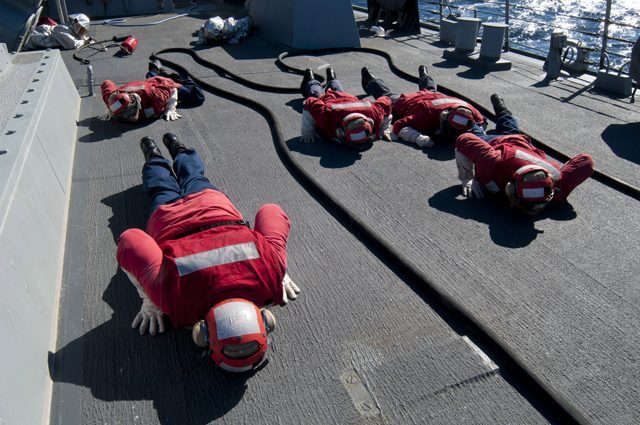
The key to success of any project starts with organization. If John Wayne didn’t have a script in his movies, all he’d do is go around punching and shooting people (OK, bad example). For the sake of training, fluidity and safety, you need to have an exact script. All of your hands are actors in this movie, and your training team members are the directors. Your Captain, Master or Mate is going to produce the whole she-bang. Let’s see if we can make a Spielberg production. [Continue Reading →]
Tags: · Firefighting, marine-firefighting, marine_firefighting, Navy, ship fire, Training

An engine room fire at 12:31 this morning forced an evacuation of Queen of the West.
From a Coast Guard Media Release:
SEATTLE – The Coast Guard, state and local authorities have offloaded the passengers and non-essential personnel from the Majestic Cruise Line passenger vessel, Queen of The West, after it suffered an engine fire earlier this morning.
The Queen of The West was beached in a controlled manner in the vicinity of Maryhill State Park, where the passengers were offloaded safely over the vessel’s bow ramp.
The 124 passengers were transported by bus to Skamania Lodge, Ore.
One crewmember became wet while fighting the fire, and was taken to a local hospital after exhibiting signs of hypothermia. Three of the crewmembers were checked and released on scene for smoke inhalation.
The vessel owner plans to tow the Queen of The West to the Port of Klickitat, Wash., just upstream of The Dalles Dam, with a crew of 26 essential personnel. There they will prepare the vessel for a further tow to Sundial Marine in Troutdale, Ore., for repairs.
Klickitat County emergency services personnel managed the disembarkation and processing of passengers.
The Washington Department of Ecology organized precautionary shoreline protection operations along the river to address the risk of any oil pollution from the disabled vessel.
The cause of the engine room fire is under investigation.
Cruise Critic tells us:
The fire was noticed last night around midnight and the Coast Guard was notified. The incident occurred while the boat was sailing between The Dalles and John Day Locks (map); the boat was towed to Maryhill where the passengers were safely evacuated at around 5 a.m. Three crewmembers were treated and released for smoke inhalation by paramedics on the scene.
Queen of the West is undergoing assessment at this time to determine what caused the fire. Passengers were transported to local hotels; the remainder of the cruise has been canceled and they are being assisted in their travel arrangements by Majestic America Line staff.
A Seattle Times article is here.
Coast Guard audio, of this morning’s call from the John Day Dam control room.
One Passenger’s account of the incident.
Ed. note: It was Majestic America’s Empress of the North that grounded less than a year ago in Alaska. The gCaptain post is here:Empress Of The North while our Majestic Line posts are here: Majestic Cruise Line.
Tags: · alaska, Cruise Ship, engine room, Firefighting, majestic line, marine-firefighting, queen of the north