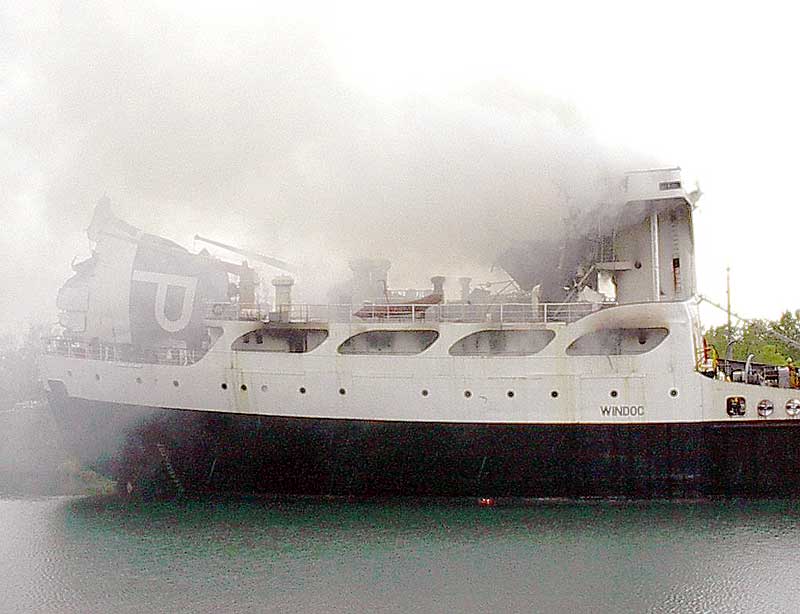
The Windoc blocks the canal. Alex Howard
In August 2001 the Bulk Carrier Windoc was lined up on the Welland Canal’s Bridge 11 in Ontario Canada. After recieving the flashing amber approach light indicating that the bridge operator was aware of the vessel the captain lined up on the centerline and maintained a speed of 5 knots. Minutes later while the vessel was half way through the bridge started descending.
The Bridge Team’s Story

When the vessel was approximately halfway under the bridge, the third officer observed that the bridge signal lights were solid red and the lift span was descending. At 2053, the master sounded a few blasts on the ship’s whistle. The master, without identifying himself or the bridge in question, called the TCC on VHF channel 14 about the lowering of the bridge. The master quickly stopped the engines and ordered an evacuation of the wheelhouse.The master and third officer left the wheelhouse by the starboard navigation bridge wing. As they proceeded down the external bridge access ladder, the span of the bridge struck the vessel in way of the wheelhouse front windows, subsequently destroying the vessel’s wheelhouse and funnel. The wheelsman remained at his station in the wheelhouse and lay down on the deck as the bridge span passed overhead. He freed himself from the debris and descended by the deckhouse stairwell alive.
Miraculously no one was killed in the event. [Continue Reading →]
Tags: · Bridges, canada, cargo ship, collision, damage photo, death, fire, Firefighting, ntsb, ship, ship photo, ship photographs, survival, windoc, youtube
.
The BBC gives us more details on the tragedy:
The operation to recover hundreds of bodies inside a sunken Philippine ferry has been suspended after a highly toxic pesticide was found to be on board.
Ten tonnes of endosulfan were illegally in the cargo, destined for a Del Monte pineapple plantation, officials said.
Whether the ferry operator, Sulpicio Lines, knew of the toxic cargo is unclear, though a senior official warned it could face prosecution.
Only 56 of more than 850 passengers are known to have survived the disaster.
The MV Princess of the Stars controversially left Manila harbour on 21 June despite the approaching Typhoon Fengshen. Continue Reading…
Tags: · Ferry, philippines, Princess Of Stars

Death came early this year. The typhoon season has only just started and already, brightly coloured flop-flop rubber sandals are arriving on the coastlines of Sibuyan in the central Philippines. They are very small slippers because many children were among the 800 or so aboard the 1984-built 23,824 tonnes Sulpicio Lines ferry Princess Of The Stars that capsized on morning of June 21 in a typhoon known internationally as Fengshen and in the Philippines as Frank.
One can only say ‘or so’ because it is unlikely anyone will ever know exactly how many people were aboard. Passenger manifests are unreliable in a country where regulations are rarely enforced, even if they are supposedly adequate in the first place. In a grounding incident in 2007 a ferry had a manifest of a little more than two dozen people, the Philippine Coast Guard rescued more than a hundred. The true human cost of the Dona Paz disaster in 1987 remains unknown, except that it possibly exceeded 4,000.
Current known figures for the Princess Of The Stars are around 626 passengers, an unknown number of minors, and 212 crew. At the time of writing there are four confirmed dead and 34 known survivors.
Sulpicio Lines has a poor safety record. In addition to the Princess Of The Stars and the Dona Paz, other casualties include the Dona Marilyn in 1988 and the Princess of the Orient in 1998. The Philippine government has ordered it to stop operations and inspections of the company’s other vessels is underway. Volunteers against Crime and Corruption, VACC, has said it will file a class suit against Sulpicio Lines management.
The domestic ferry industry has a traditional safety problem: In 1994 the William Lines Cebu City collided with a Singaporean vessel, Kota Suria, and sank with the loss of 140 lives; Kimelody Cristy of Moreta Shipping caught fire and sank in 1995; in 1996: An overcrowded wooden ferry, ML Gretchen, capsizes close to shore of central Negros island, killing 54, including 31 children, and leaving 12 missing; Trans-Asia Shipping’s Asian South Korea, another ferry, sank in 1999;Maria Carmela, a ro-ro ferry owned by Montenegro Shipping, caught fire in 2002 with 2390 people on board of which 23 were confirmed dead and 27 missing;the wooden ferry Catalyn-D caught fire and sank in 2007 losing five lives out of 250 people on board. (A full list of incidents can be found HERE)
Despite the regularity of maritime incidents in Philippine waters there is no full-time independent maritime investigation agency in the Philippines. Marina, the country’s maritime regulatory body delegates its enforcement functions to the Philippine Coastguard, which allowed the vessel to leave Manila as the typhoon was approaching. Both agencies will conduct the investigation.
Philippine President Gloria Magapagal Arroyo has, as is usual in high-visibility incidents, ordered a board of inquiry to be convened but there is no legal requirement for any of its members to be qualified maritime casualty investigators and consists of Coast Guard officers, Marina officials and members or graduates of the government-own Philippine Merchant Marine Academy. A lawyer is required to be one of the members but he, or she, is not required to have expertise in maritime law.
The aim of the Board is to establish liability, safety issues are secondary. Despite that, not a single ferry company or ship owner has been brought to book in any incident in the Philippines.
Casualty investigation reports are not made accessible to the public.
International maritime investigators would like to bring the Philippines within the fold and help it develop a more realistic and effective investigative capability but the political will is lacking, which may not be unconnected with the high level connections between ferry companies, shipowners and the country’s legislators.
It is unlikely that the Philippines will respond to the new IMO code of conduct for maritime casualty investigation any time soon. Despite becoming a member in the mid-1960s the Philippines has yet to lodge a single maritime casualty investigation report with the IMO, as it is mandated to do for serious casualties under the terms of its membership, despite the recent election of a Filipino, Neil Ferrer, as IMO deputy secretary general.
Currently, fingers are being pointed in all directions. The vessel left Manila at about 8pm on Friday, 20th June as Typhoon Fengshen approached the islands. Storm Signal Number One, the lowest level warning, had been issued by the Pagasa, the country’s under-funded and under-equipped weather bureau.
Although the typhoon was not predicted to present a threat on the vessel’s route, typhoons are notoriously erratic. Although not expected to hit the main island of Luzon, by 11.30 the highest level warning was issued, Number Three, but by then the Princess Of The Seas was in the Visayas region still heading for Cebu.
The vessel was allowed to leave Manila because it was believed that she would only enter the periphery of typhoon, but the typhoon suddenly changed direction, putting the vessel directly in its path. It reached Sibuyan Island at around 7am.
According to reports, at about non on Saturday, 21st June, the ship’s main engine failed, but some survivors say the ship only slowed down as it encountered large waves. With winds of 73 miles an hour gusting up to 94 miles and hour the ship grounded off the coast of Sibuyan Island in Romblon province, tore a gash in her hull and took on water. The master, Captain Florencio Marimon, who is still missing, ordered all passengers to abandon the ferry, which capsized 15 minutes later.
Reportedly, few passengers were able to board the 14 liferafts, a number of which flipped over in the large swells and high winds, and about half were able to don lifejackets before jumping off the ship.
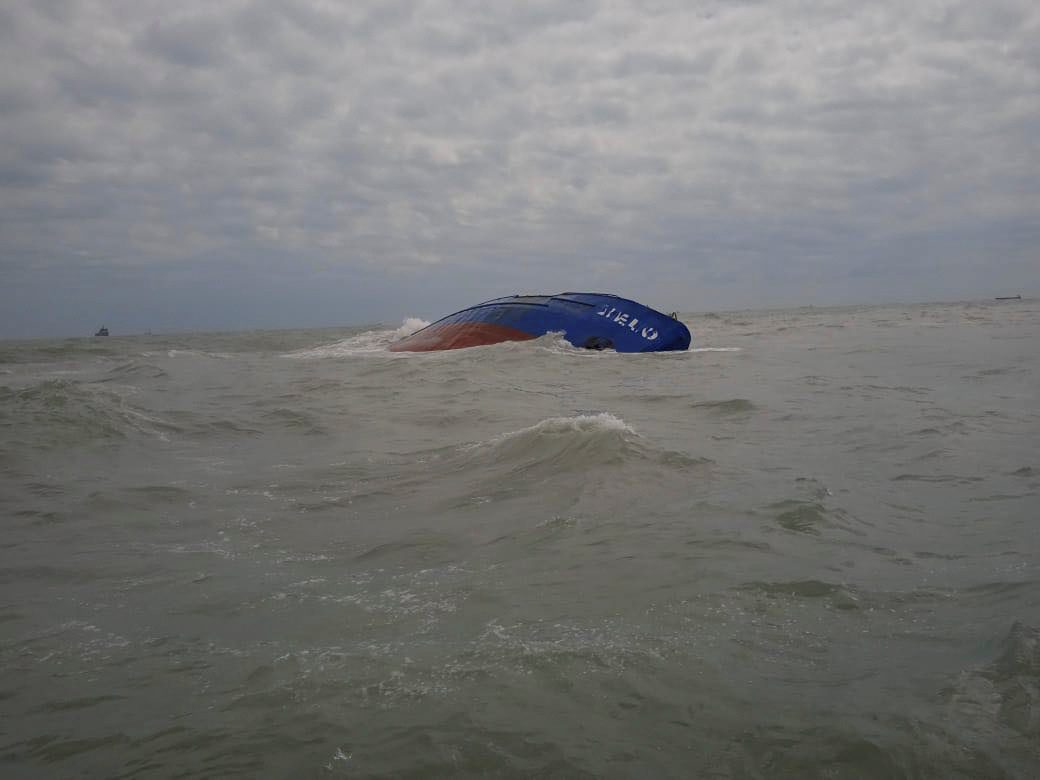
Later, police in the town of San Fernando in Romblon province reported that the vessel was two or three kilometres offshore, upside down off the coast of the town, a hole visible in the hull.
History suggests that the Princess Of The Stars tragedy will have little effect on the safety of Philippine ferry passengers or their crew. The Philippines will continue to ignore its obligations to the IMO and to the security of its travelling public because there isn’t the political will to do otherwise no matter how many children’s rubber slippers wash up on its beaches.
This post was written by Bob Couttie of Maritime Accident Casebook. Bob Couttie has written for a number of maritime industry publications, including the prestigious Lloyd’s List International daily newspaper and Lloyd’s Ship Manager magazine. His reportage on problems with ship’s officer certification examinations in the Philippines in the late 1990s influenced the adoption of computerized examinations for ship officers by the country’s Professional Regulatory Commission.
You can read more of Bob’s articles on gCaptain (LINK) and on his blog (LINK).
Tags: · Ferry, philippines, Princess Of Stars, sinking
CNN sends news of a tragic ferry capsize in the Phillipines. They write:
Rescuers have found at least 33 survivors and at least six dead among the nearly 750 aboard a ferry that capsized in Typhoon Fengshen that battered the southern Philippines, a Red Cross official said Monday.
A U.S. Navy ship equipped with helicopters will soon join the search and rescue effort, said Richard Gordon, the head of the Philippines Red Cross and a member of the country’s Senate.
Fishermen found 30 survivors from the ferry Princess of Stars, which rolled over early Saturday morning, Gordon said. One person died after being picked up, and another was lost during rescue efforts, he said, but the remaining 28 have been delivered to police.
Filipino troops have found five more survivors and five dead, Gordon said, bringing the known toll from the accident to six.
“There’s quite a few people out there that are still missing,” he said. “We are trying our best to find them, and I hope we could get some help.” Read More…
Watch images of the ferry sinking » |
Watch a report on the disaster »

.
UPDATE:
GMA News of the Phillipines has this report:
This page requires a higher version browser
.
UPDATE 2:
Bloomburg Tells Us:
June 24 (Bloomberg) — Philippine divers found “many bodies” after entering a ferry that capsized in a typhoon three days ago with at least 849 passengers and crew on board, the Navy said today.
Divers can’t tell how many bodies are in the vessel because “it’s dark and they don’t have search lights,” said Coast Guard Commodore Luis Tuason, adding the chances of rescuers finding survivors are “slim.’
Only the tip of the bow of the 24,000-ton MV Princess of the Stars is above water off the central island of Sibuyan, where it sank June 21 in what may be the country’s worst ferry disaster in two decades.
Authorities have identified 48 survivors who made it to various islands, a revision from the figure of 57 reported earlier today, Coast Guard Lieutenant Commander Rogelio Villanueva told reporters at a briefing in Manila. The additional survivors were from separate sea and land incidents, he said.
The number of dead climbed to 70 after 55 bodies were reported in Claveria, a seaside town east of Sibuyan, he said. The dead include three bodies taken by divers from the ship.
There may have been as many as 862 passengers and crew on board, Salvacion Buaron, vice president of ship owner Sulpicio Lines Inc., said at the briefing. Continue Reading…
Tags: · philippines, Princess Of Stars, typhoon, Weather

In a feature appropriately titled “Worst Case Scenario” Popular Mechanics brings us “The Coast Guard’s Most Extreme Rescue - Alaska Ranger“. They write:
“Mayday, mayday, mayday. This is the Alaska Ranger. 5, 3, 5, 3 North, 1, 6, 9, 5, 8 West… We are flooding, taking on water in our rudder room.”
It was 2:52 am on March 23, Easter morning, when Coast Guard Station Kodiak picked up the distress call from a point almost 800 miles west, in Alaska’s frigid Bering Sea.
“Roger. Good copy on position… Request to know number onboard, over.”
After a static-filled pause, the answer came through loud and clear: “Number of persons: 47.”
Capt. Peter Jacobsen was in the crowded wheelhouse of the 189-ft. fishing vessel. When the trawler’s emergency alarm had first sounded about an hour before, crew members descended below decks to see water rising fast in the ship’s stern compartments. They had pulled out a pump, but the effort soon looked futile. Now Jacobsen, 65, a veteran captain who had been fishing in the Bering Sea for 23 years, was making calls to his ship’s sister vessels, repeating the coordinates of the Ranger’s position 120 miles west of the Aleutian Island port of Dutch Harbor.
Be sure to visit our previous Alaska Ranger Coverage including commentary by Kennebec Captain titled “Sinking of the Alaska Ranger - Fishing Master vs Captain“. Then read Popular Mechanics full article which can be found HERE.
.
INTERESTING LINKS:
MayDay Call:

Alaska Ranger Mayday - Fishing Boat Sinking Offshore Alaska:
Play Now |
Play in Popup |
Download
Tags: · alaska, alaska ranger, fishing, Lifesaving Incidents, sinking
Coast Guard comes to the aid of the Ocean Challenger as the crab fleet listens to the news.
Video of USCG ( United States Coast Guard ) rescue of the crew of the Ocean Challenger which sank during the filming of the Discovery Channel’s Deadliest Catch.
Tags: · fishing, mayday, rescue, television, USCG
MEMORIAL DAY WEEKEND SPECIAL EDITION
By Robin Storm
Both Captain John Konrad of gCaptain and I have written much on the importance of GPIRBs and EPIRBs (Emergency Position Indicating Radio Beacon’s) for the maritime and boating communities. Or (Radio Distress Beacons) that include aviation and personal distress beacons.
These GPIRB/EPIRBs are critical life safety devises that every mariners life depends on when “Ship Happens”.
Our investigation started with the malfunction of the ACR Globalfix 406 Cat II aboard the Sean Seamour II.
For some background on this incident refer to my July 2007 posting, EPIRBs and the s/v Sean Seamour II , and Captain John Konrad’s posting EPIRB Failure aboard the “Sean Seamour”
Since the sinking of this sailboat and rescue of its crew we have focused on those EPIRBs and GPIRBs that have been reported either as not working or have malfunctioned.
In all fairness to the manufactures of EPIRBs and GPIRBS. These devises normally operate with great success and are credited with saving many lives. They are extremely important pieces of life safety equipment that all mariners need to take seriously. Moreover when they fail, they can for a number of reasons. Some mechanical, some weather related, some because of poor maintenance, some because of improper registration and some fail because of the poor positioning by mariners on their vessels or they just don’t turn them on. These devises are like smoke detectors or intruder alarms in ones home.
If you do not install the smoke detector properly the odds are it just might not detect the initial stages of combustion or warn late of a fire. If you don’t activate your homes burglar alarm then you can bet your not protected and wasting your money.
Since the sinking of the Sean Seamour II, we have been tracking the reports of EPIRBs and GPIRBs that have failed to transmit the emergency beacon signal or failed for one reason or another. What we found is that the Sean Seamour II is not the only incident or report of a malfunction or report of a GPIRB/EPIRB not working. The cases of the F/V Papa George, F/V Illusion the F/V Ellie B and recently the F/V Sav-A-Buck just to note a few examples of reported failures.
To date the investigation continues. What we have found so far raises concern. While there are independent test reports on why GPIRB and EPIRB might fail to some degree. There is very limited follow up when they do actually fail. Again the reasons are many and they include, the lost of the GPIRB/EPIRB during the incident at sea or a waterway and the lack of a formal reporting procedure or failure data base. More frightening still, is how many mariners never make it back to report or relate what happened. It seems that no one knows for sure what the actual failure rates are of the 75, 000 + GPIRB/EPIRBs in the NOAA 406 MHz registry data base and now with the 406 MHz ELTs and PLBs the number of 406 MHz Emergency Beacons registered now totals over 82,000.
While many, many private boats have GPIRBs and EPIRBs and many commercial vessels are required by US Law to have a certified and inspected EPIRB/GPIRB on board and while the regulation calls for the United States Coast Guard (USCG) to conduct a informal failure investigation of any USCG Certified and Inspected Life Safety devise, which includes a EPIRB and or GPIRB. The USCG just does not have the proper staffing, funding or facilities to conduct such testing independently.
Additionally it is my understanding that of these 75,000 to 80,000 + units in NOAA’s registry, it appears that no one knows how many GPIRB/EPIRBs are still operational and how many are not. While there are regulations concerning registering and certifying these devises. There are no requirements to report a EBIRB or GPIRB that is no longer certified or operational. Like your cars licenses plate, when you get a new one you must turn it in so the motor vehicles department can make the appropriate changes in their data base. Well it appears that this does not happen with EPIRBs and GPIRBs.
We are pressing for the US House Subcommittee on the Coast Guard and Marine Transportation to conduct both an investigation into these deficiencies and potentially hold formal hearings in the future.
Again I cannot stress enough the importance and success rate of both the GPIRB and EPIRB to the maritime and boating communities. They are credited with saving many lives. To date worldwide some 22, 058 people have been rescued since 1982. 5, 842 in the United States since 1982 and 94 this year in the US alone.
But if we can save just one more life by fortifying the registration data base and understanding the cause and effect of a failure. That is money and time very well spent.
CORRECTION
I also wish at this time to make a important correction to MAIS - Maritime Podcast Episode 22 that both Captain John Konrad and I did on GPIRB/EPIRBs. I made a mistake that was brought to my attention by a listener, which I was able to confirm.
During the podcast I stated that NOAA handles all GPIRB/EPIRB Registrations. Well in reality NOAA COSPAS-SARSAT is a partnership with 29 other Nation States and is only responsible for the registration of GPIRB/EPIRBs that are owned and operated by vessels registered in the United States. Each Nation State that is a partner is responsible for their respective registries.
So if your GPIRB/EPIRB is registered in the United States then NOAA COSPAS-SARSAT is the agency you should be checking with to verify the hexadecimal code with. If your registered with one of the other 29 Nation States then you must check the registry with that Nation State.
INTERIM RECOMMENDATIONS
We are recommending that all mariners who own GPIRB/EPIRBs make sure that: 1. They are properly registered with the Nation State that the vessel is registered with. If you own one that is not registered please take the time and register it. Registration is free.
We are also recommending that all mariners check the hexadecimal code with that Nation State. If you are US registered there are a couple of ways to achieve this. 1. You can write the NOAA registry at COSPAS-SARSAT, NSOF, E/SP3, 4231 Suitland Road, Suitland, MD 2. You can call COSPAS-SARSAT at 301.817.4515 or toll free: at 888.212.7283. 3. Fax them at 301.817.4565. Provide them with all the information on the GPIRB/EPIRB including the boat/vessel/aircraft and owners identification which the devise is registered to.
4. You can check on-line if the GPIRB/EPIRB is already registered by clicking on the link below…

Once again check and make sure that your GPRIB/EPIRB’s certification and maintenance is in order and was done properly by which ever service company was used. Even if this means calling them. Lastly, we ask all mariners who’s GPIRB/EPIRBs are no longer operational to contact their respective Nation State registries and cancel out the registration.
DO NOT ACTIVATE THE GPIRB/EPIRB TO TEST IT! Talk about all hell breaking out….
While your checking this equipment why not check the rest of your life safety equipment, such as all flotation devises, beacons, rafts, radio’s, flare guns etc…. Do it now and do not wait until your underway. Remember also filing a “Float Plan” is not a bad idea. Who knows it just might be your life it saves one day. The idea is to make it easy for rescue agencies to locate you. No matter if your sailing transatlantic or floating on a lake or bay.
I will also add that it appears that the other Nation States that are partnered with NOAACOSPAT-SARSAT seem to have the same problems that we are covering here. It just might be something that the International Maritime Organization (IMO) may have to get involved with.
We will keep you posted as our investigation continues. If any of our readers have heard or know of a reported GPIRB/EPIRB failure(s) please contact us.
Tags: · epirb
Tags: · ice prince, Incidents, Video

Photo of the research boat Russell W. Peterson takes on water about 14 miles off the coast of Rehoboth Beach, Del., Monday, May 12, 2008. Video of this incident can be found HERE.
Via H&K Law
Tags: · incident photos, Photo, Research Vessel