Increasing numbers of main engine failures and blackouts have led some organizations to investigate the problem. Leading the charge is the UK P&I Club, which recently tasked investigators with analyzing more than 700 claims relating to blackouts. According to the Club, a significant number of these claims for third party property damage- many of which were enormously expensive and in some cases amounted to millions of dollars- could be attributed, directly or indirectly, to main engine failures or electrical blackouts.
According to the report, ships effectively out of control as a result of these problems have caused extensive damage to berths, locks, bridges, dolphins, navigational marks, loading arms, cranes and gantries, as well as to moored ships. While this information is known to most mariners, the report further outlines the statistical cause of failures.
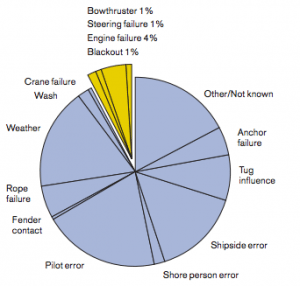
A chart of the primary causes of main engine failure.
Out of a total of 400 reported blackouts, the highest number (90 or 23%) are attributable to human error. Several of these incidents were caused by procedural errors – ‘pressing the wrong button’ – and stopping or tripping an on-load generator. A further 65 (16%) were caused by electrical failure and a notably high number of these blackouts were caused by starting bow thrusters and deck machinery such as mooring winches or cranes, with insufficient electrical power being available.
A shortage of fuel supply, automation failure, failure of control equipment and mechanical failure were also listed as primary causes of ship blackouts.
The full results of this investigation have been published to the Club’s website in a special report titled Risk Focus: Loss of Power.
Aw Nuts! By The Artful Blogger Another day of reviewing incident reports. It never ceases to amaze me, how many of these tragedies could have been avoided. Yes, I judge....
September 11, 2007
Total Views: 31
Get The Industry’s Go-To News
Subscribe to gCaptain Daily and stay informed with the latest global maritime and offshore news
— just like 105,236 professionals
Secure Your Spot
on the gCaptain Crew
Stay informed with the latest maritime and offshore news, delivered daily straight to your inbox
— trusted by our 105,236 members
Your Gateway to the Maritime World!
Essential news coupled with the finest maritime content sourced from across the globe.

 Join The Club




 Increasing numbers of main engine failures and blackouts have led some organizations to investigate the problem. Leading the charge is the UK P&I Club, which recently tasked investigators with analyzing more than 700 claims relating to blackouts. According to the Club, a significant number of these claims for third party property damage- many of which were enormously expensive and in some cases amounted to millions of dollars- could be attributed, directly or indirectly, to main engine failures or electrical blackouts.