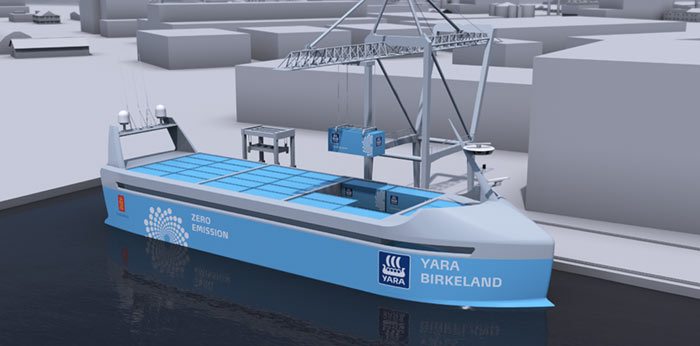
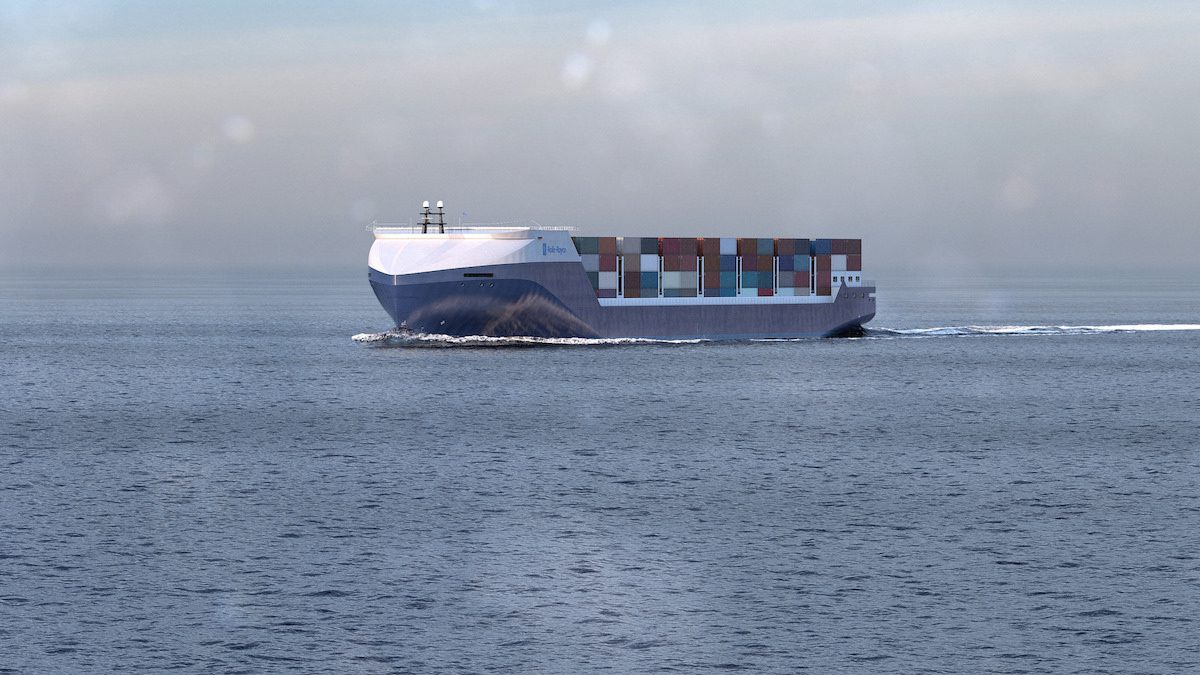
Manned operation is planned to start in the latter half of 2018, with remote-operation beginning in 2019 and fully-autonomous operation starting in 2020. Credit: Yara/Kongsberg
Norwegian fertilizer producer Yara and maritime technology firm Kongsberg Gruppe are teaming up to build what they say will be the world’s first fully-electric and autonomous container feeder ship.
“The new zero-emission vessel will be a game-changer for global maritime transport contributing to meet the United Nations sustainability goals,” the companies said on Tuesday.
The planned autonomous container feeder ship, to be named YARA Birkeland, will cut emissions from road transport when it starts shipping products from Yara’s Porsgrunn plant to Norway’s Brevik and Larvik ports, the companies said. Brevik and Larvik ports are about 14 km and 26 km away from Porsgrunn respectively by road. The vessel is expected to reduce emissions and boost safety by removing up to 40,000 truck journeys per year.
YARA Birkeland will initially operate as a manned vessel before moving to remote operation in 2019, and later to fully-autonomous operations from 2020 onwards.
Kongsberg will be responsible for the development and delivery the technology required for the vessel, including the sensors and integration required for remote and autonomous operations, in addition to the electric drive, battery and propulsion control systems.
“By moving container transport from land to sea, YARA Birkeland is the start of a major contribution to fulfilling national and international environmental impact goals. The new concept is also a giant step forward towards increased seaborne transportation in general,” says Geir Håøy, President and CEO of Kongsberg.
“Developing systems for autonomous operations is a major opening and natural step for KONGSBERG, considering our decades of expertise in the development and integration of advanced sensors, control and communication systems for all areas of ship operations. YARA Birkeland will set the benchmark for the application of innovative maritime technology for more efficient and environmentally friendly shipping,” Håøy added.
In 2016 Kongsberg teamed up with the UK’s Automated Ships Ltd to build what they claimed would be the world’s first unmanned and fully-automated vessel for offshore operations. If all goes as planned the offshore vessel, named Hrönn, could enter service as the world’s first full-size unmanned ship as early as 2018.
The World’s First Zero-Emission, Full-Automated Container Ship
The maritime industry has spent the better part of a decade debating whether autonomous ships represent genuine commercial progress or elaborately funded engineering theatre. That debate has not been entirely...
The International Maritime Organization has adopted the world’s first international framework governing autonomous commercial ships, marking a major milestone in shipping’s push toward remotely operated and fully autonomous vessels. The new non-mandatory...
Hanwha Defense USA and maritime autonomy startup HavocAI have formalized a strategic partnership to jointly develop and potentially mass-produce 200-foot autonomous surface vessels for the U.S. Navy, a move that...
January 8, 2026
Total Views: 1405
Get The Industry’s Go-To News
Subscribe to gCaptain Daily and stay informed with the latest global maritime and offshore news
— just like 105,236 professionals
Secure Your Spot
on the gCaptain Crew
Stay informed with the latest maritime and offshore news, delivered daily straight to your inbox
— trusted by our 105,236 members
Your Gateway to the Maritime World!
Essential news coupled with the finest maritime content sourced from across the globe.

 Join The Club