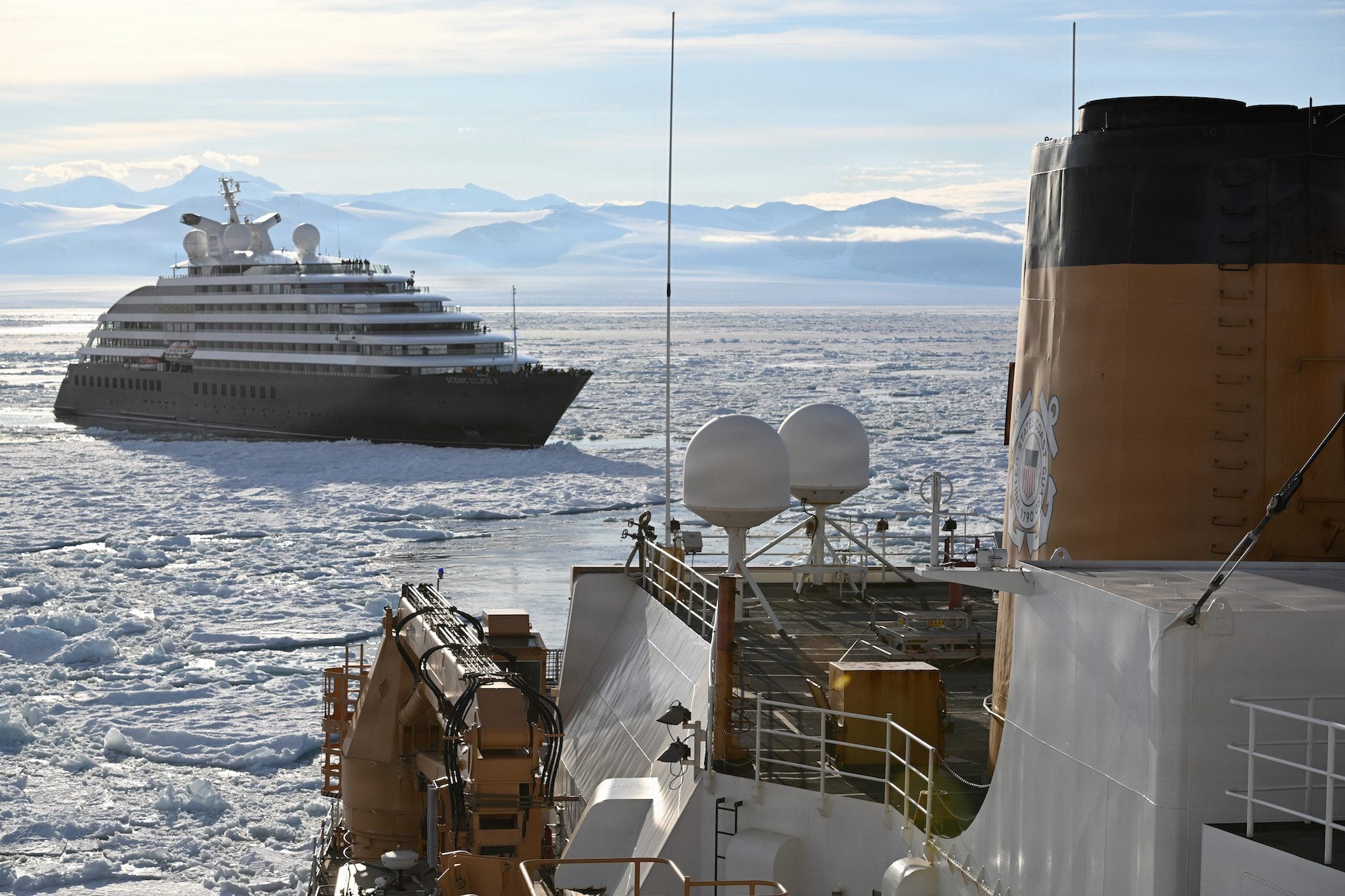
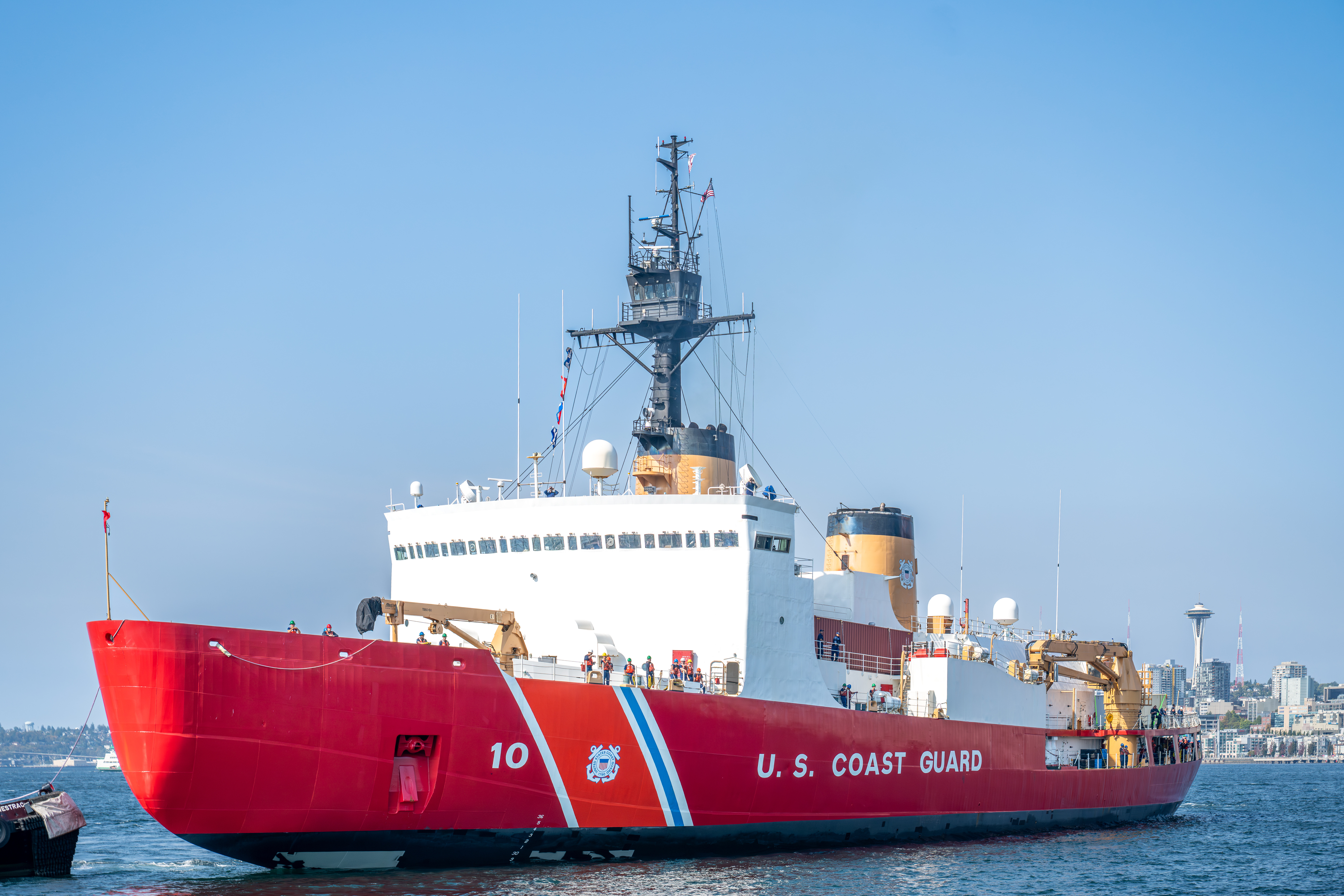

The 50-year-old U.S. Coast Guard Cutter Polar Star freed an Australian cruise ship trapped in pack ice near McMurdo Sound during the cutter’s 29th deployment to Antarctica, marking its 50th year of commissioned service.
The heavy icebreaker received a distress call from the cruise ship Scenic Eclipse II at approximately 11 p.m. local time Friday after the vessel became beset in pack ice roughly eight nautical miles from McMurdo Sound.Polar Star’s crew conducted two close passes to break the vessel free, then escorted it approximately four nautical miles to open water.
The rescue came as Polar Star began icebreaking operations in the Southern Ocean in support of Operation Deep Freeze 2026, a mission that provides critical logistical support for the U.S. Antarctic Program managed by the National Science Foundation.The operation includes breaking a navigable channel through miles of dense Antarctic ice to allow fuel and cargo deliveries essential for sustaining research stations and operations.
“I am constantly amazed at this crew’s tremendous energy and enthusiasm,” said Capt. Jeff Rasnake, Polar Star’s commanding officer. “Despite the many challenges associated with getting and keeping this ship on mission, they remain eternally positive and committed to meeting the high standards we’ve set for ourselves.”
Commissioned on January 17, 1976, Polar Star is the nation’s only active heavy icebreaker and has served as a cornerstone of U.S. presence in the polar regions for five decades. The cutter departed Seattle in November for the deployment.
Throughout its service life, Polar Star has completed dozens of Operation Deep Freeze missions and numerous Arctic deployments, defending U.S. sovereignty, securing critical shipping lanes, protecting energy and mineral resources, and countering adversaries’ presence in the polar regions.Despite its age, the cutter continues to demonstrate unmatched heavy icebreaking capability, routinely operating in conditions few vessels can navigate.
“At 50 years old, Polar Star remains the world’s most capable non-nuclear icebreaker,” said Cmdr. Samuel Blase, Polar Star’s executive officer. “That’s a testament to the crews that have maintained it over the decades. With years of service left to give, Polar Star will continue to guide the way in the high latitudes well into the future.”
The cutter recently completed a comprehensive five-year Service Life Extension Program, with the final phase wrapping up in September 2025 after 175 days at Mare Island Dry Dock in Vallejo, California.The $12.7 million investment recapitalized integral systems including propulsion, communication, and machinery control systems.
“This is a tremendous ship, and it is in better shape today than it was ten years ago,” Rasnake said following the refurbishment. “That’s a testament to the unrelenting efforts of the crew, the enduring support of our mission partners, and the renewed enthusiasm and investment in our nation’s polar icebreaking capabilities.”
The 50th anniversary deployment is Polar Star’s 29th to Antarctica and marks a milestone that puts it in rare company. “Polar Star’s 50 years of service in the polar regions puts it in the discussion with other great Coast Guard icebreakers such as USCGC Glacier, whose record of Operation Deep Freeze deployments Polar Star matches this year,” Rasnake noted.
The Coast Guard currently operates just three polar-capable vessels — the heavy icebreaker Polar Star, the medium icebreaker Healy, and the recently commissioned Storis, a converted commercial vessel — far short of operational requirements.
To close the gap, the service is pursuing a sweeping recapitalization effort that includes building up to nine new Arctic Security Cutters under a joint U.S.–Finland production partnership, alongside three new Polar Security Cutters intended to eventually replace Polar Star. The first of those new heavy icebreakers is not expected to enter service until 2030, leaving Polar Star to shoulder the nation’s most demanding polar missions for years to come.

 Join The Club