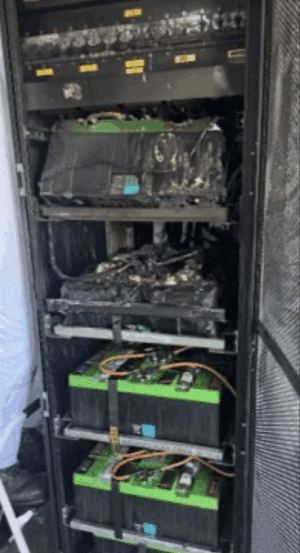
A recent fire aboard an inspected passenger vessel has prompted the U.S. Coast Guard to issue a comprehensive safety alert regarding lithium-ion battery installations on vessels. The incident, which occurred when loosely crimped lugs overheated in an integrated Li-ion battery bank, resulted in minimal damage and no injuries but highlighted significant safety concerns inherent to these power systems.
“All integrated Li-ion battery systems on inspected vessels must undergo engineering plan review, be fitted with supporting safety systems, be tested and inspected at installation and periodically afterward, and be properly maintained by competent mariners, regardless of the battery bank size or end consumer,” states the Safety Alert 14-25 issued on July 14, 2025.
Image of the integrated Li-ion battery bank. Photo courtesy U.S. Coast Guard
The Coast Guard highlighted several unique safety considerations that vessel operators should be aware of when utilizing these increasingly popular power systems. While Li-ion batteries offer advantages through their high energy density, enabling longer voyages and full electrification, this same characteristic increases risk during fire incidents.
Of particular concern is the phenomenon known as thermal runaway, where “upon internal failure or short circuit, Li-ion batteries may release high-temperature flammable gases that can catch fire or explode.” This creates a dangerous chain reaction as “the heat output of a fire can increase the rate of off-gassing, and those off-gasses in turn increase the size of the fire.”
Compounding the danger, these fires demonstrate “fire suppression resistance” and are “very difficult to suppress once propagation to other battery modules begins.” Rather than traditional suppression methods, the Coast Guard recommends strategies focused on “early detection, fire containment, and heat absorption with a water-based suppression system.”
The safety alert references Coast Guard design guidance for integrated Li-ion battery systems found in CG-ENG Policy Letter 02-19, which incorporates ASTM F3353-19 standards for shipboard use. These guidelines specifically address integrated systems that are hardwired to power ship’s electrical loads, not plug-in electronics or Li-ion batteries carried as cargo.
For vessel owners and operators, the Coast Guard provides practical guidance including proper battery identification methods, which emphasizes that “packaged Li-ion batteries often visually resemble traditional lead acid batteries” making nameplate specification verification essential.
The alert stresses that “crew members responsible for battery operation and maintenance should be well-trained in the manufacturer’s guidelines and operational procedures and familiar with the functioning of the battery management system.” Additionally, specific safety drills for Li-ion battery fires should be incorporated into vessel safety protocols.
As Li-ion battery technology continues to evolve in maritime applications, the Coast Guard may release additional guidance to address emerging safety considerations.
Tags:
Subscribe for Daily Maritime Insights
Sign up for gCaptain’s newsletter and never miss an update
Shareholders in the Shell Plc-led LNG Canada venture greenlit plans to double its liquefied natural gas export capacity, forging ahead with the multibillion-dollar investment as key customers in Asia face the biggest supply shock of recent times.
US government agencies are tracking cyber threats against nearly 20 shipping vessels around the world, according to US officials familiar with the situation.
Brent crude futures breached $100 a barrel on Wednesday for the first time since late July, as Iran and the U.S. hit tankers in the biggest wave of attacks on shipping since the war began, threatening to worsen the ongoing impairment of energy supplies from the Middle East.
September 9, 2026
Total Views: 343
Get The Industry’s Go-To News
Subscribe to gCaptain Daily and stay informed with the latest global maritime and offshore news
— just like 107,009 professionals
Secure Your Spot
on the gCaptain Crew
Stay informed with the latest maritime and offshore news, delivered daily straight to your inbox
— trusted by our 107,009 members
Your Gateway to the Maritime World!
Essential news coupled with the finest maritime content sourced from across the globe.

 Join The Club