Don’t Miss Your Daily Briefing for the Maritime Industry
Join the leading maritime news network
— trusted by our 106,440 members
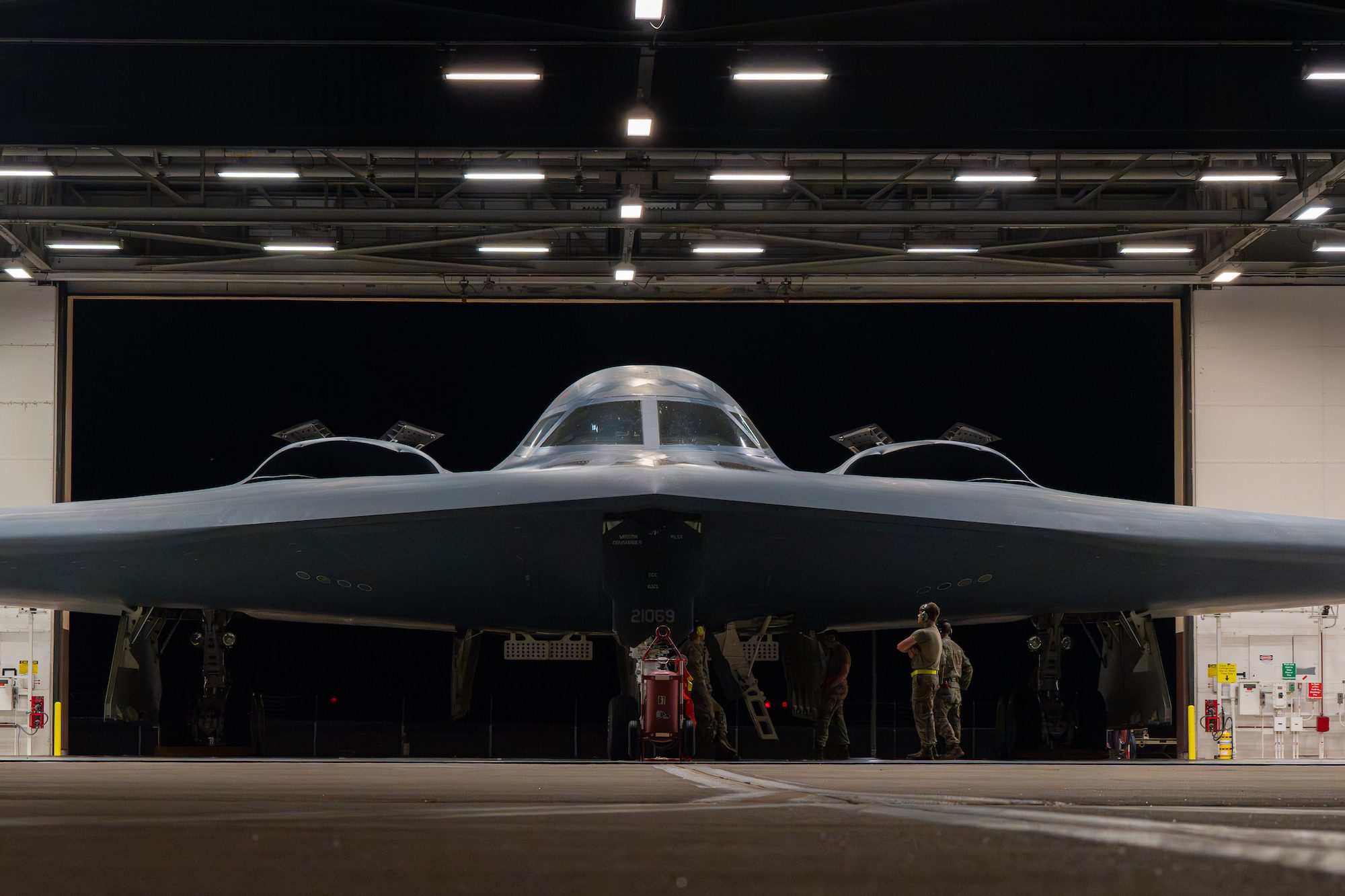
U.S. Airmen assigned to the 393rd Bomber Generation Squadron prepare a B-2 Spirit aircraft carrying Joint Direct Attack Munitions for departure at Whiteman Air Force Base, Missouri, Sept. 2, 2025. The aircraft delivered a maritime strike on surface vessel in the High North, in collaboration with Norwegian Allies, as part of the Air Force Research Laboratory QUICKSINK Joint Capability Technology Demonstration. U.S. Air Force Photo
U.S. Air Force and Norwegian Allies Test QUICKSINK Anti-Ship Weapon in Norwegian Sea
The U.S. Air Force successfully partnered with Norwegian allies to test next-generation precision maritime strike capabilities in the Norwegian Sea. The joint operation, which took place on September 3, demonstrated the effectiveness of the QUICKSINK maritime weapon system in a realistic combat scenario.
The test integrated a B-2 Spirit stealth bomber from Whiteman Air Force Base in Missouri with Royal Norwegian Air Force F-35s to execute a long-range strike mission against a surface vessel. The B-2 employed precision-guided QUICKSINK munitions to engage and sink the maritime target, validating the aircraft’s stealth, range, and payload flexibility.
The QUICKSINK system incorporates Joint Direct Attack Munitions (JDAM), a precision-guided bomb that comes in variants ranging from 500-2000 pounds. This latest operation involved the 500lb variant known as the GBU-38 JDAM, according to photos released by the U.S. Air Force.
“This test is a clear example of how we work with trusted allies to bring new capabilities into play faster and smarter,” said Col. Scott Gunn, 53rd Wing commander. “We’re not just preparing for tomorrow; we’re shaping it together.”
A U.S. Airman assigned to the 393rd Bomber Generation Squadron inspects GBU-38 Joint Direct Attack Munitions prior to them being loaded into a B-2 Spirit aircraft at Whiteman Air Force Base, Missouri, Aug. 28, 2025. U.S. Air Force Photo
Norwegian support provided critical infrastructure and airspace access, enabling the test to be conducted in a strategically critical and operationally challenging environment. The exercise advanced tactics for long-range sensor-to-shooter operations, including integrating beyond-line-of-sight communications and multi-domain targeting capabilities essential in contested environments.
“We are building readiness on both sides of the Atlantic and creating options that make maritime strike more distributed, survivable and integrated,” said Lt. Col. Stephen Bressett, 72nd Test and Evaluation Squadron commander.
The QUICKSINK system represents a significant advancement in maritime strike capabilities. Developed as a Joint Capability Technology Demonstration, QUICKSINK provides a low-cost method for neutralizing surface vessels using modified, air-delivered munitions. The system was previously tested in June 2025, when a 500-pound variant was successfully deployed from a B-2 Spirit at the Eglin Air Force Base Gulf Test Range.
The U.S. Air Force has conducted other QUICKSINK exercises at the Gulf Test Range in 2022 and 2024, as well as in July 2024 during the RIMPAC SINKEX.
Top: The QUICKSINK test item displaying classic girder-whipping in QUICKSINK Experiment 2. Credit: AFMC 96 RANSS/RNRD. Bottom: QUICKSINK Experiment 2, the Coastal Sea broken on the bottom of the Gulf of Mexico. Image Credit: Okaloosa County, FL, Artificial Reef Office.
Unlike traditional anti-ship weapons like torpedoes, which require submarines to expose their position, QUICKSINK allows for air-delivered maritime strikes across vast areas at a much higher pace. The technology utilizes the Air Force Research Laboratory’s Weapon Open Systems Architecture (WOSA) seeker technology, which reduces costs through modularity and allows for the integration of components from different manufacturers.
This latest test also validated both large and small variants of the precision strike system, expanding operational options for commanders in maritime-focused operations.
Tags:
Subscribe for Daily Maritime Insights
Sign up for gCaptain’s newsletter and never miss an update
The U.S. Coast Guard Cutter Munro has returned to its homeport in Alameda, California, following a 112-day patrol across the Bering Sea and Arctic Ocean that included monitoring Chinese research...
China's military said on Tuesday it had sent forces to watch a US warship that "illegally" entered waters around a disputed shoal in the South China Sea, while further north in the waterway, Taiwan reported a standoff with a Chinese vessel.
DUBAI, Oct 18 (Reuters) – Iran’s offer to the United States to reopen the Strait of Hormuz within seven days is still on the table, Foreign Minister Abbas Araqchi told Iranian media...
October 18, 2026
Total Views: 5254
Get The Industry’s Go-To News
Subscribe to gCaptain Daily and stay informed with the latest global maritime and offshore news
— just like 106,440 professionals
Secure Your Spot
on the gCaptain Crew
Stay informed with the latest maritime and offshore news, delivered daily straight to your inbox
— trusted by our 106,440 members
Your Gateway to the Maritime World!
Essential news coupled with the finest maritime content sourced from across the globe.

 Join The Club