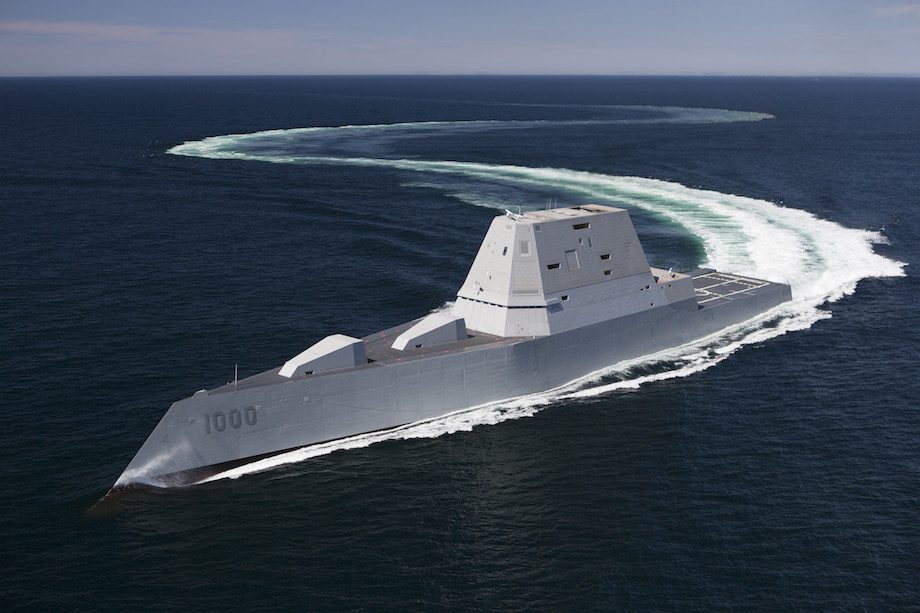
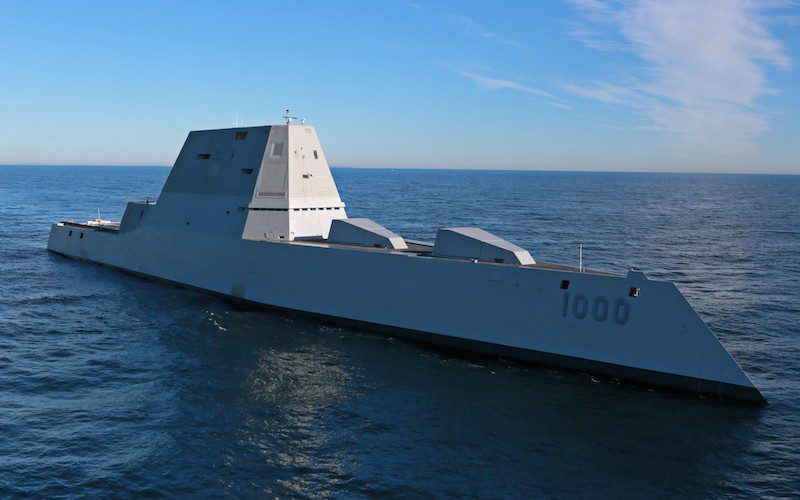
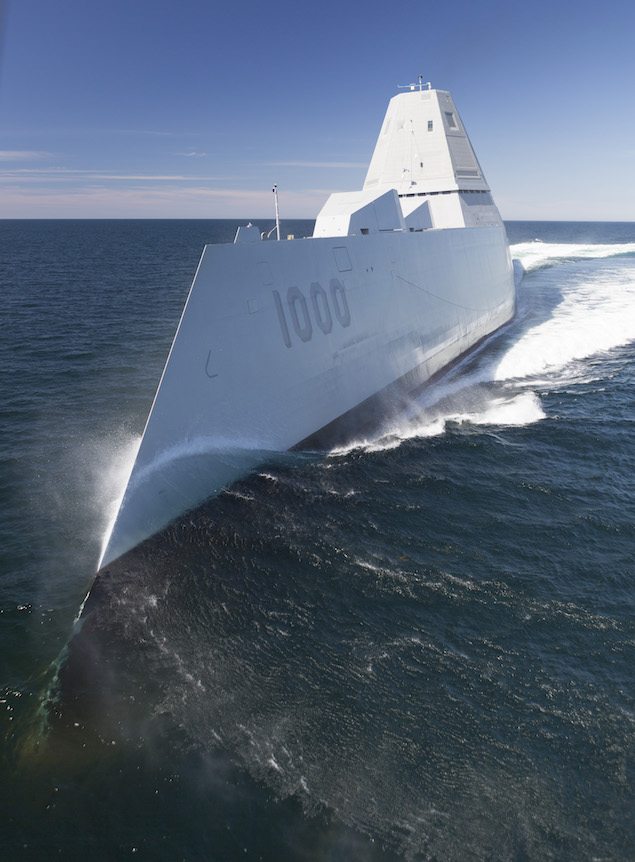
The future guided-missile destroyer USS Zumwalt (DDG 1000) in the Atlantic Ocean during acceptance trials April 21, 2016. U.S. Navy Photo
The Navy on Friday accepted delivery of the future USS Zumwalt (DDG 1000), the lead ship of the Navy’s next-generation multi-mission surface destroyers.
DDG 1000 is designed for operations in the littorals (close to shore) and land attack, and features a technologically advanced design that will allow independent operations across the globe in support of special operations forces and forward presence and deterrence.
The ship’s delivery follows extensive tests, trials and demonstrations of the ship’s hull, mechanical, and electrical systems including the ship’s handling, anchor and mooring systems, as well as major demonstrations of the damage control, ballasting, navigation and communications systems.
“Today represents a significant achievement for not only the DDG 1000 program and shipbuilding team but for the entire U.S. Navy,” said Rear Adm. (select) Jim Downey, DDG 1000 program manager, Program Executive Office Ships. “This impressive ship incorporates a new design alongside the integration of sophisticated new technologies that will lead the Navy into the next generation of capabilities.”
The 610-foot ship is designed with a wave-piercing tumblehome hull, as well as a special composite superstructure and arrangement of antennas that will significantly reduce its radar cross section, making the ship extremely stealthy and less visible to enemy radar at sea. In fact, on radar the ship is said to appear simply as a small fishing boat despite that fact that it displaces 15,656 long tons, making it about 40% larger than the Arleigh Burke-class destroyers that precedes it.
Zumwalt is also the first U.S. Navy destroyer to use an innovative and highly survivable Integrated Power System (IPS), which distributes 1000 volts of direct current across the ship. The IPS’s architecture gives the ship the unique ability to allocate all 78 megawatts of installed power to propulsion, ship’s service, and combat system loads from the same gas turbine prime movers based on operations.
In terms of firepower, the class features a battery of two Advanced Gun Systems, capable of firing Long-Range Land Attack Projectiles (LRLAP) up to 63 nautical miles – about 3 times the Navy’s current range. Each ship is also equipped with eighty Advanced Vertical Launch System cells for tomahawk missiles, Evolved Sea Sparrow Missiles, Standard Missiles, and Vertical Launch Anti-Submarine Rockets (ASROC) (VLA).
The ship will also employ active and passive sensors and a Multi-Function Radar (MFR) capable of conducting area air surveillance, including over land.
Another fun fact about the future USS Zumwalt – it will be commanded by the real-life Captain James Kirk.
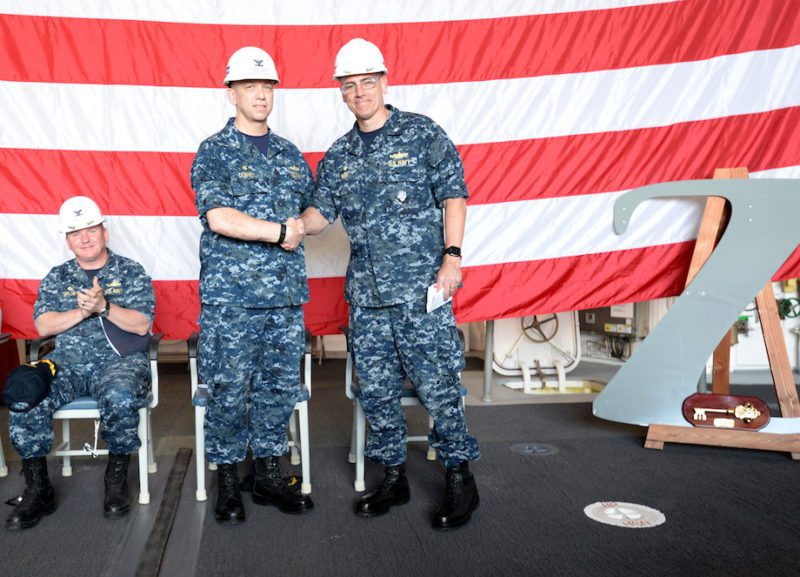
Capt. James A. Kirk (pictured right), commanding officer of the future guided-missile destroyer USS Zumwalt (DDG 1000), shakes hands with Capt. James Downey, DDG 1000 Program Manager. U.S. Navy Photo
Following delivery and a crew certification period at General Dynamics-Bath Iron Works, the ship will be commissioned in Baltimore, Maryland on October 15 before heading to its new homeport in San Diego, where activation will continue in parallel with post-delivery preparations.
“Zumwalt’s crew has diligently trained for months in preparation of this day and they are ready and excited to take charge of this ship on behalf of the U.S. Navy,” said Capt. James Kirk, commanding officer of future Zumwalt. “These are 143 of our nation’s finest men and women who continue to honor Adm. Zumwalt’s namesake with their dedication to bringing this ship to life.”
Bath Iron Works is also constructing two follow-on ships, the future Michael Monsoor (DDG 1001) and Lyndon B. Johnson (DDG 1002).
A merchant vessel diverted to assist in the rescue of 14 Indian mariners after their vessel became disabled and was abandoned off the coast of Oman, according to statements from...
All 20 Indian crew members aboard the tanker MT Jalveer were safely evacuated to shore Thursday after U.S. forces disabled the vessel during a blockade enforcement operation in the Gulf of Oman,...
A U.S. Navy-operated autonomous surface vessel (ASV) built by Saronic rescued two U.S. Army aviators after their AH-64 Apache helicopter crashed off the coast of Oman, marking what appears to...
June 9, 2026
Total Views: 5994
Get The Industry’s Go-To News
Subscribe to gCaptain Daily and stay informed with the latest global maritime and offshore news
— just like 105,059 professionals
Secure Your Spot
on the gCaptain Crew
Stay informed with the latest maritime and offshore news, delivered daily straight to your inbox
— trusted by our 105,059 members
Your Gateway to the Maritime World!
Essential news coupled with the finest maritime content sourced from across the globe.

 Join The Club