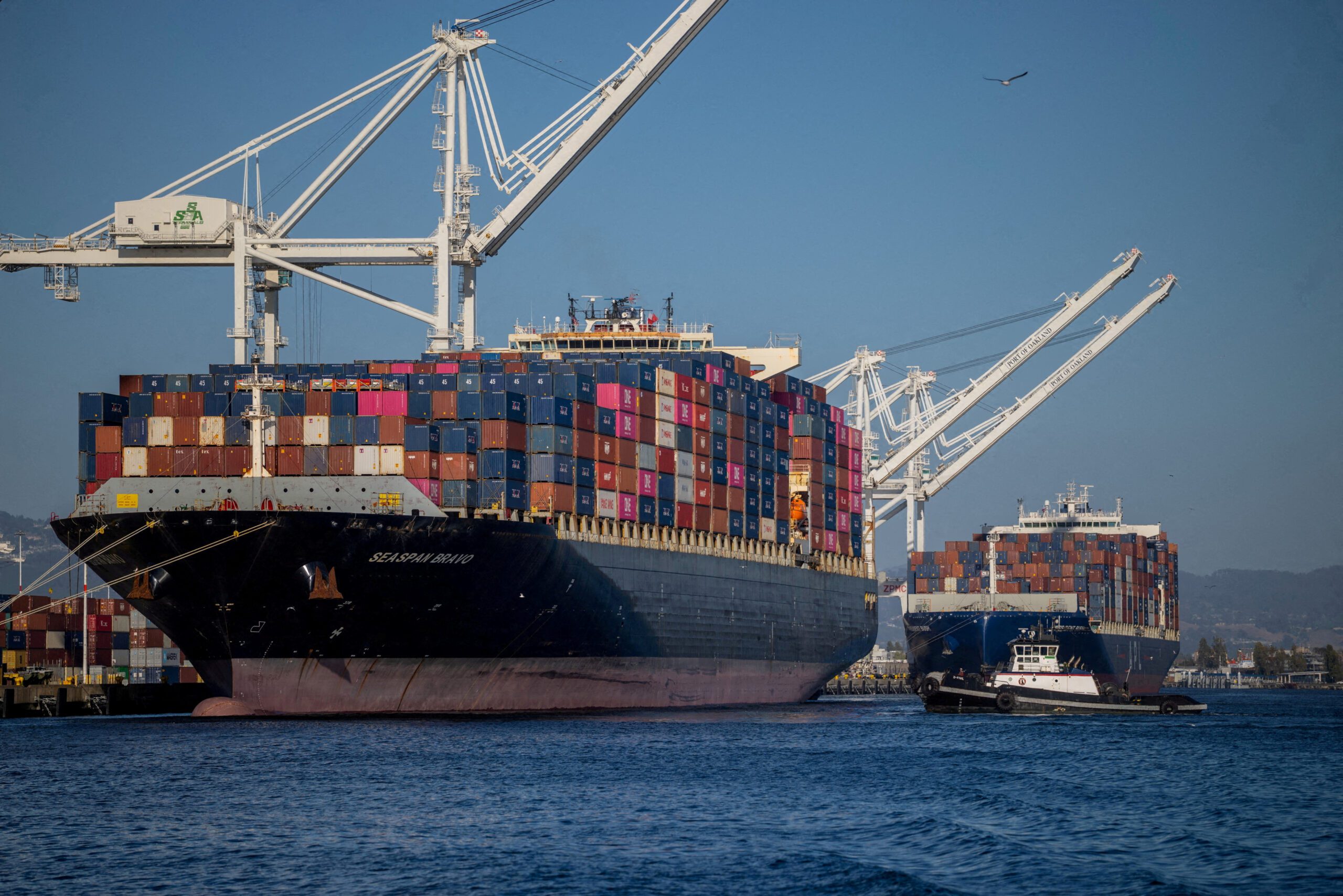
The Port of Oakland and U.S. Army Corps of Engineers have signed a design agreement for a $642 million project aimed at making it easier for larger containerships to maneuver at one of the busiest ports on the U.S. West Coast.
The agreement, signed August 27, moves the Oakland Harbor Turning Basins Widening Project into its Pre-Construction, Engineering and Design phase, setting the stage for eventual construction.
The project calls for widening both the inner and outer harbor turning basins at the Oakland Seaport, where the growing size and length of vessels calling at the port have increasingly created maneuvering restrictions and operational inefficiencies.
“Oakland Harbor is a critical node in our nation’s supply chain,” said Maj. Gen. Jason E. Kelly, deputy commanding general for Civil and Emergency Operations at the U.S. Army Corps of Engineers. “Today, we take the next step in ensuring it remains a powerhouse of American commerce for decades to come.”
Under the plan, the Inner Harbor Turning Basin would be widened by 334 feet, increasing its diameter from 1,500 feet to 1,834 feet. The Outer Harbor Turning Basin would grow by 315 feet, from 1,650 feet to 1,965 feet.
The larger basins are intended to accommodate the bigger vessels now routinely serving Oakland while reducing transit restrictions and allowing ships to turn more safely and efficiently.
The Army Corps and Port are also looking at using a design-build approach for the Outer Harbor Turning Basin rather than the more traditional design-bid-build process. Officials said the approach could shorten contracting timelines and get dredging work underway sooner.
The project also includes an environmental component, with suitable dredged material expected to contribute to the creation of approximately 205 acres of wetlands.
“Investing in critical infrastructure today ensures Oakland remains a competitive port city for generations to come,” said Port of Oakland Executive Director Kristi McKenney. “Larger vessels and taller cranes are the lifeline to our regional economy, and we’re grateful our partners at the Army Corps of Engineers share our vision for a more prosperous, efficient, and safer future.”
McKenney signed the agreement alongside U.S. Army Corps of Engineers San Francisco District Commander Lt. Col. Virginia Brickner during a ceremony aboard the historic USS Potomac at Oakland’s Jack London Square.
The agreement follows years of planning, including completion of the project’s Chief of Engineers Report in 2024.
“If we look back, it has really been an enormous lift by so many people moving us through the early stages of the planning process to a signed chief’s report in 2024 to today’s design agreement to the investment we will see for decades to come,” Brickner said.
The Army Corps determined during its feasibility study that vessels using Oakland increasingly exceed the dimensions around which the existing 50-foot federal navigation project was designed. Those constraints are expected to become more pronounced as vessel sizes continue to grow.
The widening effort builds on Oakland’s previous major navigation improvement, the $433 million Oakland Harbor Minus 50-Foot Deepening Project completed in 2009. That project deepened the harbor’s federal navigation channels from 42 feet to 50 feet.
More than 3.5 million cubic yards of dredged material from the deepening project was beneficially reused for wetland restoration at the former Hamilton Army Airfield in Novato, California.
The latest project represents the next major effort to adapt Oakland Harbor to the larger ships serving the transpacific container trade.

 Join The Club