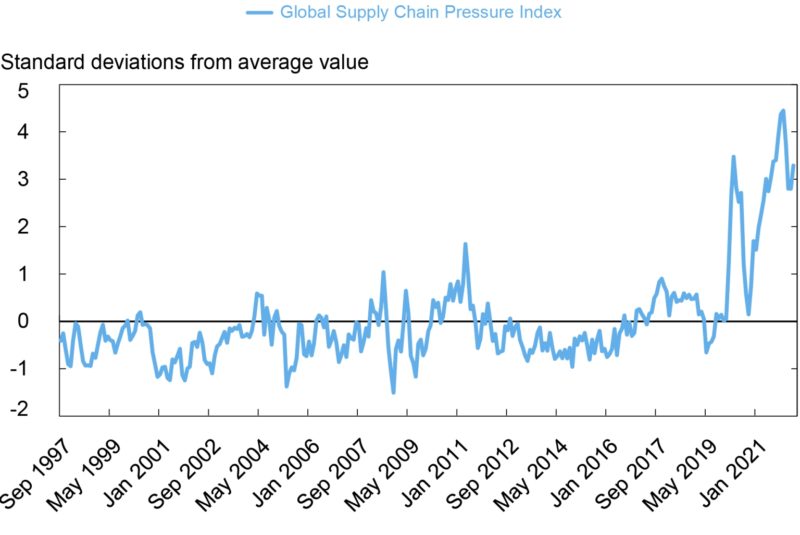
The Federal Reserve Bank of New York’s Global Supply Chain Pressure Index (GSCPI) ticked up in April for the first time since its December peak.
The GSCPI, first introduced in January, integrates transportation cost data and manufacturing indicators to provide a gauge of global supply chain conditions using variables from the Baltic Dry Index, the Harpex container ship rate index, the U.S Bureau of Labor Statistics In- and Outbound price indices, and several supply chain-related components from the Purchasing Managers’ Index surveys on delivery times, backlogs, and purchased stocks.
The index provides a bird’s-eye view of potential disruptions as well as regional indicators for analyzing trade, inflation, and globalization trends across the United States, China, Japan, the Euro-area, South Korea, Taiwan, and the United Kingdom. The New York Fed announced Wednesday that it will start publishing the GSCPI as a standalone product on a monthly basis with updates on the fourth business day of each month.
April Data Indicate Worsening of Supply Chain Pressures
The GSCPI in April rose to 3.29, up from 2.80 in March, measured as the standard deviation from average. The index peaked in December 4.45.
“Despite the majority of the components of the GSCPI declining, positive contributions from China and Euro Area delivery times and United Kingdom backlogs were enough to moderately increase the GSCPI for the month of April,” the New York Fed said in a statement.
“Looking ahead, we note the potential for heightened geopolitical tensions to stoke supply chain pressures in the near term.”
A New York Fed Liberty Street Economicsblog post provided some additional insight into April’s GSCPI reading.
“This estimate suggests that the moderation we have observed in recent months has been partially reversed, as lockdown measures in China and geopolitical developments are putting further strains on delivery times and transportation costs in China and the euro area. Forthcoming readings will be particularly interesting as we assess the potential for these developments to further heighten global supply chain pressures,” the blog post reads.
Tags:
Subscribe for Daily Maritime Insights
Sign up for gCaptain’s newsletter and never miss an update
President Donald Trump said Friday that Russia has agreed to release millions of tons of diesel fuel into U.S. and global markets following a telephone call with Russian President Vladimir...
The past fortnight has delivered a clear reminder that the industry’s regulatory problem is no longer a shortage of rules. It is the widening distance between what is agreed in London and Brussels and what can actually be demonstrated on deck, in the engine room and in a ship’s emissions data.
For a sign of just how extraordinary oil shipping costs have become, consider this: It’s now more expensive to hire a tanker from the US to China than to launch a rocket into space.
19 hours ago
Total Views: 510
Get The Industry’s Go-To News
Subscribe to gCaptain Daily and stay informed with the latest global maritime and offshore news
— just like 106,969 professionals
Secure Your Spot
on the gCaptain Crew
Stay informed with the latest maritime and offshore news, delivered daily straight to your inbox
— trusted by our 106,969 members
Your Gateway to the Maritime World!
Essential news coupled with the finest maritime content sourced from across the globe.

 Join The Club