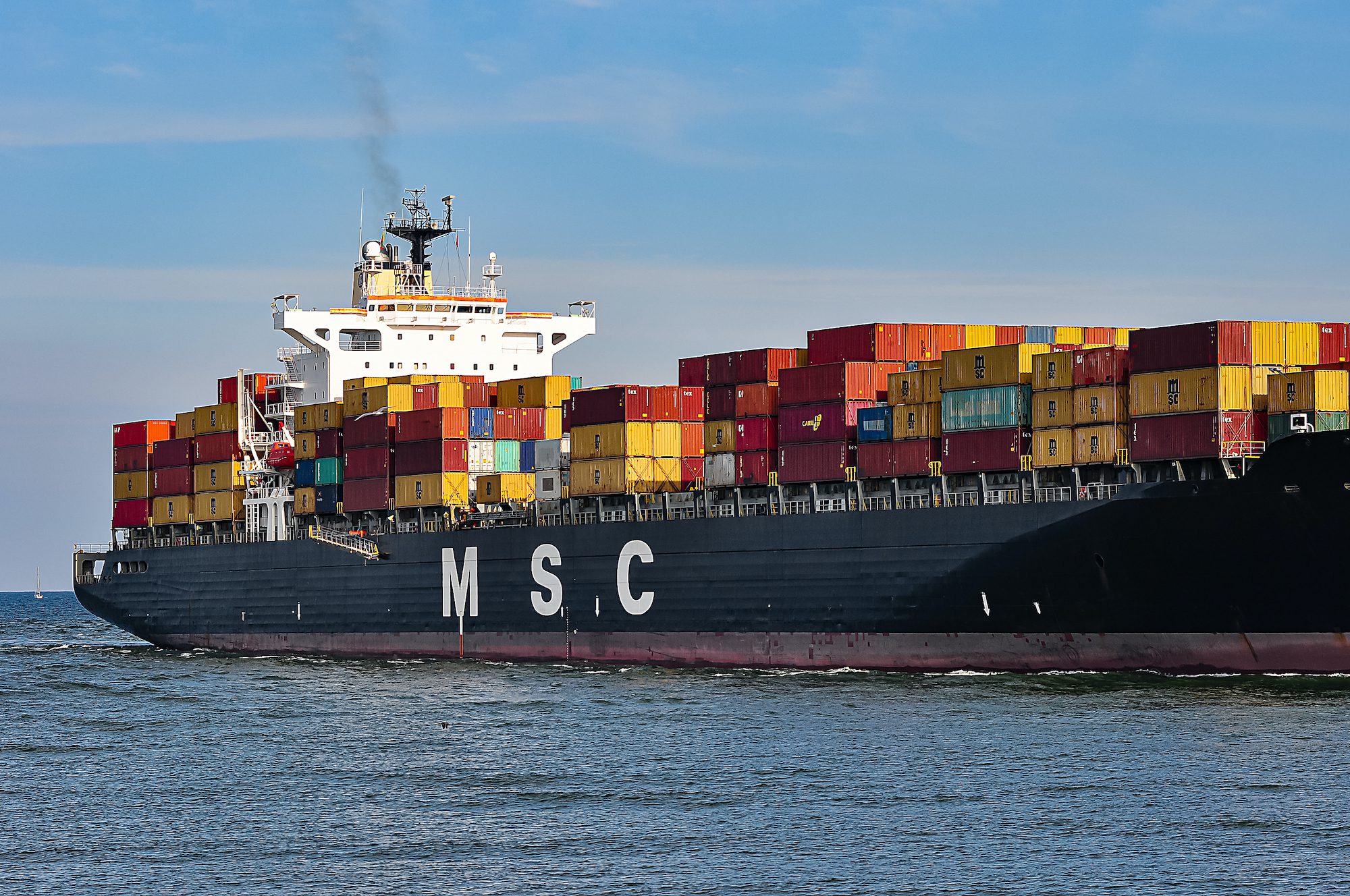
MSC Shipmanagement Limited has been fined $6 million and placed on four years of probation over the 2024 “runaway ship” incident involving the containership MSC Michigan VII in Charleston, South Carolina, which forced authorities to evacuate the Arthur Ravenel Jr. Bridge amid fears of a collision.
The vessel’s chief engineer, Fernando San Diego San Juan, was separately sentenced to pay a $2,000 fine after previously pleading guilty to failing to report a hazardous condition and obstructing the subsequent federal investigation.
The U.S. Department of Justice announced the sentences Tuesday, more than two years after the MSC Michigan VII lost the ability to slow its main engine while departing Charleston Harbor on June 5, 2024.
The Liberian-flagged containership accelerated to approximately 16 to 17 knots after a linkage rod connecting the main engine governor to the fuel rack became disconnected. With the engine unable to respond normally to commands from the bridge, the vessel continued outbound toward the Arthur Ravenel Jr. Bridge.
Authorities evacuated the eight-lane bridge over concerns the ship could strike it, just months after the containership Dalidestroyed Baltimore’s Francis Scott Key Bridge in March 2024.
A harbor pilot ultimately guided the MSC Michigan VII safely beneath the Ravenel Bridge and out to sea. Local beaches were also cleared because of the vessel’s large wake, which injured two people and damaged ships and piers along the waterway.
“The hazardous condition onboard this vessel, and MSC’s failure to report it, could have ended in a fatal bridge strike as occurred months earlier in Baltimore,” said Principal Deputy Assistant Attorney General Adam Gustafson of the Justice Department’s Energy and Natural Resources Division.
“Had the MSC Michigan VII been heading into port instead of out to sea, the result would likely have been catastrophic,” he added.
Investigators Uncover Improvised Engine Adjustments
The investigation revealed that the incident was not simply an unexpected mechanical failure.
MSC and San Juan admitted that the ship’s engineering crew had been manually adjusting the length of the governor linkage rod to make the main engine achieve the revolutions per minute ordered from the bridge.
The governor regulates engine speed, and according to prosecutors, only trained technicians should have been making adjustments to the governor and linkage system. None of the engineering crew aboard the MSC Michigan VII were qualified to do so.
Nevertheless, engineers had developed a practice of watching the bridge telegraph from the engine control room and manually turning the linkage rod when necessary until the engine reached the requested rpm.
San Juan admitted he knew the practice was hazardous because manually adjusting the linkage could cause it to fail, but allowed it to continue.
Investigators found that nuts on both ends of the linkage rod had been loosened so engineers could turn the rod more easily. Locking washers designed to prevent the nuts from backing out had also been removed. The Coast Guard later found one of the washers on the deck beneath the governor.
The dangerous arrangement failed during the June 5 departure after the crew made another manual adjustment. Once the linkage rod disconnected, the engine could no longer be slowed normally.
Both the main engine’s inability to reliably achieve the rpm ordered from the bridge and the crew’s manual adjustment of the linkage rod constituted hazardous conditions that should have been reported to the Coast Guard, according to the Justice Department.
They were not.
Chief Engineer Lied to Investigators
The case expanded after investigators determined that San Juan repeatedly lied about the crew’s actions.
During interviews with the Coast Guard and National Transportation Safety Board, San Juan initially claimed the crew never adjusted the linkage rod and that only qualified technicians performed such work.
He also denied that there had previously been delays between bridge telegraph commands and the main engine’s response, despite knowing the linkage had been manually adjusted on earlier occasions to achieve the requested rpm.
San Juan later told another crew member that he had told the Coast Guard he had not seen anyone adjust the linkage rod. He instructed that crew member and two others to give investigators the same account so they would be on “the same page,” according to prosecutors.
San Juan pleaded guilty in September 2025 to failing to report a hazardous condition and obstructing the federal investigation.
Court records previously revealed broader machinery problems aboard the 74,583-gross-ton containership. The engine governor issue was linked in part to problems with the vessel’s fuel injection system when operating on lower-viscosity low-sulfur fuel. The vessel also experienced problems with its main air compressors and generators, several of which could not sustain a 75% power load, at times preventing use of the bow thruster while maneuvering in port.
Records also showed that San Juan received only about five hours to complete his handover when he joined the vessel near Santos, Brazil, in April 2024. San Juan maintained that the process should normally have taken at least 24 hours and that the abbreviated handover was insufficient to obtain a complete picture of the engine room and critical machinery.
MSC Gets Four Years of Probation
MSC Shipmanagement pleaded guilty to failing to report the hazardous condition and obstructing the Coast Guard and NTSB investigation.
In addition to the $6 million criminal fine, the company was sentenced to four years of probation and ordered to conduct a root-cause analysis examining the circumstances surrounding the hazardous conditions aboard the MSC Michigan VII.
U.S. Attorney Bryan P. Stirling for the District of South Carolina credited local authorities with preventing the incident from becoming a potentially far greater disaster.
“The true heroes here are our local law enforcement, who evacuated the Ravenel bridge and local beaches, and the harbor pilot who navigated the vessel safely out to sea,” Stirling said.
The case was investigated by Coast Guard Sector Charleston, the Coast Guard Investigative Service and the NTSB.
The sentencing closes the criminal case stemming from an incident that occurred against the backdrop of heightened concerns over large containerships and bridge safety following the Dali disaster in Baltimore less than three months earlier.

 Join The Club