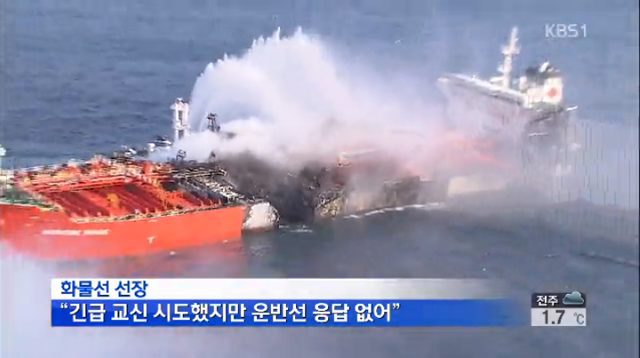
A screenshot of the Maritime Maisie following the December 29 collision and fire off Busan.
Classification society Lloyd’s Register has warned that the fire-scorched chemical tanker Maritime Maisie is in danger of breaking up more than 50 days after a collision with a car carrier off Busan, South Korea.
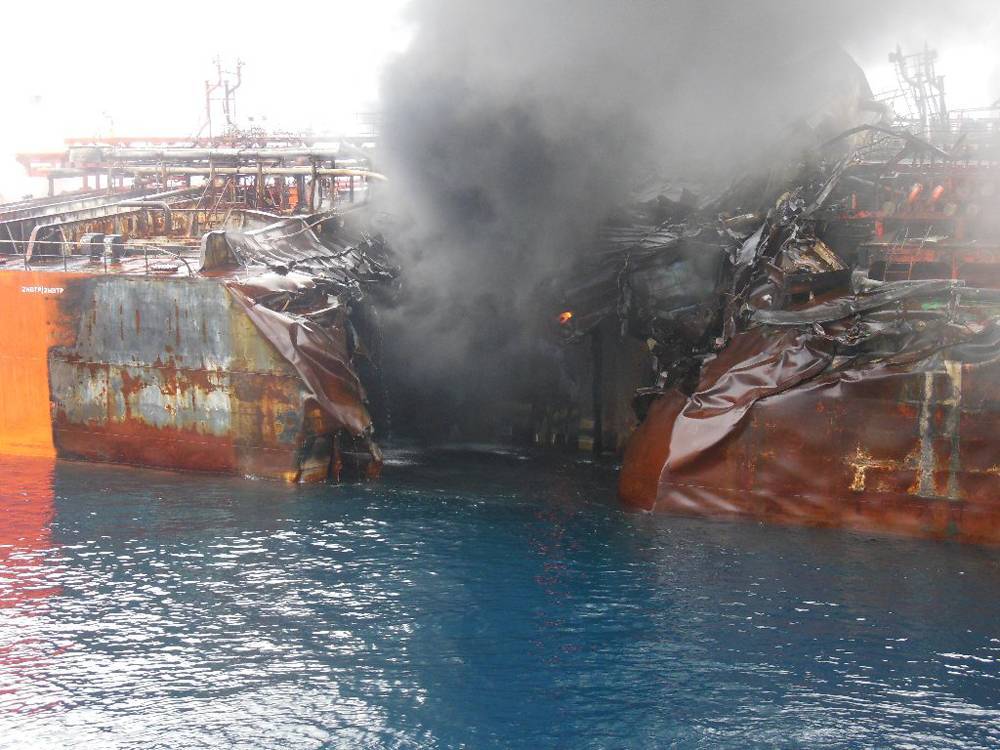
An update from Lloyd’s Register said that the maximum bending moment for the ship currently exceeds estimated damage strength limits, adding that the vessel is in serious danger of breaking up if subjected to either worsening weather or a long ocean tow.
The Hong Kong-flagged Maritime Maisie was carrying an estimated 30,000 tons of the highly flammable chemical acrylonitrile when it was involved in a collision with the car carrier Gravity Highway near the port of Busan on December 29, causing the Maritime Maisie to catch fire.
Damage to the Maritime Maisie
Now, more than 50 days since the collision and a month since the fire was extinguished, there is growing concern over the structural integrity of the tanker. The ship has spent the last seven weeks held at sea by tugs with Japan and South Korea unwilling to give it refuge even though they risk a wider environmental disaster if it breaks up and sinks.
Lloyds Registers Ship Emergency Response Service (SERS) has been working with the ships managers, Singapore-based MSI Shipmanagement, to develop a plan to best manage the casualty and help ensure the ship can be taken to a secure anchorage where the remaining cargo can be transferred safely.
Calculations show that should a complete structural failure occur, both halves of the ship will remain floating and upright. However, if sheltered water can be found then further calculations have shown that the ships remaining cargo can be offloaded without exceeding estimated strength limits, Lloyd’s Register said. Thus, Lloyd’s Register says, the call for the Port of Refuge is most critical.
“Continued exposure to seas will weaken the ships structure at some point it is likely to fail,” commented Wijendra Peiris, SERS Team Leader, Lloyds Register. “Maritime Maisie needs to be taken to a safe haven and offload its cargo as soon as possible. We would be very concerned if the ship is towed for a lengthy period in the open ocean or remains where she is for an extended period.”
Of the 30,000 tons of cargo the ship was carrying when the collision occurred, an estimated 4,000 tons was lost to the sea, atmosphere or was consumed by fire, meaning an estimated 26,000 tons of cargo could remain on the vessel.
The Maritime Maisie incident was noted as one of the catalysts for a recent call to action from shipowners, salvors and insurers for the implementation of international measures to provide a Place of Refuge for stricken vessels where casualty vessels have been delayed or denied in accessing a safe harbor.
Tags:
Subscribe for Daily Maritime Insights
Sign up for gCaptain’s newsletter and never miss an update
President Donald Trump said Friday that Russia has agreed to release millions of tons of diesel fuel into U.S. and global markets following a telephone call with Russian President Vladimir...
Nearly 500,000 barrels a day of oil-refining capacity sit in the projected path of Hurricane Isaias, raising the risk that a US fuel market with no supplies to spare will lose critical output.
A commercial vessel was struck by a projectile in the Persian Gulf on Friday, sparking a fire onboard in the second reported attack on shipping inside the Gulf in just...
October 9, 2026
Total Views: 1156
Get The Industry’s Go-To News
Subscribe to gCaptain Daily and stay informed with the latest global maritime and offshore news
— just like 106,969 professionals
Secure Your Spot
on the gCaptain Crew
Stay informed with the latest maritime and offshore news, delivered daily straight to your inbox
— trusted by our 106,969 members
Your Gateway to the Maritime World!
Essential news coupled with the finest maritime content sourced from across the globe.

 Join The Club