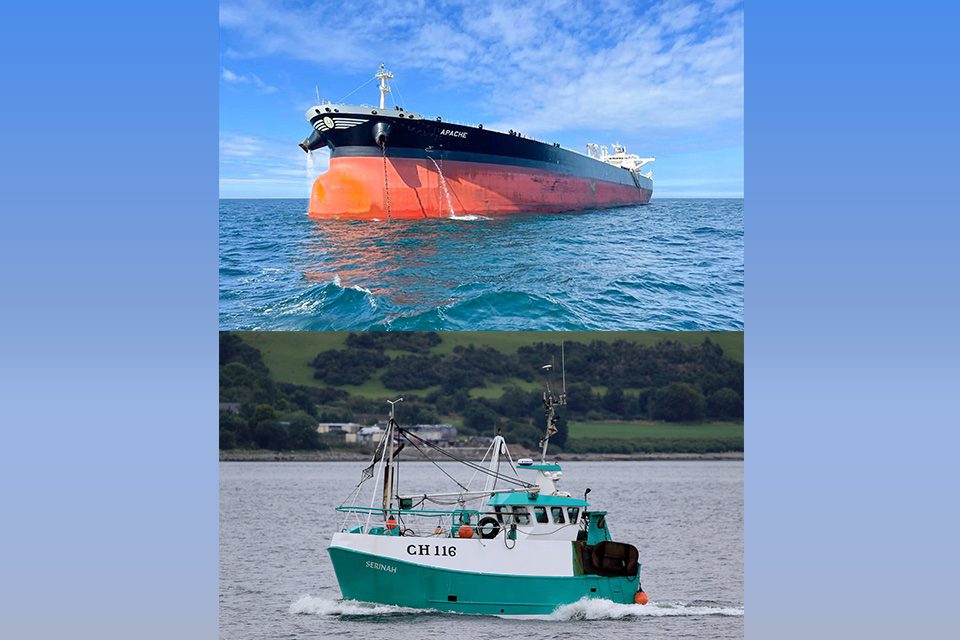
A collision between a crude oil tanker and a fishing trawler in Scotland’s Firth of Clyde has prompted investigators to call for mandatory navigation training for small fishing vessel crews, after a near-fatal incident that exposed systemic safety gaps.
The tanker Apache struck the stern trawler Serinah on April 25, 2024, causing the fishing vessel to sink rapidly. All three crew members survived, though Serinah’s skipper spent around 15 minutes in the water before being rescued by his crewmates, who managed to deploy and board an inflatable liferaft.
A report published today by the UK’s Marine Accident Investigation Branch (MAIB) found that neither vessel took sufficient action to avoid the collision, despite clear obligations under the International Regulations for Preventing Collisions at Sea (IRPCS). Crucially, investigators determined that Serinah’s crew had received no formal navigation training, leaving them unaware of their responsibilities and unable to recognize the developing risk.
“This accident could have had a far worse outcome,” said Chief Inspector of Marine Accidents Andrew Moll OBE. “The investigation identified shortcomings in the navigational practices on both vessels involved.”
The MAIB found that although Apache was the give-way vessel—Serinah was restricted in its ability to maneuver while conducting fishing operations—the tanker’s bridge team assumed the trawler would turn clear, based on past experience. No effective avoiding action was taken.
The collision occurred shortly after 3:00 p.m. as Serinah was making circular fishing tows in a seabed depression. When Apache’s bow ran over the trawler’s towing wires, the damage worsened dramatically, causing Serinah to list heavily and sink. Apache initially continued toward its pilot boarding station at Finnart Oil Terminal, only turning back after being reminded by Belfast Coastguard of its obligation to render assistance.
Investigators noted that the fishing gear limited Serinah’s maneuverability, and by the time it became clear Apache would not alter course, there was little time left to take evasive action. On both vessels, assumptions about the other ship’s intentions—and the perceived constraints of the operating area—delayed meaningful response until the collision was effectively unavoidable.
The MAIB issued three formal safety recommendations. The Maritime and Coastguard Agency has been urged to require approved navigation training for skippers and watchkeepers on UK fishing vessels between 7 and 16.5 meters. Apache’s manager, Nereus Shipping S.A., has been advised to improve fleet-wide understanding of fishing vessel behavior, while Serinah’s operator, S & B Fish (Agency) Limited, has been told to ensure all watchkeepers are properly trained and familiar with the IRPCS.
Since the incident, Nereus Shipping has audited navigational practices across its fleet and introduced revised procedures and in-house training. Peel Ports Group has also announced plans to upgrade monitoring capabilities at Clyde Port to vessel traffic service standards.
The collision highlights a persistent weakness in the UK’s maritime safety framework: mandatory training requirements for fishermen do not guarantee that those standing navigational watches are adequately qualified. As commercial and fishing vessels continue to share increasingly congested waters, the MAIB says the incident serves as a clear reminder that formal training—and strict compliance with collision-avoidance rules—remain essential to preventing avoidable accidents at sea.
The full report can be found on the UK MAIB website.
Editorial Standards · Corrections · About gCaptain

 Join The Club