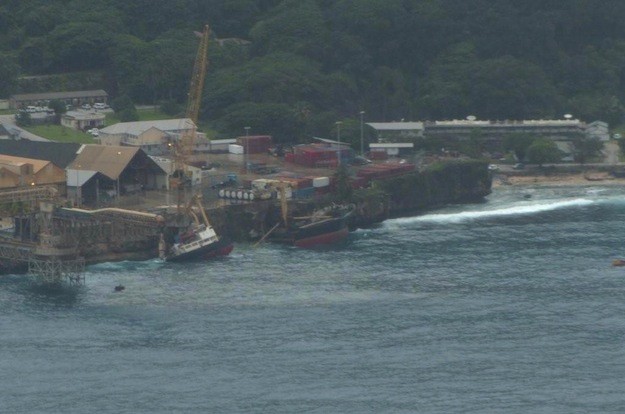
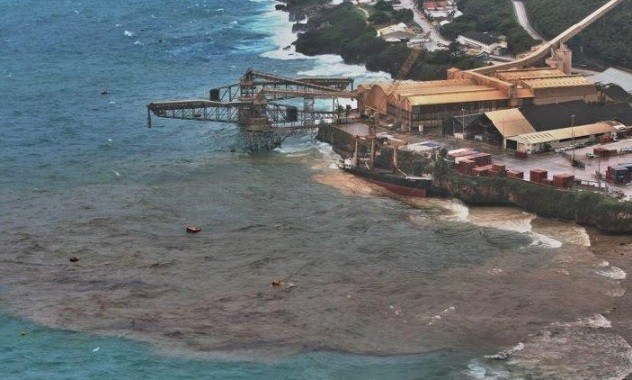
An update from the Australian Maritime Safety Authority (AMSA) said that the vessel broke in pounding seas overnight and the bulk of the vessel’s oil and cargo (phosphate) has been released from the breach in the hull. Initial reports from the master of the MV TYCOON indicated that there are approximately 102 tonnes of intermediate fuel oil, 11,000 litres of lubricant oil, 32 tonnes of diesel oil and approximately 260 tonnes of phosphate cargo onboard the vessel.
As a result the AMSA has activated the Australia’s National Plan to Combat Pollution of the Sea by Oil and other Noxious and Hazardous Substances, or the National Plan, and that there are now two salvage and three pollution response experts on-site to assess the situation.
Luckily the crew of 15 was evacuated from the vessel with assistance from the Royal Australian Navy and the Australian Federal Police.
Aerial photo. Photo: Australia Customs and Border Protection
The news site The Australian, tells us that the grounding comes as a surprise to local mariners who claim that bad weather is routine and ships are often ordered by port authorities to return to sea when a storm arrives – procedures set in place by the Australian Maritime Safety Authority soon after the 2007 grounding of the ship Pasha Bulker on a popular tourist beach.
Port officials claim that regular checks were conducted on the ship on and its morning lines checked Saturday night. The pilot, an employee of the phosphate mine, checked the ship at 8pm, the local harbor master followed up with a visual inspection at 9pm and the boss of the island’s stevedoring company at midnight. But, in the early hours of Sunday morning concern grew along with a surrounding swell.
At 6:18 the ship’s captain called shore asking to be moved but was told it was too rough to send barges. The navy soon responded with inflatable boats to work the mooring lines but, by the time they arrived, a line parted leaving the ship to scrape the harbour cliffs.
INCIDENT UPDATE:
The following is the latest official update from the Australian Maritime Safety Authority:
Two pollution response experts and one salvage expert arrived at Christmas Island yesterday, 10 January 2012.
There are now two salvage and three pollution response experts on-site, as part of the National Plan response.
Shoreline cleanup commenced yesterday and continues today. There are around 80 registered volunteers working in shifts under the direction of the pollution response experts.
In addition, there are 11 environmental staff on the island from Parks Australia. They are standing by to support the wildlife rescue team, particularly for any seabird rescue, and to assist island volunteer teams.
Park staff report that many thousands of young red crabs are emerging from the sea at Flying Fish Cove today, in greater numbers than yesterday.
Discussions are continuing between government officials and representatives of the ship’s owner and insurer regarding removal of the wreck.
Sea swells around the island remain moderate.
The Australian Transport Safety Bureau (ATSB) investigation team arrived on the island yesterday to begin the on-site investigation.
The team comprises a Master Mariner and an experienced marine Chief Engineer.
The team spent yesterday afternoon talking to relevant people including the Harbour Master and the harbour pilot and interviewed the ship’s master, first mate and chief engineer.
The ATSB preliminary investigation report, presenting factual information about the incident and the investigation, will be available within 30 days.
An AMSA official has commenced an investigation into whether there were breaches in navigation law.
What new ship construction project has cost more than a US Navy Supercarrier and is equally troubled with delays and problems? Shell’s Prelude FLNG. by Sonali Paul (Reuters) – Royal...
By Perry Williams (Bloomberg) — After a decade planning the world’s largest floating gas export plant, Royal Dutch Shell Plc’s supplies could get tapped by a competitor first. Shell and...
(Reuters) – Japan’s JERA Co, the fuel-buying joint venture of Tokyo Electric Power and Chubu Electric Power, said it received the first liquefied natural gas (LNG) cargo shipped from Chevron’s...
November 13, 2017
Total Views: 182
Get The Industry’s Go-To News
Subscribe to gCaptain Daily and stay informed with the latest global maritime and offshore news
— just like 107,374 professionals
Secure Your Spot
on the gCaptain Crew
Stay informed with the latest maritime and offshore news, delivered daily straight to your inbox
— trusted by our 107,374 members
Your Gateway to the Maritime World!
Essential news coupled with the finest maritime content sourced from across the globe.

 Join The Club