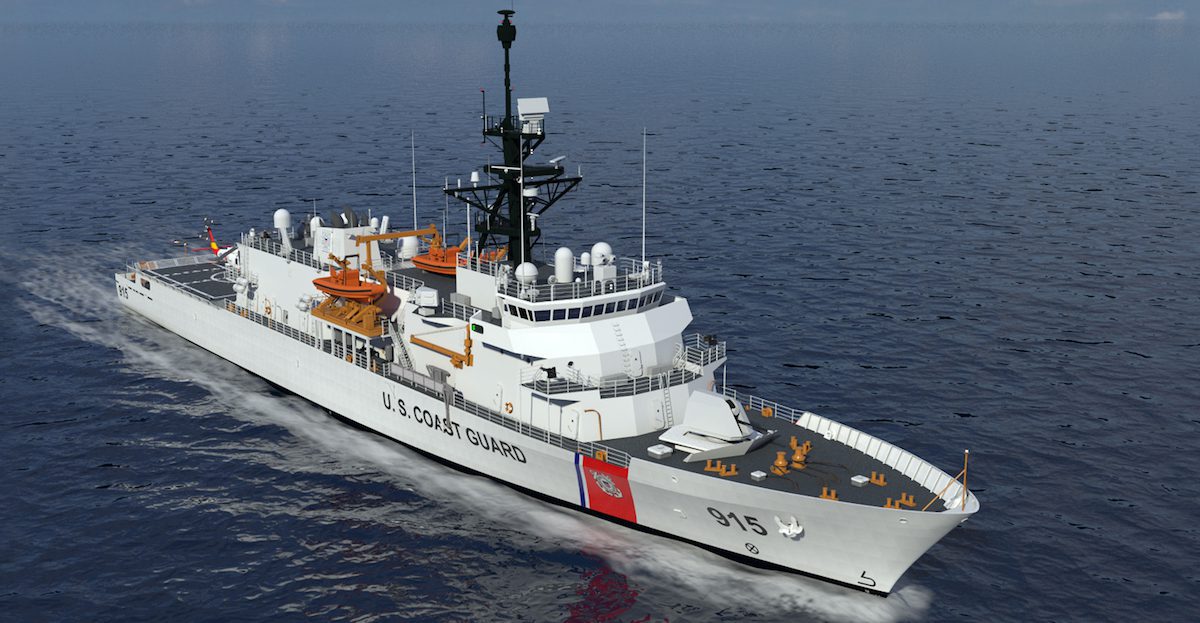
A rendering of Eastern Shipbuilding Group’s preliminary design for the Offshore Patrol Cutter. Image courtesy: Easter Shipbuilding Group
The U.S. Government Accountability Office says the Coast Guard accepted significant risk with the Offshore Patrol Cutter program after Hurricane Michael hit the shipyard where the first of the vessels are being built.
Hurricane Michael, a category 5 storm, devastated the Panama City, Florida shipyard of Eastern Shipbuilding Group in October 2018 where construction of the Coast Guard’s Offshore Patrol Cutters was about to begin. The damage prompted the Department of Homeland Security to grant up to $659 million in extraordinary contractual relief to the shipbuilder to help it recover.
RELATED BOOK: The Finest Hours: The True Story of the U.S. Coast Guard’s Most Daring Sea Rescue by Michael J. Tougias,
In total, the Coast Guard has committed to spend over $12 billion to acquire a fleet of 25 OPCs to replace its aging fleet Medium Endurance Cutters.
In 2016, the Coast Guard awarded ESG with the contract to design and construct the first nine Offshore Patrol Cutters marking largest-ever vessel procurement contract ever awarded in the history of the Coast Guard. However, due to the widespread damage caused Hurricane Michael, the Coast Guard later divided program two stages and revised its cost and schedule goals. Under the revised plan, ESG would build only up to four OPCs in the first stage, while the acquisition of the remaining 21 OPCs will be awarded under one or more new contracts starting in second stage in fiscal year 2022.
According to the GAO, the Coast Guard’s determination to deliver the OPCs in a timely manner, even after the hurricane, has driven the program through key acquisition decisions despite certain risks.
“The Coast Guard accepted significant risk with the design, schedule, and cost—both before and after the hurricane—to get the cutters built quickly. But the cutter’s design is unstable, its schedule optimistic, and its cost estimate incomplete—making it likely that building it will take longer and cost more,” the GAO said in its findings.
GAO has made eight recommendations to the Coast Guard and DHS, including ensuring that the program stabilizes its design before proceeding with construction of the next OPC, updates its schedule to address deficiencies and incorporate risks, and updates its cost estimate to improve its credibility.
RELATED BOOK: The Finest Hours: The True Story of the U.S. Coast Guard’s Most Daring Sea Rescue by Michael J. Tougias,
Updated: November 20, 2023 (Originally published November 16, 2020)
Editorial Standards · Corrections · About gCaptain

 Join The Club