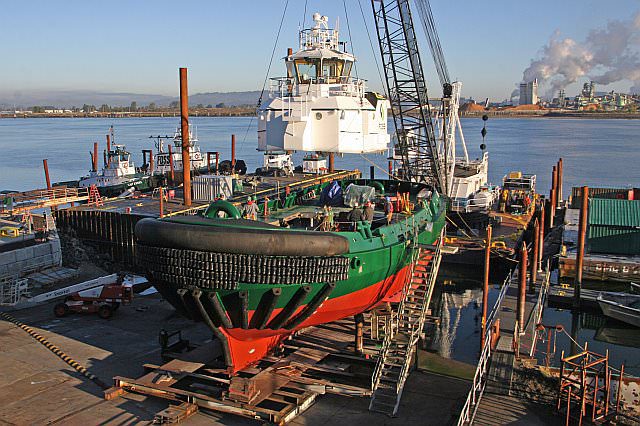
Tug construction at Foss’ Rainier Shipyard. Photo: Foss Maritime
Foss Maritime on Tuesday announced plans to build the first three vessels of its new Arctic Class of tugs as the company responds to growing demand and new opportunities in the oil and gas industry.
“At Foss we innovate,” said Gary Faber, Foss’ President and Chief Operating Officer. “These vessels will be built using the latest advances in technology and equipment. We want to increase efficiency, improve safety and performance, and reduce environmental impact. These concerns are paramount to our customers, our stakeholders and our crews involved in offshore drilling and other project work in extreme environments.”
Faber said the new tugs have been designed to withstand harsh environment Arctic operations and position Foss to compete for global opportunities in the quickly evolving oil and gas industry. Currently, Foss has five assets committed to Shell’s arctic offshore exploration program in the Chukchi and Beaufort Seas and looks towards providing additional assets in the Arctic in the future.
“Foss has worked Alaskan Arctic waters for decades with a well-known record for our focus on, and innovation in, environmental protection with the highest of safety standards,” Faber said. “We have unique skills when it comes to the transportation of infrastructure needed for Arctic oil and gas exploration in to areas with little or no infrastructure. The new tugs will enhance our ability to move cargoes safely.”
Construction on the first tug in the Arctic Class starts in early 2013 at Foss’ Rainier, Oregon shipyard, work which will bring additional jobs to the growing Columbia River facility. Faber added that additional ABS classed tugs and support vessels are already under consideration.
Mike Magill, Vice President of Technical Services, who oversees Foss’ two shipyards and the company’s engineering department, said the three new tugs will be designed to achieve in excess of 100 metric tons of bollard pull, a measure of pulling power. The vessels will be used primarily to tow barges with oil field modules, rig topsides and project cargoes throughout the world.
Glosten Associates, who is Foss’ naval architecture partner on the project, expects the design phase to be completed by year’s end. Machinery on the new tugs will include Caterpillar C280-8 main engines, which comply with the highest federal environmental standards; and Reintjes reduction gears. Markey Machinery will supply the tow winch.
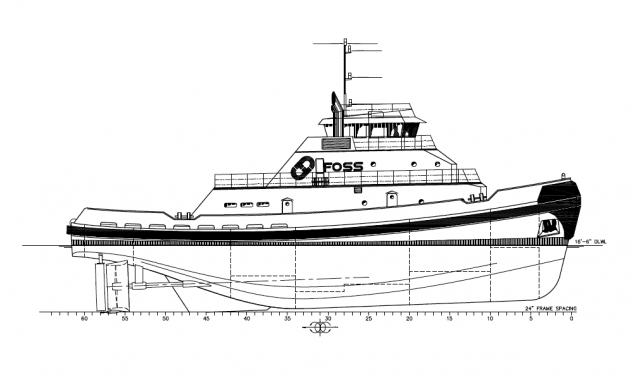
General arrangement of Foss’ Arctic Class of tugs. Image: Foss Maritime
The decision to build the three ocean-going tugs will have a ripple effect throughout Foss, Magill said. The vessels will be built at the company’s Rainier, OR, shipyard Foss has already announced that the facility, which specializes in new vessel construction, will expand by an additional 10,000 square feet, and will require additional staff. These highly anticipated vessels signify a continuing commitment to Foss growth and expansion into new and exciting markets.
“This is a win-win for us,” Magill said. “We have a fine workforce in place at Rainier and we’re very excited to be able to expand Fosses’ fleet in ways that grow our business.”
Specifically, the new tugs will meet:
American Bureau of Shipping (ABS) A1 requirements, including standards for hulls, machinery, towing, anchors and cable;
American Bureau of Shipping (ABS) Ice Class requirements
International Convention for the Safety of Life at Sea (SOLAS) requirements, including an on-board rescue boat and davit; and
Green Passport, which requires an inventory of shipboard hazardous materials that make decommissioning of vessels far safer.
In addition to the low-emission Caterpillar engines, the vessels will incorporate several environmentally focused designs and structural and technological upgrades, including:
Elimination of ballast tanks, so there is no chance of transporting invasive species;
Holding tanks for black and gray water to permit operations in nodischarge zones (such as parts of Alaska and California);
Hydraulic oil systems compatible with biodegradable oil;
The New Bedford Foss Marine Terminal (NBFMT) has opened its first deep water berth after two years of construction, marking a significant step in supporting North America’s emerging wind energy...
Vineyard Wind shipped out the first GE Haliade-X Wind Turbine Generator (WTG) from New Bedford to its home location over 30 miles from Cape Cod. Foss Maritime, a U.S.-based service...
March 12 (Reuters) – U.S. President Joe Biden will prevent or limit oil drilling in 13 million acres of Alaska and the Arctic Ocean, the Associated Press reported on Sunday, citing an administration...
March 12, 2023
Total Views: 2140
Get The Industry’s Go-To News
Subscribe to gCaptain Daily and stay informed with the latest global maritime and offshore news
— just like 105,171 professionals
Secure Your Spot
on the gCaptain Crew
Stay informed with the latest maritime and offshore news, delivered daily straight to your inbox
— trusted by our 105,171 members
Your Gateway to the Maritime World!
Essential news coupled with the finest maritime content sourced from across the globe.

 Join The Club