
 Join The Club




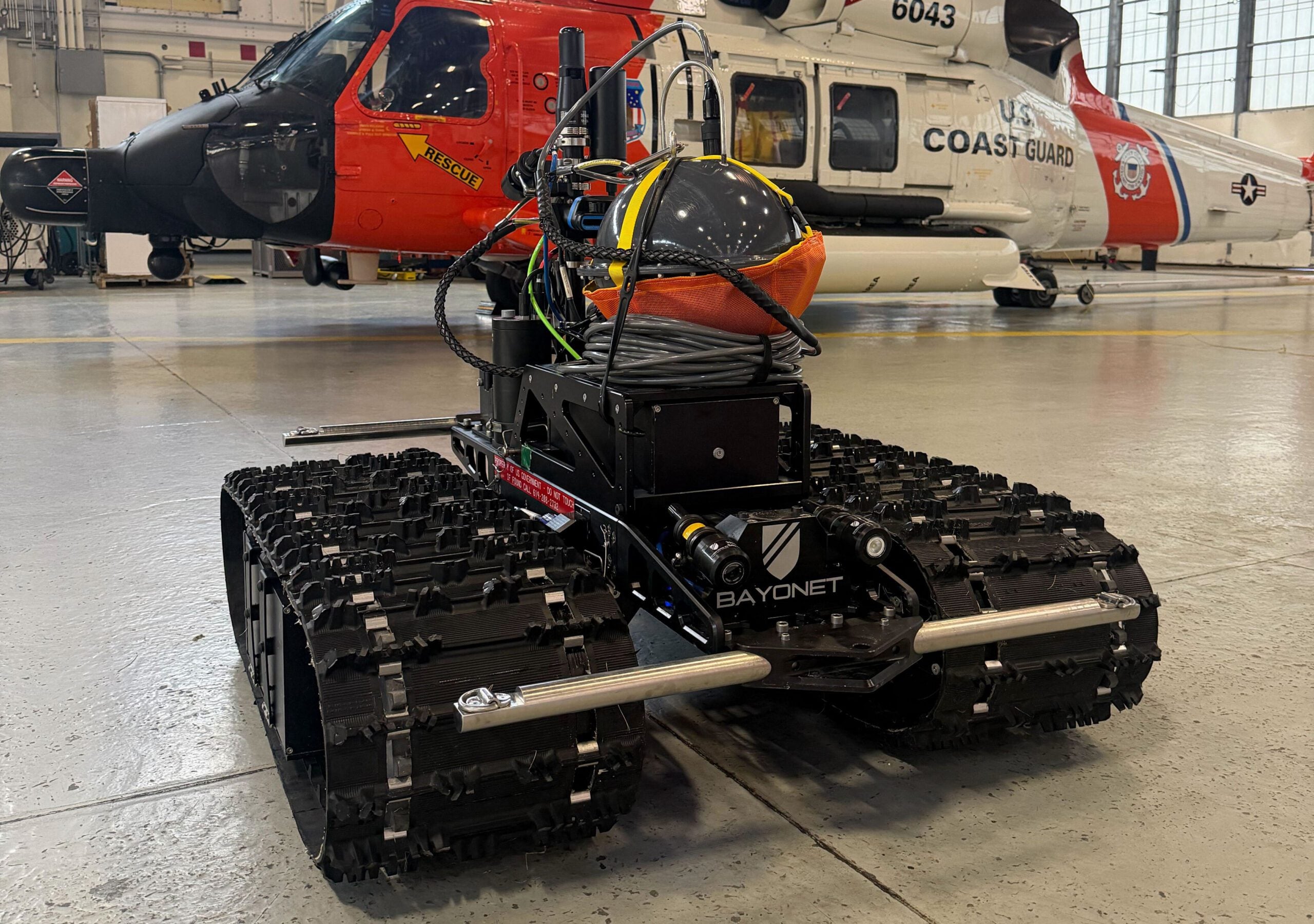
Clearing the Strait: How Autonomous Systems Are Redefining Mine Countermeasure Operations
A mine doesn’t have to strike a ship to disrupt global commerce. In the Strait of Hormuz, the threat of mines alone has sparked uncertainty across the entire maritime industry, increasing insurance costs and delaying shipments along major routes. For shipowners, operators, and insurers, the challenge is not just the presence of mines but the time it takes to determine whether these critical waterways are safe.
This challenge begins on the seabed. Detecting mines across deep sea and littoral environments requires specialized technology, operational experience, and the ability to survey with precision and confidence.
For 20 years, Greensea IQ has developed autonomous maritime technology for complex maritime operations. Since 2014, they have been building, testing, and deploying maritime Explosive Ordnance Disposal (EOD) solutions with the U.S. Navy. Today, the Bayonet underwater crawler is the only commercially ready robot capable of conducting mine countermeasure missions from the shoreline to the seafloor.
The challenge is that mines rarely present themselves as easy targets. They can be triggered by a disturbance or detonated on command, and may be entirely buried or camouflaged in seafloor terrain. Regardless, a mine must be detected and accurately located before any action can be taken.
This requires sophisticated sensors, specialized equipment, and a significant amount of survey time. Once a threat is identified, it must be precisely located before neutralization operations can begin, or, if needed, be safely recovered for intelligence purposes.
The Complexity of the Strait
A nation does not need thousands of mines to disrupt global commerce. A small number of strategically placed munitions creates enough uncertainty to delay shipping, increase the cost of goods, inflate insurance premiums, force route changes, and consume naval resources.
At the same time, modern mines are becoming smaller, more sophisticated, and harder to detect, increasing the complexity of clearance operations and reinforcing the need for advanced autonomous systems capable of operating in these conditions.
In critical waterways like the Strait of Hormuz, the economic and operational impact of a minefield begins before the first mine is recovered. The current situation carries added difficulty due to the geographical terrain. The narrow shipping channel contains a diverse underwater environment. Strong currents in shallow waters, paired with sand waves and rocky areas, create a waterway full of debris generated by heavy traffic. This produces cluttered terrain filled with objects that can mask potential threats.
Autonomous systems like Greensea IQ’s Bayonet Underwater Ground Vehicle (AUGV) are beginning to change the equation.
Historically, mine countermeasure operations have relied heavily on divers. While divers remain an essential capability, they are constrained by bottom time, decompression, water temperature, fatigue, visibility, and life support equipment.
“Divers are an incredible capability, but they should be the last asset you send into a minefield, not the first. The Strait of Hormuz is one of the most dangerous mine warfare environments on the planet. The combination of heavy commercial traffic, shallow water, strong currents, poor visibility, and a capable adversary makes it exactly the kind of place where autonomous systems provide enormous advantages.”
- Greensea IQ EOD Product Manager and retired U.S. Navy EOD Senior Chief, Dennis Doan
The Bayonet AUGV can operate for hours at a time, collecting continuous survey data without the proximity risk that divers face. This pairing results in greater coverage, faster assessments, and reduced risk to personnel.
Autonomous systems provide a level of consistency and data collection that is difficult to achieve through diver operations alone. Greensea IQ has built an open architecture software that unifies marine robotics, sensors, and mission tools in one environment, specifically tailored for mine clearance missions. It has been a familiar operation interface with the U.S Navy for almost a decade and can be integrated into any unmanned system.The mission centric user interface builds high-resolution seabed maps, records sonar imagery, stores video and sensor data, and compares data over time.
In environments like the Strait of Hormuz, where visibility is limited, currents are unpredictable, and the seabed is complex, the Bayonet AUGV relies on sonar as its primary detection tool, utilizing sound as it travels farther in water than light does. Greensea IQ has developed machine learning-based algorithms to assist with target detection, using AI to identify shapes that are manmade and indicative of mines or mine-like objects.
Combined with intelligent software brainpower, the Bayonet AUGV brings mission flexibility and simplicity to operations. It can be launched from shore or driven directly off a vessel, and once deployed, it can navigate from the shoreline into deep seafloor environments. In a region where the speed of detection and clearance carries significant implications for global commerce, autonomous systems offer a safer and more efficient path to understanding and mitigating underwater threats.
Learn more about Greensea IQ’s Bayonet AUGV.

Subscribe for Daily Maritime Insights
Sign up for gCaptain’s newsletter and never miss an update
— trusted by our 105,257 members
Stay Informed. Stay Connected.
Get The Daily Insights That Power Maritime Professionals Worldwide
Essential maritime and offshore news, insights, and updates delivered daily straight to your inbox
— trusted by our 105,257 members
Have a news tip? Let us know.
Get The Industry’s Go-To News
Subscribe to gCaptain Daily and stay informed with the latest global maritime and offshore news



