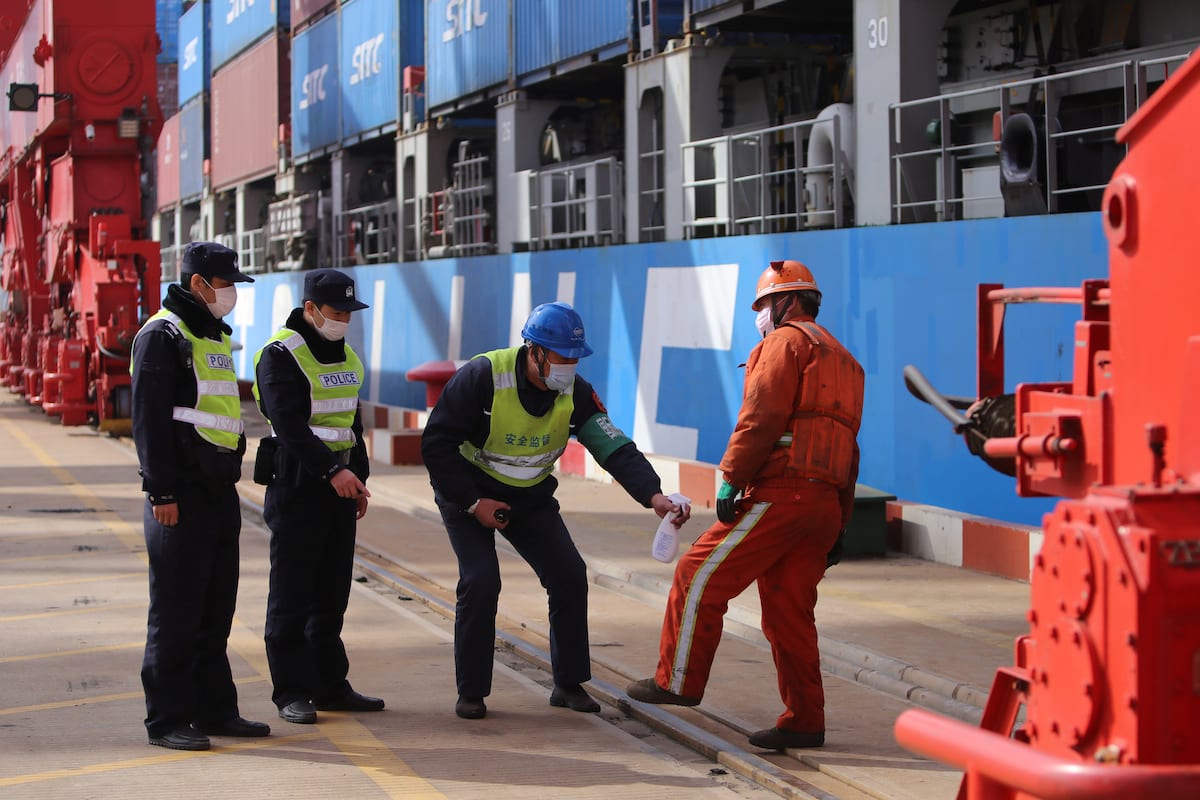
Police officers, wearing face masks, supervise the disinfection of a worker near a ship with containers at a port in Lianyungang, Jiangsu province, China March 12, 2020. cnsphoto via REUTERS
By Muyu Xu and Dominique Patton BEIJING, March 13 (Reuters) – Severe congestion at Chinese ports is easing, say officials and industry participants, although a logjam of refrigerated containers has disrupted supplies of fresh and frozen food and pushed up freight rates outside China.
Thousands of refrigerated containers carrying meat, seafood and fruit from around the world to China have been stuck for weeks at the country’s ports after Beijing extended its Lunar New Year holiday and cities around the nation restricted free movement to curb the spread of coronavirus
With skeleton staffing at ports and few truck drivers available to transport cargoes onwards, refrigerated containers – known as reefers – were either stranded at already congested ports or redirected around Asia to find places where they could be plugged in to power to keep their contents fresh.
In recent weeks Beijing has allowed more travel and offered financial support to companies to restart operations. Some ports chartered trains to bring truck drivers back to clear containers.
“There were staff shortages everywhere, at berths, among inspectors, truck drivers and at downstream companies. But it’s getting much better now, as people are coming back,” said Zhang Ruxing, secretary general of the container division at the China Ports & Harbours Association.
German shipping company Hapag-Lloyd told Reuters in a statement that port congestion in China has eased, berthing operations have improved and terminals have resumed normal working conditions.
More places to plug in reefers had also become available and the company is no longer diverting cargoes on a large scale, it said.
About 18,000 twenty-foot-equivalent unit (TEU) reefers were still at Shanghai and Tianjin ports as of March 6, the port association said this week, down from 27,000 in mid February.
Shanghai, the world’s largest container port by volume, and Tianjin have added 7,000 new spots to plug in reefers, expanding storage capacity for chilled cargoes by 40%, it said.
About a third of rerouted cargoes have been brought back to China, it added. An official from Busan Port Authority confirmed that the South Korean port that has taken some of the rerouted cargoes is seeing a decline in numbers.
A Shanghai-based fruit importer, who asked to be identified only as Huang, said port congestion has eased and shipping lines were giving priority to perishable cargo.
However, despite a recovery in port logistics and operations, the logjam has dampened the confidence of many exporters and importers who were waiting for less congestion to resume business.
“Everyone is waiting for port capacity to fall from about 80% capacity currently to 50% to be more certain,” he said.
REEFER SHORTAGE
With many containers still tied up in Asia and shipping lines cancelling sailings, a large imbalance in reefer supply around the world is also pushing up freight rates, said Frank Madsen, global director of reefer and marine logistics at Danish freight forwarder Blue Water Shipping.
Spot, or short-term, freight rates have increased as much as 200%, he said, and are set to rise further.
“There’s both a space and equipment issue that we think could continue for four to eight weeks,” Madsen said, noting that fewer ships leaving China meant it was harder to return the reefers.
Factory activity in China plunged to its worst level on record in February, and while more businesses have reopened in recent weeks, analysts do not expect activity to return to normal until April.
Meanwhile, new containers are still being loaded for China, particularly for goods like frozen pork, which is in high demand, even as prices rise due to soaring freight rates. Pork accounts for about half of Blue Water’s reefer business.
A severe shortage of pork in China following a disease epidemic has pushed imports in recent months to record levels, further squeezing the space available for reefers at ports.
In mid February, about 10,000 reefers containing meat were stuck in Chinese ports, estimated a Beijing-based meat importer, about twice the usual level, though many of those have now been unloaded.
(Reporting by Muyu Xu and Dominique Patton in Beijing; additional reporting by Jane Chung in Seoul and Emily Chow in Shanghai; editing by Richard Pullin)
The informal fleet of crude tankers that operated under the radar in Nicolas Maduro’s Venezuela is beginning to emerge from the shadows after the strongman’s capture lifts the veil of how the South American oil producer sought to evade US sanctions.
The Iranian dry cargo ship Rona issued an SOS signal in the Caspian Sea on Wednesday, January 14, prompting a swift rescue operation by Turkmenistan’s Coast Guard Services that saved...
Dozens of commercial ships have dropped anchor at a distance outside Iran's port limits in recent days, according to data and shipping sources, as tensions with the United States grow.
Such movements were precautionary given the tensions amid ongoing protests in Iran, the shipping sources said. Port limits are significant because they run a higher risk of collateral damage in the event of air strikes on nearby infrastructure.
The U.S. is withdrawing some personnel from bases in the Middle East, a U.S. official said on Wednesday, after a senior Iranian official said Tehran had warned its neighbors that it would hit American bases if Washington strikes Iran.
The country relies on seaborne trade for imports using dry bulkers, general cargo and container ships as well as oil tankers for oil exports.
The number of tankers moving into Iran's exclusive economic zone (EEZ), a stretch of water along its Gulf and Caspian coasts that extends up to 24 miles and beyond local territorial limits of 12 nautical miles, jumped from 1 vessel to 36 tankers between January 6 and January 12, analysis by maritime intelligence solutions provider Pole Star Global shows.
At least 25 bulk carriers were stationary in Iran's EEZ off the major port of Bandar Imam Khomeini, data from ship tracking and maritime analytics provider MarineTraffic showed.
A further 25 ships including container and cargo vessels had dropped anchor further south off the port of Bandar Abbas, MarineTraffic data showed.
Israel launched air strikes in June 2025 on targets in Bandar Abbas, where at least 70 people were killed in unexplained blasts in April and authorities did not rule out sabotage.
As Iran's leadership tries to put down the worst unrest the Islamic Republic has faced, Tehran is seeking to deter U.S. President Donald Trump's repeated threats to intervene on behalf of anti-government protesters.
The level of interference with GNSS navigation systems, which included GPS, had increased to "substantial" in the Gulf and Strait of Hormuz area over the past week, the U.S. Navy's Combined Maritime Force said in a note on Monday.
"This is highly likely due to force protection measures being taken in relation to the ongoing political tensions in the region. Vessels transiting this area could be impacted," the note said.
9 hours ago
Total Views: 485
Get The Industry’s Go-To News
Subscribe to gCaptain Daily and stay informed with the latest global maritime and offshore news
— just like 107,481 professionals
Secure Your Spot
on the gCaptain Crew
Stay informed with the latest maritime and offshore news, delivered daily straight to your inbox
— trusted by our 107,481 members
Your Gateway to the Maritime World!
Essential news coupled with the finest maritime content sourced from across the globe.

 Join The Club