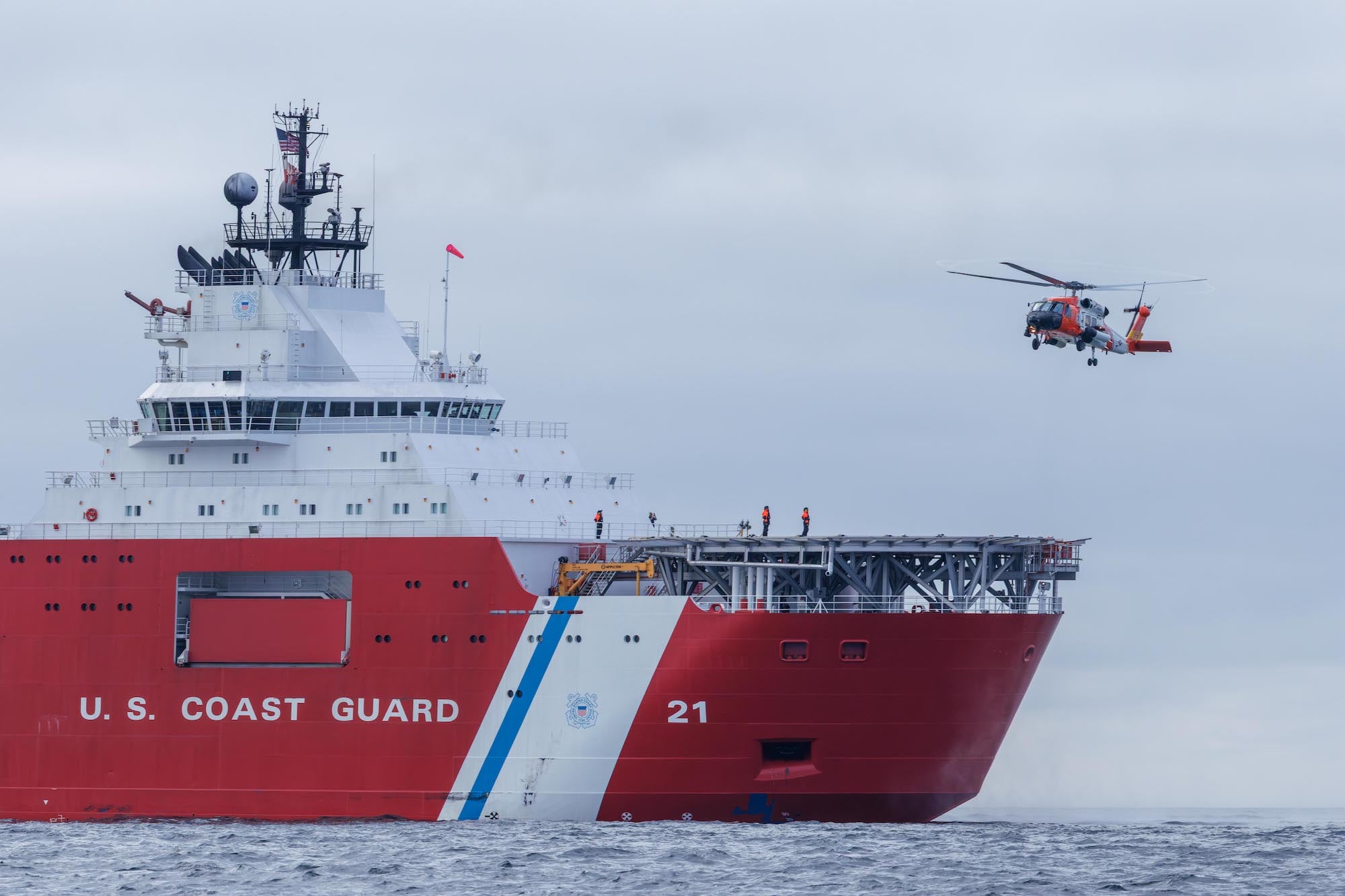
By Malte Humpert (gCaptain) China continues to push ahead with the rapid expansion of its Arctic-capable fleet. For the first time it has dispatched three icebreaking vessels into the region this summer.
The U.S., meanwhile, will remain without surface presence in the Arctic for the remainder of the year, possibly longer. Following last month’s fire aboard Coast Guard icebreaker Healy the vessel had to abort its Arctic patrol returning back to its homeport Seattle on a single engine. The only other USCG icebreaker, Polar Star, remains currently dry docked in an attempt to squeeze a few more years of service life out of the 55-year old vessel.
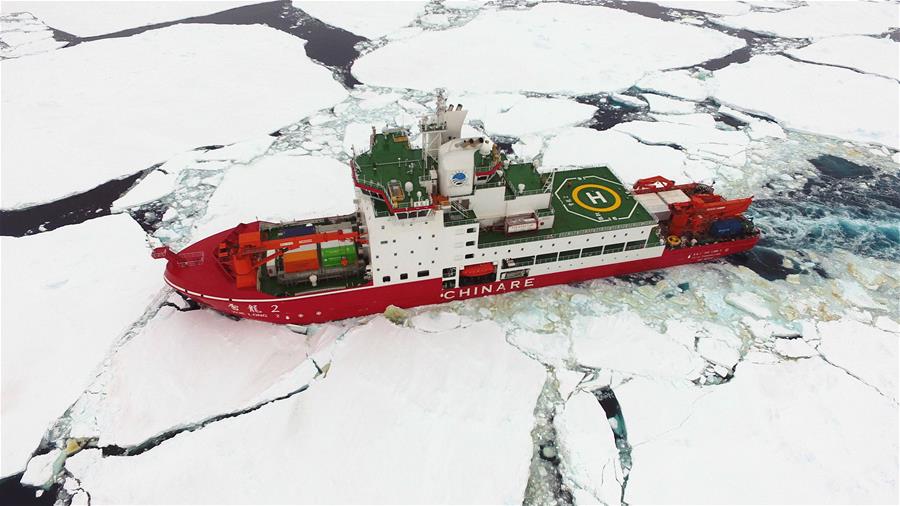
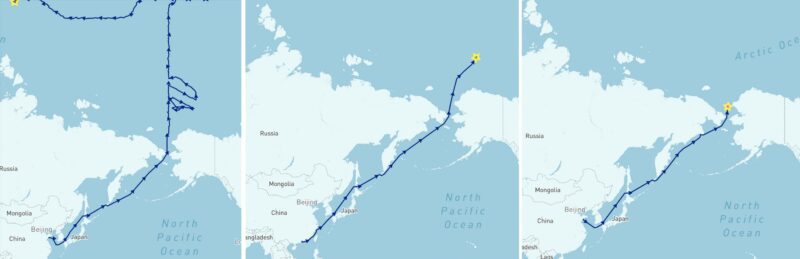
China’s largest and most capable icebreaking research vessel, Xue Long 2, departed for a months-long expedition in early July. Comparable in size and capability to Healy, the vessel passed through the Bering Strait weeks later and spent more than two weeks in the waters of the Chukchi and Beaufort Seas to the north of Alaska, before continuing its voyage into the Central Arctic Ocean.
The smaller Zhong Shan Da Xue Ji Di, an icebreaker operated by Sun Yat-sen University, set sail on a similar path at the end of July. It currently sits 200 nautical miles from Utqiagvik, formerly known as Barrow, in the Beaufort Sea.
China’s newest Arctic icebreaking vessel Ji Di, commissioned in June, departed from Qingdao on August 5 also en route to the Arctic. It reached the Bering Strait this week and is currently operating to the west of the Alaskan town of Nome. The state-of-the-art research vessel was constructed at the Guangzhou Shipyard International and is operated by China’s State Oceanic Administration.
Path of Xue Long 2, Zhong Shan Da Xue Ji Di, and Ji Di. (Source: Shipatlas)
Another icebreaking research vessel, Tan Suo San Hao, was floated earlier this year by the same shipyard and will enter into service with China’s Institute of Deep-sea Science and Engineering of the Chinese Academy of Sciences early next year.
Chinese shipyards have constructed icebreaking research vessels at an impressive rate, albeit smaller in size than the much-delayed U.S. Polar Security Cutter. The construction of Ji Di and Tan Suo San Hao took only around two years from first steel-cutting to completion. The much-larger Xue Long 2, China’s first domestically-built polar icebreaker, was completed in 2019 in under three years.
In comparison the latest Coast Guard estimates put the construction of the first PSC at between 6-8 years. Test work on the first steel sections began in April 2023 and delivery of the initial vessel could slip into the 2030s. The contract was awarded to VT Halter Marine, now Bollinger, already back in 2019.
Related Video – Look Inside China’s Xuelong2 Icebreaker
The U.S. Coast Guard has intercepted a vessel carrying fuel to Cuba after an international enforcement operation found large quantities of fuel concealed inside the ship’s ballast tanks. The Coast Guard...
Rauma Marine Constructions in Finland has made rapid progress on the first of two Arctic Security Cutters it is building for the U.S. Coast Guard, with almost half of the vessel's blocks already launched and construction of the second ship approaching, according to the Finnish shipbuilder's chief executive.
The U.S. Coast Guard has awarded a $315 million contract to Tutor Perini Corp. to build a new fuel pier and major cutter mooring at Base Kodiak, Alaska, as the service prepares...
September 23, 2026
Total Views: 1753
Get The Industry’s Go-To News
Subscribe to gCaptain Daily and stay informed with the latest global maritime and offshore news
— just like 106,969 professionals
Secure Your Spot
on the gCaptain Crew
Stay informed with the latest maritime and offshore news, delivered daily straight to your inbox
— trusted by our 106,969 members
Your Gateway to the Maritime World!
Essential news coupled with the finest maritime content sourced from across the globe.

 Join The Club