DAILY BLOG. Up to the minute news and info on ships.
Tag Archive

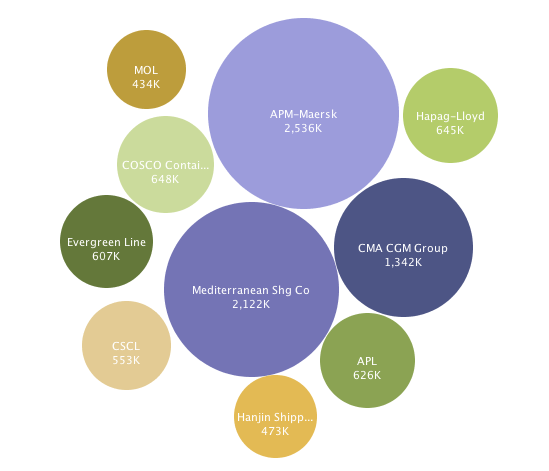
The data visualization above represents the worlds 10 largest container shipping companies by TEU capacity. We created this chart using IBM’s Many Eye’s project which we enjoy using since it gives us a clear, easy to understand and interactive picture of numeric data. Plus it looks pretty cool.
Want to know which company has the largest number of ships or the highest percentage of the overall market? If so then click on the picture above for the interactive version.
For those who prefer more traditional data:
| Company |
TEU capacity |
Market Share |
Number of ships |
| A.P. Moller-Maersk Group |
1,665,272 |
18.2% |
549 |
| Mediterranean Shipping Company S.A. |
865,890 |
8.6% |
299 |
| CMA CGM |
507,954 |
5.6% |
256 |
| Evergreen Marine Corporation |
477,911 |
5.2% |
153 |
| Hapag-Lloyd |
412,344 |
4.5% |
140 |
| China Shipping Container Lines |
346,493 |
3.8% |
111 |
| American President Lines |
331,437 |
3.6% |
99 |
| Hanjin-Senator |
328,794 |
3.6% |
145 |
| COSCO |
322,326 |
3.5% |
118 |
| NYK Line |
302,213 |
3.3% |
105 |
(Source: 2006 BRS Report)

We recently ran across some interesting statistics from a 2005 joint study on manpower from BIMCO and the ISF.
Q: How many officers are currently employed aboard ships?
A: Approximately 466,000
Here’s a chart of the numbers;

Regarding this chart the study notes:
An updated estimate of global seafarer supply has been produced based on the most recent national statistics provided by authorities in almost all principal labor supply and other maritime countries. The worldwide supply of seafarers in 2005 is estimated to be 466,000 officers and 721,000 ratings. The OECD countries (North America, Western Europe, Japan etc.) remain an important source of officers, although Eastern Europe has become increasingly significant with a large increase in officer numbers. The Far East and South East Asia (the “Far East”), and the Indian sub-continent remain the largest sources of supply of ratings and are rapidly becoming a key source of officers.
Here is the age structure of officers from OECD countries;

The study tells us:
The world fleet continues to rely heavily on officers from Europe, North America, Japan and other OECD countries However, over 25% of these are over 50 years old, and well over50% are over 40. Most are in senior positions such as Masters or Chief Engineers. The impact of their retirement, without adequate numbers of well trained and experienced replacements, could be severe.
The study itself discus, in depth, manpower issues facing the industry. You can download the report summary, including more information on the above charts HERE or the full report HERE.

It’s the classic scenario from the Academy… You are the stand on vessel with no room to maneuver and a zero CPA contact is bearing down on you. You try the radio but no answer… what do you do next?
This post doesn’t answer the question but gives you other options not available when you were at the academy.
Use your AIS & VHF DSC:
- Head to the AIS and get the contact’s MMSI number & name
- Enter the number into your VHF DSC controller
- Select a working frequency.
- Hit send then start hailing on the working channel
What happens next is the GMDSS alarm will go off and his VHF will change to a working frequency. If he was away from the bridge he’ll have to return to silence the alarm at which point he hears your hail.
What if the alarm doesn’t wake him or he has it disabled?
CALL HIS BOSS
- Get his name from the AIS.
- Look him up in your ITU pub.
- Find his INMARSAT-B number and call him.
Why does this work? As it was explained to me “Most captains have an INMARSAT-B extension in their office, most captains spend most of their time in their office. Most of the time the captain will answer the phone and rectify the problem post-haste.” …smile
By Bob Couttie
Once the US National Transportation Safety Board has produced the transcripts of the voyage data recorder from the Cosco Busan (Formerly the Hanjin Cairo, the Hanjin name remains on the ship side) we’ll have a better idea of who said what to whom and when. Currently only the pilot’s version of events is available and it is raising a number of questions.
A malfunctioning radar appears to have been an element, though not the cause, of the incident and so far there has been no indication regarding the second radar on the ship’s bridge. Given that there was poor visibility, was the speed of the vessel excessive? Should departure have been delayed until the fog cleared.
The pilot was not familiar with the ECDIS equipment onboard, which does not appear to have malfunctioned. When the pilot asked the Captain to point out the centre of the bridge span the captain allegedly pointed to the bridge support and the pilot navigated accordingly.
With an apparently malfunctioning radar and a lack of familiarity with the primary method of navigation, did the pilot seek to confirm the vessels position with the VTS and/or the accompanying tug?
VTS informed the pilot that the ship was off course, which the Pilot disputed and shortly afterwards a lookout shouted a warning that there was a bridge support ahead and the vessel went hard right and allided with the Delta bridge support.
There also appears to have been a lack of detail in the master/pilot exchange when the latter took conduct of the vessel, as the pilot’s lawyer admits. Would the missing information have been enought to prevent the incident?
There may also have been communications problems between the American pilot and the bridge team who were Chinese. Of there were, to what extent did they reduce the pilot and the bridge team’s situational awareness?
It is not uncommon for pilots to ‘go it alone’ rather than work with a bridge team with whom communication is problematic. This increases the workload on the pilot and reduces his situational awareness. Had the pilot and the bridge team undergone bridge team/bridge resource management training?
Incidents such as this rarely have a single cause, or a single responsible individual. They are usually the result of systemic problems with Bridge Team Management, leadership, culture and navigational practices.
It will be a while before we know the full story of the Cosco Busan, but we’ll hit that bridge when we get to it.
______
Bob Couttie has written for a number of maritime industry publications, including the prestigious Lloyd’s List International daily newspaper and Lloyd’s Ship Manager magazine. His reportage on problems with ship’s officer certification examinations in the Philippines in the late 1990s influenced the adoption of computerized examinations for ship officers by the country’s Professional Regulatory Commission.
Bob currently writes and produces podcasts for The Maritime Accident Casebook
_____
Would you like your article published by gCaptain? Submit it now.
For those curious how the editors at gCaptain research maritime incidents like the Cosco Busan’s allision with San Francisco’s Bay Bridge, here are some of the websites that provide excellent reference material.

Our first stop in researching any maritime related topic is our own Maritime Industry CSE. It’s a powerful resource since it provides search results with the aid of google’s powerful search database and algarithims. Actually the only difference between it and google.com is the fact that our tool narrows the results down and only displays sites that pertain to large ships.
*Tip: Try the “incidents” refinement to narrow down the results even further.

If you are looking for trusted information on incidents as they happen then MAC should be your first stop. Be sure to visit their podcast section as well as their links page which contains a list of the best maritime resources for incident prevention.

For those looking for data that specifically pertains to Container Ships, head over to Searates’ Container Ship Reference Book. Not only is it full of Web 2.0 eye candy, it also has some great hard data.
*Tip: Its shipping lines section has links to both Cosco and Hanjin. By visiting Cosco’s site you will quickly learn they have removed their official “Cosco Busan” statement from Nov 11th.

For breaking news your first stop should be our Maritime News Discoverer but a close second is our Maritime News Mash-up which is automatically updated with the industry’s most trusted news sources.
*Tip - Also take a look at our gCaptain News and Maritime Blog Mash-ups

For those looking for expert opinion from Ship Captain’s we hope you contact us… but your next stop should be CAMM. Contact them directly for contacts from the Maritime Expert Database.

Traditional media is know for making small errors when reporting maritime incidents. To obviate this problem subscribe to MAREX’s FREE weekly newsletter. It is published every Thursday and is written by professional journalists with maritime backgrounds. For past articles click HERE.
*Tip: If you are more interested in weekly blog postings check out Fred Fry’s Maritime Monday
_______________
If you have a reference site of interest please submit it to our Maritime News Discoverer under the category “Links“

Coast Guard Photo By CWO Scott Epeprson
I thought I would list a few podcasts, interviews and audio files that relate to the Cosco Busan Incident and the resultant oil spill in San Francisco Bay. If you find any more of interest please leave a comment with link below.
Our first file (click on the player below) is a very informative hour long discussion I heard on the radio earlier today. It is from KQED’s Forum and is nationaly syndicated by NPR. (Direct Link)

With a criminal probe now launched by the U.S. attorney in San Francisco into Wednesday’s crash of the container ship Cosco Busan, Forum looks at whether oil spills are preventable.
Host: Michael Krasny
Guests:
 |
Debbie Hersman, board member of the National Transportation Safety Board |
 |
Paul Rogers, resources and environment writer with the San Jose Mercury News and managing editor of QUEST, KQED’s weekly science and environment program |
 |
Rear Admiral Craig Bone, the U.S. Coast Guard’s top official in California; and George Miller, Democratic congressman from California’s Seventh District. |
 |
Robert Bea, professor of civil engineering at the University of California at Berkeley |
First is the audio file from the US Coast Guard Commandant , Admiral Thad Allen’s meeting with the San Francisco Chronicle. (Direct Link)

Coast Guard talks with Chronicle
Coast Guard Commandant Adm. Thad Allen and Rear Adm. Craig Bone spoke to The Chronicle Monday morning about the oil spill and the Coast Guard’s response time to the incident. Here’s what they had to say:

KQED Forum - Cosco Busan Oil Spill:
Play Now |
Play in Popup |
Download

Coast Guard talks with Chronicle:
Play Now |
Play in Popup |
Download

CLICK FOR INTERACTIVE VISUALIZATION
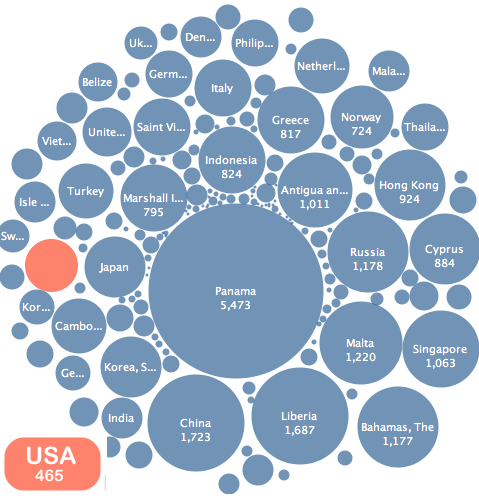
With the recent LNG News I decided to get to work on some maritime visualizations. Above is a bubble graph I created representing the number of ships registered to each flag state.

CLICK FOR INTERACTIVE VISUALIZATION
This graph is even more interesting, it shows the number of ships registered to each country by foreign owners. Notice the Flags of Convenience? Surprising that the U.S. has 51 flagged ships registered by foreigners.
Data is from the May 15th 2007 version of the CIA World Factbook.
Total number of ships registered worldwide: 33,222
Total number of foreign owned ships: 16,717.
More graphs of this data:
Merchant Marine - Rank Order (top chart): Read the rest of this entry »
U.S. v. Kapp – What Happened?
By James MacGuire
As many are aware at this point, Mr. Kapp was the defendant in an action brought forth by the United States Department of Justice. This action sought a court order for Mr. Kapp to cease in preparing, or assisting in the preparation of U.S. Income Tax returns which assert that mariners are entitled to tax deductions for meals that are provided without cost.This action also sought to require Mr. Kapp to furnish (essentially) a copy of the portion of his client list that contains mariners who took these illegal deductions to the U.S. Attorney.
In these types of clear cut cases, the Department of Justice (DOJ) can request a summary judgment from the Court. Essentially, this is telling the judge that the evidence is so overwhelming that a trial is not necessary. Judge Schiavelli granted summary judgment in this case and found in favor of the government.
I have heard through the pipe that Mr. Kapp is planning on appealing this decision. Neither myself nor my colleages have noted any appeals of this matter on file with the Court.
Who is affected by this decision?
Mr. Kapp and his agent, servants, employees, attorneys, and all persons in active concert or participation with him who receive actual notice of this order. We are in the process of determining whether this order extends to firms that were deemed “approved” by Mr. Kapp.
Speaking from personal experience, I was contacted by Mr. Kapp’s attorneys in 2004, and subsequently 2005 regarding a type of computer program “patent” that was issued to Mr. Kapp in relation to the preparation of mariners’ income tax returns. It was demanded that I furnish the intellectual property that I use to prepare income tax returns to his attorneys so that they could evaluate it. As an alternative, Mr. Kapp’s attorneys (and subsequently Mr. Kapp himself) offered to sell me licensing rights to his patent and advertise my firm as an “approved” preparer. I was unwilling and uninterested. I use congress and the Internal Revenue Code as my primary source for the preparation of all income tax returns.
It could stand to reason under the order that the people who did pay to be licensed and approved by Mr. Kapp could be notified of the order, and subsequently be held to the ruling. Mr. Kapp however is the only individual required to furnish client information as previously mentioned.
Am I affected by this decision?
This is a tricky question. What the DOJ does with the list of clients remains to be seen. Simply as a mariner, you are not directly bound to this court order. Could the DOJ forward this list to the IRS? Yes.
What will the IRS do with this list if they get it?
I am unable to comment on what they will do, but I can on what they could. The service can send a notice of deficiency for tax years that took illegal deductions. The service could assess an additional tax due, plus interest, plus penalties. It remains to be seen what the Service will do. The Service is in the business of assessing and collecting taxes. If you had a list of names of people who took illegal tax deductions in which you could recover millions, what would you do?
I was Mr. Kapp’s client for 10 years, can the IRS assess for all of those years?
In most circumstances, no. In most cases, the IRS can audit the prior three years returns (ex. Until April 15, 2008, the Service can assess tax years 2004, 2005, 2006. If you filed an extension in 2004, it would be the extension due date rather than April 15).
Do I have to amend my taxes?
You fulfilled your legal obligation in filing a timely income tax return. However, interest and penalties are assessed from the time the additional tax was due.
How many of Mr. Kapp’s clients does this apply to?
I do not know. Mr. Kapp has been ordered to furnish this information to the DOJ. I have only examined returns of my clients who were former clients of Mr. Kapp. Of those returns I examined, all of them took the illegal meal deductions outlined in this order.
How do I tell if I took these deductions?
Look at your return, specifically “Schedule A Line 20 – Supplemental Sailor Travel Schedule” which is usually attached after your state return “if applicable”. You need to crosscheck the rates listed on various ports of call with the published rates https://secureapp2.hqda.pentagon.mil/perdiem/perdiemrates.html . This website is pretty user friendly. If the rates indicated include the meal rate, you may have taken the deduction illegally.
My return is taking the meal deductions, now what?
It gets a little tricky. As stated, you aren’t required to amend. Additionally, these deductions quite often don’t produce a tax benefit. Consider the Alternative Minimum Tax (Alt Min). As income increases, taxpayers quite often don’t fully benefit from these employee business deductions. A $1,000 business deduction may produce a $250 reduction in tax. However Alt Min applies a tax that negates the $250 benefit. You may well want to have someone experienced look your return over if you want to know the tax effect. If you are in such an Alt Min situation, the Service would not be able to recover additional taxes, interest, and penalties upon audit.
Let’s say I receive a notice, and I owe money to the IRS. Who’s going to pay?
You are responsible for your income taxes. Penalties can sometimes be lifted because you relied upon the advice of a professional. Interest is pretty non-negotiable.
You would owe the IRS personally. However, you may have a legal action against the preparer (even if you aren’t audited).
Can you look over my returns, I’m just curious where I stand with respect to the ruling?
I’ve thought this one over. Current clients have or can have prior returns examined at no charge. I’ve already received many phone calls from non-clients asking to have the returns examined. The flood of returns I could possibly receive could halt business for several weeks. I don’t want you to have to pay to have them looked over. It’s enough that you have spent thousands in preparation fees. So, here’s my compromise. Current clients, if they want an opinion on their returns can have this done free of charge. All others, I will provide an opinion on your returns free of charge if you prepay for 2007 preparation. I think this is a fair trade off. Basically, by becoming a client, the examination is free of charge. My rates are competitive (pricing usually ranges from $225-$450) and the clients’ best interests come first.
Please feel free to e-mail me with any questions jkm@maguiretaxes.com and visit my website. I intend to provide additional tax planning guidelines in the near future. It’s my hope to work with fellow mariners to implement proper, legal, tax planning and credit sheltering.
We have been hard at work finding information for those who have been “Kappsized” by the IRS’ decision against certain aspects of mariner tax deductions promoted by Martin A. Kapp’s Sailor Tax service. Today we bring you Mariner Tax Expert James MacGuire.
James holds a masters in taxation from Northeastern University. His practice focuses on individual (particularly mariners’) taxation, general tax planning, financial tax and trust planning, estate tax planning, audit resolution and forensic accounting services. James operates side by side with noted estate and business planner Attorney Hugh J. Crossland of Crossland and Crossland P.C.; also of counsel to Graber, Davis, and Cantwell P.C.
James’ goal is to provide tax and tax planning services to mariners, paying particular attention to the planning aspects so often ignored. “The US Supreme Court has stated many times that a taxpaying citizen should only be liable for their fair share. We are allowed under the law to utilize every deduction legally available.” James enjoys big picture planning with clients – taking into account current and future goals to create a tax plan that follows the clients intended interests.

I wanted to take some time and thank some of our partner sites; Maritime Experts from around the web. I also wanted to take the time to explain each one to our readers. The sites can be found at the bottom of the right sidebar —>
Our first set of links in this series concentrates on sites devoted to large ships.
Fred Fry has a great set of posts on his blog called “Maritime Monday”. Fred is an avid reader and saves his favorite maritime related stories of the week and posts them every Monday morning. Along with our own Maritime News Discoverer it’s a must read for all in the shipping industry who need to keep up on the week’s news and interesting stories.
Maritime Executive publishes a monthly magazine that I eagerly await. Of greater interest to the online community is their free weekly newsletter, a must read for shipping executives and sailors alike. I encourage everyone to subscribe to their MarEx Newsletter, it’s free and contains the best hard news stories delivered straight to your email inbox each week. If your interested in the magazine sign up to receive a trial copy HERE.
Council of American Master Mariners
A great resource from an organization devoted to the interests of the Master Mariner. They do not have a blog but publish stories on their homepage as well as a newsletter that can be read online.
Robin is a Salvage Master, Licensed Chief Engineer and a Severe Weather Guru. We have collaborated on many stories including our series on the Sean Semour and a look into EPIRB failures. His blog contains mostly weather related stories and links pertinent to safety at sea. The blog is well written, thorough and is updated frequently… what more could you ask for.
If your a Ship’s Captain interested in keeping your crew safe Bob Couttie’s Maritime Accident Casebook should be your first stop. It contains detailed information, lessons learned and reports on maritime incidents from around the world. Bob is a talented writer and excellent investigator. Our favorite part of his site are his Maritime Incident Podcasts that can be downloaded to your ipod and listened to on those long flights to your ship.
Probably the best blog of the US Merchant Marine officer. Our only complaint is that the post are not as frequent as some of the other blogs we follow but this is because the Maritime Links editors are actually sailors with real shipping jobs. Many interesting stories can be found in their archives.
Ok this blog link has nothing to do with maritime affairs but considering it (as well as Unofficial Squaw’s Blog ) was created by our company and is written by our chief editor’s brother, it gets a link. The blog follows the travels of Tim Konrad as he ski’s the Andes mountain range in South America. A good read.
Stay tuned for part 2 of this series and if you have a blog to suggest be sure to email it to our tip line; tips{at}gCaptain.com